
Book V : Sundara Kanda - Book Of Beauty
Hanuma moves about the city of Lanka, going from one house to another in search of mother Seetha. He finds amazing wealth and riches abounding in that city of Ravana. He finally enters the huge house of Ravana. | 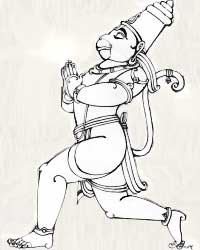 |
sa nik˜mam vim˜neÿu viÿaõõa× k˜ma r¨padh®t |
vicac˜ra punarlaðk˜m l˜ghavena samanvita× || 5-6-1
1. saH= that Hanuma; kaamaruupadR^it= who could assume any desire form; vimaaneshhu= (searching) among houses; nikaamamvishhaNNaH= had a lot of grief; laaghavenasamanvitaH= endowed with great speed; vichachaara= roamed; punaH= again; laN^kaam= the city of Lanka.
That Hanuma who could assume any desire form, searching among houses had a lot of grief. Endowed with great speed, He roamed again the city of Lanka.
˜sas˜da atha lakÿmŸv˜n r˜kÿasa indra niveþanam |
pr˜k˜reõa arka varõena bh˜svareõa abhisamvrtam || 5-6-2
2. atha= after that; lakshmivaan= the glorious Hanuma; asasaada= neared; raakshasendraniiveshanam= the house of Ravana; bhaasvareNa= shining; arkavarNena= with the hue of Sun; abhisamvR^itam= surrounded; praakaareNa= by a compound wall.
After that, the glorious Hanuma neared the house of Ravana shining with the golden hue of Sun, surrounded by a compound wall.
rakÿitam r˜kÿasair bhŸmai× simhair iva mahad vanam |
samŸkÿam˜õo bhavanam cak˜þe kapi kunjara× || 5-6-3
3. kapikunJNjaraH= Hanuma; chakaashe= shined; samiikshamaaNaH= purveying; bhavanam= the building; rakshitaam= protected; bhiimaiH raakshasaihi= by horrible rakshasas; mahaavanamiva= like a forest; simhaiH= by lions.
Hanuma shined purveying the building protected by horrible rakshasas, like a forest by lions.
r¨pya kopa hitai× citrai× toraõair hema bh¨ÿitai× |
vicitr˜bhi× ca kakÿy˜bhir dv˜rai× ca rucirair vrtam || 5-6-4
4. vR^itam= (Ravana's house)consisted of; toraNaiH= archways; ruupyakopahitaiH= decorated with sliver; chitraiH= surprising one's; hemabhhuushhitaiH= decorated with gold; vichitraabhi= strange; kakshyaabhiH= entrances; ruchiraiH dvaaraishcha= and beautiful doors.
Ravana's house consisted of surprising archways decorated with sliver and gold, strange entrances and beautiful doors.
gaja ˜sthitair mah˜ m˜trai× þ¨rai× ca vigata þramai× |
upasthitam asamh˜ryair hayai× syandana y˜yibhi× || 5-6-5
5. upasthitam= (Ravana's house)waited upon; gajaasthitaiH= by men on elephants; shuuraiH= warriors; vigatasramaiH= people with removed tiredness; mahaamaatraiH= drivers of elephants; asamhaaraiH hayaiH= by undefeatable horses; syandanayaayibhiH= by charioteers.
Ravana's house waited upon by men on elephants, warriors, people with removed tiredness, drivers of elephants, by undefeatable horses, and by charioteers.
simha vy˜ghra tanu tr˜õair d˜nta k˜ncana r˜jatai× |
ghoÿavadbhir vicitrai× ca sad˜ vicaritam rathai× || 5-6-6
6. (Hanuma saw Ravana's house) simhavyaaghraatanutraaNaiH= with protective shields made of lion and tiger skins; daantakaaJNchanaraajataiH= decorated with ivory, gold and silver; vicharitam= being roamed; sadaa= always; vichiraiHradhaiH= by strange chariots; ghoshhavadbhiH= with great sound.
Hanuma saw Ravana's house with protective shields made of lion and tiger skins, decorated with ivory, gold and silver, being roamed always by strange chariots with great sound.
bahu ratna sam˜kŸrõam para ardhya ˜sana bh˜janam |
mah˜ ratha sam˜v˜sam mah˜ ratha mah˜ ˜sanam || 5-6-7
7. (Hanuma saw Ravana's house) bahuratnasamaakiirNam= filled with a lot of diamonds; paraardhyaasanabhaajanam= having valuable seats and utensils; mahaarathasamaavaasam= abode of great warriors; mahaarathamahaasanam= with great chariots and great utensils.
Hanuma saw Ravana's house filled with a lot of diamonds, having valuable seats and utensils, abode of great warriors, with great chariots and great utensils.
d®þyai× ca parama ud˜rai× tai× tai× ca m®ga pakÿibhi× |
vividhair bahu s˜hasrai× parip¨rõam samantata× || 5-6-8
8. paripuurNam= filled all around with; taiH taiH= those and those; vividhaiH= various kinds of; mR^igapakshibhiH= animals and birds; bahusaahasraiH= in those thousands; dR^ishyaiH= lovely to watch; paramodaaraiH= very beautiful ones.
Filled all around with those and those various kinds of animals and birds in thousands, lovely to watch - very beautiful ones.
vinŸtair anta p˜lai× ca rakÿobhi× ca surakÿitam |
mukhy˜bhi× ca vara strŸbhi× parip¨rõam samantata× || 5-6-9
9. surakshitam= well protected; rakshobhi= by rakshasas; viniitaiH= well trained one's; antapaalaiH= protecting the inner area; paripuurNam= filled; samantataH= all over; varastriibhiH= by best women; mukhyaabhiH= who were important.
Well protected by well trained rakshasas, protecting the inner area, filled all over by best women who were important.
mudita pramad˜ ratnam r˜kÿasa indra niveþanam |
vara ˜bharaõa nirhr˜dai× samudra svana nihsvanam || 5-6-10
10. muditapramaadaaratnam= having happy women; raakshasendraniveshanam= the abode of Ravana; varaabharaNasamhraadaiH= with the tinkling of best jewellery; samudrasvananisvanam= had a sound like that of an ocean.
Having happy women, the abode of Ravana with the tinkling of best jewellery had a sound like that of an ocean.
tad r˜ja guõa sampannam mukhyai× ca vara candanai× |
bherŸ mrdanga abhirutam þankha ghoÿa vin˜ditam || 5-6-11
11. raajaguNasampannam= together with royal insignia; mukhaiH agaruchandanaiH= with best scents and sandal woods; samaakiirNam= spread with; mahaajanaiH= great number of people; mahatvanamiva= like a great forest; simhaiH= with lions.
Together with royal insignia, with best scents and sandal wood, spread with great number of people like a great forest with lions.
bherŸm®daðg˜bhirutam þaðkhaghoÿanin˜ditam |
nitya arcitam parva hutam p¨jitam r˜kÿasai× sad˜ || 5-6-12
12. bheriimR^idaN^gabhirutam= resounded by bheris and mrindagas; shankhaghoshhitaninaaditam= resounded by the sound of conch-shells; nityaarchitam= prayed upon daily; parvahutam= with rituals on festivals; sadaa= always; puujitam= worshipped; rakshaiH= by rakshasas.
Resounded by bheris and mridagas, resounded by the sound of conch-shells, prayed upon daily by Rakshsas, with rituals on festivals, always worshipped by rakshasas.
samudram iva gambhŸram samudram iva nihsvanam |
mah˜tm˜no mahad veþma mah˜ ratna pariccadam || 5-6-13
mah˜ jana sam˜kŸrõam dadarþa sa mah˜ kapi× |
13. samahaakapiH= the great Hanuma; dadarsha= saw; mahaatmanaH= the wealthy Ravana's; mahatveshma= big house; ghambhiiram= inscrutable; samudramiva= like an ocean; nissvanam samudramiva= like a noiseless ocean; mahaaratna parichchhadam= with a roof embedded with great diamonds; mahaaratnasamaakiirNam= filled with great diamonds.
The great Hanuma saw the wealthy Ravana's huge house, inscrutable like an ocean, like a noiseless ocean, with a roof embedded with great diamondsand filled with great diamonds.
vir˜jam˜nam vapuÿ˜ gaja aþva ratha samkulam || 5-6-14
lank˜ ˜bharaõam iti eva so amanyata mah˜ kapi× |
cac˜ra hanum˜mstatra r˜vaõasya samŸpata× || 5-6-15
14,15. saH= that great Hanuma; amanyata= thought; viraajamaanam= (the house which was) shining; vipushhaa= with its form; gajaashvarathasankulam= filled with elephants, horses, chariots; laN^kaabharaNam ityeva= to be the jewel of Lanka; hanumaan= Hanuma; chachaara= walked about; tatra= there; samiipataH= near hood; raavaNasya= of Ravana;
That great Hanuma thought the house, which was shining with its form filled with elephants, horses, chariots, to be the jewel of Lanka. Hanuma walked about there in the near-hood of Ravana.
g®h˜d g®ham r˜kÿas˜n˜m udy˜n˜ni ca v˜nara× |
vŸkÿam˜õo hi asamtrasta× pr˜s˜d˜m× ca cac˜ra sa× || 5-6-16
16. saH= That Hanuma; chchaara= moved about; gR^ihaat gR^iham= from one house to another; rakshsaanaam= of rakshasas; vudyaanaanicha= and also parks; viikshamaaNaH api= and observing; sarvashaH= in all directions; asantrastaH= without fear; praasaadaamshcha= and also courtyards.
That Hanuma moved about from one house to another of Rakshasas and also parks and observing in all directions without fear and also courtyards.
avaplutya mah˜ vega× prahastasya niveþanam |
tato anyat pupluve veþma mah˜ p˜rþvasya vŸryav˜n || 5-6-17
17. mahaaviiryaH= Hanuma with great prowess; mahaavegaH= and one with great speed; avaplutya= jumping; niveshanam= for the house; prahastasya= of Prahasta; tataH= and from there; plupluve= leapt; anyatveshma= for another house; mahaapaarshvasya= that of Mahaparshva.
Hanuma with great prowess, and one with great speed, jumped for the house of Prahasta and from there leapt for another house that of Mahaparshva.
atha megha pratŸk˜þam kumbha karõa niveþanam |
vibhŸÿaõasya ca tath˜ pupluve sa mah˜ kapi× || 5-6-18
18. atha= thereafter; mahaakapiH= the great Hanuma; plupluve= leapt; kumbhakarNaniveshanam= for the house of Kumbhakarna; meghapratiikaasham= which resembled a cloud; tathaa= and in the same way; vibhiishhanasya= for the house of Vibhishana.
Thereafter the great Hanuma leapt for the house of Kumbhakarna which resembled a cloud and in the same way for the house of Vibhishana.
mah˜ udarasya ca tath˜ vir¨pa akÿasya caiva hi |
vidyuj jihvasya bhavanam vidyun m˜le× tathaiva ca || 5-6-19
vajra damÿ÷rasya ca tath˜ pupluve sa mah˜ kapi× |
19. saH mahaakapiH= That great Hanuma; tathaa= in the same way; plupluve= leapt; bhavanam= for the house; mahodarashya= of Mahodara; viruupaakshasya caivaH= and also that of Virupaaksha; viddyujjihvasya= that of Viddutjihva; tathaivacha= and in the same fashion; vidyunmaaleH= that of Vidhunmaali; tathaiva= and in the same way; vjradamshhTrasya= that of Vajradamshhtra.
That great Hanuma in the same way leapt for the house of Mahodara and also that of Virupaaksha, that of Viddutjihva.
þukasya ca mah˜ vega× s˜raõasya ca dhŸmata× |
tath˜ ca indrajito veþma jag˜ma hari y¨thapa× || 5-6-20
20. hariyuudhapaH= Hanuma the commander of Vanara army; mahaatejaaH= with great radiance; jagaama= went; shukasya= for Suka's house; dhiimataH shukasya= for the intellectual Suka's house; saaraNasya= for Sarana's house; tathaa= in the same way; gR^iham= for the house; indrajitaH= of Indrajit.
Hanuma the commander of Vanara army with great radiance went for the intellectual Suka's house, for Sarana's house, and in the same way for the house of Indrajit.
jambu m˜le× sum˜le× ca jag˜ma hari y¨thapa× || 5-6-21
raþmi keto× ca bhavanam s¨rya þatro× tathaiva ca |
vajrak˜yasya ca tath˜ pupluve sa mah˜kapi× || 5-6-22
21,22. harisattamaH= the best among Vanaras Hanuma; jagaama= went; jambumaaleH= for the house of Jambumali; sumaaleshcha= and for the house of Sumali; saH mahaakapiH= the great Hanuma; pupluve= jumped; rashmiketoH= for the house of Rasmiketu; tathaivacha= and in the same way; suryaketoH= for the house of Suryaketu; tathaa= and in that way; bhavanam= for the building; vajrakaayasya= of Vajrakaaya.
The best among Vanaras Hanuma went for the house of Jambumali and for the house of Sumali. The great Hanuma jumped for the house Rasmiketu and in the same way for the house of Suryaketu and in that way for the building of Vajrakaaya.
dh¨mra akÿasya ca samp˜ter bhavanam m˜ruta ˜tmaja× |
vidyud r¨pasya bhŸmasya ghanasya vighanasya ca || 5-6-23
þuka n˜bhasya vakrasya þa÷hasya vika÷asya ca |
hrasva karõasya damÿ÷rasya romaþasya ca rakÿasa× || 5-6-24
yuddha unmattasya mattasya dhvaja grŸvasya n˜dina× |
vidyuj jihva indra jihv˜n˜m tath˜ hasti mukhasya ca || 5-6-25
kar˜lasya piþ˜casya þoõita akÿasya caiva hi |
23,24,25. maarutaatmajaH= Hanuma (jumped); dhuumraakshhasaya= for Dhumrah's house; sampaateH= for Sampati's house; vidhudtruupasaya= for Vidhudrupa's; bhiimasya= for Bhimaa's house; ghanasya= for Ghana's house; vighanasyacha= and Vighana's house; shukanaasasya= for Sukhana's house; vakrasya= for Vakra's; shaThasya= for Satha's house; vikaTasyacha= and also for Vikatasaa house; brahmakarnasya= for Brahmakarnas house; damshhtrasya= for Damshra's house; romashyasya= for Romasas house; rakshasaH= for Rakshasas house; yuddhonmatasya= for Ydhonmata's house; mattasya= for Mattaas house; dvaja griivasya= for Dvajagriva's house; naadinaH= for Naadi's house; vidhyujjihvendrajihvaanaam= for Vidhutjiva's and Indrajihva's houses; tathaa= in the same way; hastimukhasya= and also Hastimukaas house; karaaLasya= for Karaala's house; pishchasya= for Pischa's house; shoNitaakshasyachaivaH bhavan= and also for the building of Shonita.
Hanuma jumped for Dhumrah's house, for Sampati's house, for Vidhudrupa's, Bhiima's house, for Ghana's house and Vighana's house, for Sukhana's house, for Vakra's, for Satha's house and also for Vikata's house, for Brahmakarna's house, for Damshra's house, for Roma's house, for Raksha's house, for Ydhonmata's and Indrajihva's house, in the same way for Hastimukas house, for Karala's house, for Pisacha's house, and also for the building of Shonita.
kramam˜õa× krameõa eva han¨m˜n m˜ruta ˜tmaja× || 5-6-26
teÿu teÿu mah˜ arheÿu bhavaneÿu mah˜ yaþ˜× |
teÿ˜m rddhimat˜m ®ddhim dadarþa sa mah˜ kapi× || 5-6-27
26,27. maarutaatmajaH= the son of Vayu; mahaayashaaH= one with great fame; mahaakapiH= great one among Vanaras; saH hanumaan= that Hanuma; dadarsha= saw; teshhaam buddhim= the wealth of those rakshasas; bhuddhimataam= who were rich; kramamaaNaH= moving; krameNaiva= in a sequence; teshhu teshhu= (in) those and those; mahaarheshhu bhavaneshhu= best buildings.
The son of Vayu, one with great fame, great one among Vanaras , moving about in a sequence in those and those best buildings, saw the wealth of those rakshasas, who were rich.
sarveÿ˜m samatikramya bhavan˜ni samantata× |
˜sas˜da atha lakÿmŸv˜n r˜kÿasa indra niveþanam || 5-6-28
28. lakshmivaan= the glorious Hanuma; samati kramya= passing; sarveshham bhavanaani= every ones houses; samantataH= all round; tathaa= there after; asasaada= neared; raakshasendraniveshanam= the house of Ravana.
The glorious Hanuma passing everyone's houses all round, there-after neared the house of Ravana.
r˜vaõasya upaþ˜yinyo dadarþa hari sattama× |
vicaran hari þ˜rd¨lo r˜kÿasŸr vik®ta Ÿkÿaõ˜× || 5-6-29
þ¨la mudgala hast˜× ca þakto tomara dh˜riõŸ× |
29. harisattamaH= Hanuma best among Vanaras; harishaardulaH= tiger among Vanaras; vicharan= moving about; dadarsha= saw; raakshasiiH= Rakshasa women; raavaNasya upashaayinya= those who were sleeping near to Ravana; vikR^itekshaaH= those who had horrific eyes; shuulamudgarahastaashcha= those who had Sulaas, Mudgaras in their hands; shaktitomaradhaariNiiH= those who had Shaktis and Tomaras.
Hanuma best among Vanaras, tiger among Vanaras, moving about saw Rakshas women, those who were sleeping near to Ravana, those who had horrific eyes, those who had Sulaas, Mudgaras in their hands, those who had Shaktis and Tomaras.
dadarþa vividh˜n gulm˜m× tasya rakÿa× pater g®he |
r˜kÿas˜Õþca mah˜k˜y˜nn˜n˜praharaõodyat˜n || 5-6-30
30. dadarsha= (Hanuma) saw; tasyagR^ihe= in that house; rakshaHpate= of Ravana; vividhaangulmaan= a variety of army divisions; raakshasaamshcha= and also rakshasas; mahaakaayaan= those who had huge bodies; naanaapraharaNodhyataan= having different weapons raised up.
Hanuma saw in that house of Ravana a variety of army divisions and also Rakshasas those who had huge bodies having different weapons raise up.
rakt˜n þvet˜n sit˜m× caiva harŸm× caiva mah˜ jav˜n || 5-6-31
kulŸn˜n r¨pa sampann˜n gaj˜n para gaja ˜ruj˜n |
niÿ÷hit˜n gaja þikh˜y˜m air˜vata sam˜n yudhi || 5-6-32
nihantrrn para sainy˜n˜m g®he tasmin dadarþa sa× |
kÿarata× ca yath˜ megh˜n sravata× ca yath˜ girŸn || 5-6-33
megha stanita nirghoÿ˜n durdharÿ˜n samare parai× |
32,33. saH= that Hanuma; tasmingR^ihe= in that house; dadarsha= saw; hariim chaapi= horses; raktaan= in red colour; shvethaan= in white colour; stitaamshchaiva= slightly whitish; mahaanjavaan= capable of great speed; gajaan= elephants; puliinaan= born in a good breed; ruupasampannaan= having good appearance; paragajaarujaan= capable of harassing enemy's elephants; nishhThitaan= skilled; gajashikhsaayaam= in good elephant training; airaavatasamaan= equalling Iraavata; nihantruun= capable of killing; parasainyaanaam= enemies armies; yudhi= in war; ksharataH= rutting; meghaanyathaa= like raining clouds; giriinyathaa= like mountains; sravataH= (with water falls)that are pouring down; meghastanitanirghoshhaan= with trumpeting resembling thundering of clouds; durdharshhaan= unassailable; paraiH= by enemies; samare= in a battle.
That Hanuma in that house saw horses in red colour and in white colour, slightly whitish, capable of great speed, elephants born in a good breed having good appearance capable of harassing enemy's elephants, skilled in good elephant training, equalling Iraavata, capable of killing enemies armies in war, rutting like raining clouds, like mountains with water falls that are pouring down, with trumpeting resembling thundering of clouds, unassailable by enemies in a battle.
sahasram v˜hinŸ× tatra j˜mb¨nada pariÿk®t˜× || 5-6-34
hema j˜lair aviccinn˜× taruõa ˜ditya samnibh˜× |
dadarþa r˜kÿasa indrasya r˜vaõasya niveþane || 5-6-35
34,35. tatra= there; dadarsha= (Hanuma) saw; niveshane= in the house; raavaNasya= of Ravana; rakshasendrasya= the king of rakshasas; vaahiniiH= army divisions; sahasram= in thousands; jaabuunadaparishhkR^itaaH= decorated with gold; hemajaalaparichchhannaH= covered with heaps of gold; taruNaadityasannibhaaH= equalling the sun who has fully come up.
There Hanuma saw in the house of Ravana, the king of rakshasas, army divisions in thousands decorated with gold, covered with heaps of gold, equalling the Sun who has fully come up.
þibik˜ vividha ˜k˜r˜× sa kapir m˜ruta ˜tmaja× |
lat˜ g®h˜õi citr˜õi citra þ˜l˜ g®h˜õi ca || 5-6-36
krŸý˜ g®h˜õi ca any˜ni d˜ru parvatak˜n api |
k˜masya g®hakam ramyam div˜ g®hakam eva ca || 5-6-37
dadarþa r˜kÿasa indrasya r˜vaõasya niveþane |
36,37. saH kapiH= that Hanuma; maarutaatmajaH= the son of Vayu; dadarsha= saw; niveshane= in the house; ravanasya= of Ravana; rakshasendrasya= the king of Rakshasas; shibikaaH= palanquins; vividhaakaaraaH= of various shapes; chitraaNilathaagR^ihaaNi= wonderful bowers; chitraashaalaagR^ihaaNi= art galleries; anyaani= and other; kriiDaagR^ihaaNi= pleasure houses; daaruparvatakaanapi= (which were constructed) with wooden mountains; kaamasyagR^ihakam= house for sexual delights; ramyam divaagR^ikamevacha= and a beautiful diurnal house.
That Hanuma the son of Vayu saw in the house of Ravana the king of rakshasas, palanquins of various shapes, wonderful bowers, art galleries and other pleasure houses which were constructed with wooden mountains, house for sexual delight and a beautiful diurnal house.
sa mandara tala prakhyam may¨ra sth˜na samkulam || 5-6-38
dhvaja yaÿ÷ibhir ˜kŸrõam dadarþa bhavana uttamam |
ananta ratna nicayam nidhi j˜lam samantata× || 5-6-39
dhŸra niÿ÷hita karma antam g®ham bh¨ta pater iva |
38,39. saH= That Hanuma; dadarsha= saw; bhaanuvantam= the best among building; mandaragiriprakhyam= equalling mount Mandara; mayuurasthaanasamkulam= filled with pens for peacocks; aakiirNam= spread; dhvajayashhTibhiH= by flag staffs; dhiiranishhThatakarmaantam= managed by courageous one's; bhuutapateHgR^ihamiva= like the house of Kubera; anekaratnasamkiirNam= filled with many diamonds; nidhijaalam= and also heaps of riches.
That Hanuma saw the best among buildings equalling mount Mandara filled with pens for peacocks, spread by flag staffs managed by courageous ones like the house of Kubera filled with many diamonds and also heaps of riches.
arcirbhi× ca api ratn˜n˜m tejas˜ r˜vaõasya ca || 5-6-40
virar˜ja atha tad veþma raþmim˜n iva raþmibhi× |
40. tat= That; veshma= building; viraraaja= shone; archirbhishchaapi= by the rays; ratnaanaam= of diamonds, tejasaacha= by the splendour; raavaNasya= of Ravana; rashmimaaniva= like the Sun; rashmibhiH= by rays.
That building shone by the rays of diamonds, by the splendour of Ravana like the Sun by rays.
j˜mb¨ nadamay˜ni eva þayan˜ni ˜san˜ni ca || 5-6-41
bh˜jan˜ni ca þubhr˜õi dadarþa hari y¨thapa× |
41. hariyuudhapaH= leader of Vanaras, Hanuma; dadarsha= saw; shayanaani= couches; aasanaanicha= and seats;mukhyaani= and chief vessels; jaambuunadamayaanyeva= all made with gold.
Hanuma leader of Vanaras saw couches and seats and chief vessels all made with gold.
madhv ˜sava k®ta kledam maõi bh˜jana samkulam || 5-6-42
mano ramam asamb˜dham kubera bhavanam yath˜ |
n¨pur˜õ˜m ca ghoÿeõa k˜ncŸn˜m ninadena ca || 5-6-43
m®danga tala ghoÿai× ca ghoÿavadbhir vin˜ditam |
pr˜s˜da samgh˜ta yutam strŸ ratna þata samkulam || 5-6-42
suvy¨ýha kakÿyam hanum˜n praviveþa mah˜ g®ham |
42,43,44. hanumaan= Hanuma; pravivesha= entered; mahaagR^iham= the big house; madhvaasavakR^itakledam= moistened by liquor made of honey; maNibhaajanashankulam= filled with vessels made of gems; manoramam= delightful one; asambaadham= un-congested one; kuberabhavanamyathaa= like the building of Kubera; ninaaditam= resounded; nuupuraaNaamghoshheNa= by the sound of tinkles; kaaJNchiinaam ninadena= by the sound waist ornaments; mR^idaN^gatalaghoshhaiishcha= by the sound of percussion on Mrudangas; ghoshhvidbhiH= with deep sound; praasaadasamgaatayutam= which consisted of many mansions; striiratnashetasamkulam= filled with hundreds of best women; suvyuuDhakakshyam= encircled by many spacious enclosures.
Hanuma entered the big house moistened by liquor made of honey, filled with vessels made of gems delightful one, un-congested one like the building of Kubera resounded by the sound of tinkles by the sound of waist ornaments, by the sound of percussion on Mrudangas with deep sound, which consisted of many mansions filled with hundreds of best women, encircled by many spacious enclosures.
iti v˜lmŸki r˜m˜yaõe ˜di k˜vye sundara k˜õýe ÿaÿ÷ha× sarga×
Thus, this is the 6th chapter in Sundara Kanda of Valmiki Ramayana, the First Epic poem of India.
© 2002 August, Durga and Kishore Kopalle