
Book V : Sundara Kanda - Book Of Beauty
Jambavan, seated along with the monkey-troops, requested Hanuma to narrate clearly whatever has occurred. Hanuma narrates in detail how he saw Mount Mainaka in the course of his journey to Lanka and how he escaped on the way from the clutches of Surasa, a great serpent living in the ocean. Hanuma also narrated about his killing of Simhika, a female demon on the way and also about defeating another female demon (Lanka-incarnate) who was guarding the City of Lanka. Hanuma explains to Jambavan, how he beholds Seetha in Ashoka garden after a thorough search in the City of Lanka and how he introduces himself as an envoy sent by Rama and Sugreeva. Hanuma informs Jambavan that he hands over a finger-ring of Rama as a token of remembrance to Seetha and that he further asks for a return-token of remembrance from her, to be handed over to Rama. Hanuma then narrates about Seetha having delivered to him an excellent jewel for her head, as a token of remembrance. He further narrates about the demolition of the garden attached to Ravana's gynaecium and about killing of Aksha, Ravana's son. Hanuma further informs about his capture by Indrajit, Ravana's son and his tail being burnt by demons on receiving the orders of Ravana. He further informs about his setting fire of the City of Lanka. He finally narrates about his re-visit to Seetha and his return to Mount Mahendra. | 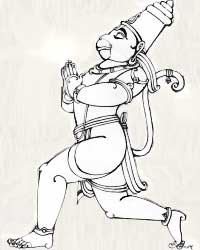 |
tata× tasya gire× þ®nge mah˜indrasya mah˜bal˜× |
hanumat pramukh˜× prŸtim harayo jagmu× uttam˜m || 5-58-1
1. tataH= thereafter; mahaabalaaH= the mighty; harayaH= monkeys; hanumat pramukhaaH= headed by Hanuma and others; jagaama= obtained; uttamaam= a great; priitim= joy; tasya mahendrasyagireH= on that summit of Mount Mahendra.
Thereafter, the mighty monkeys, headed by Hanuma and others, experienced a great joy on that summit of Mount Mahendra.
tam tata× pratisamh®ÿ÷a× prŸtimantam mah˜kapim |
j˜mbav˜n k˜rya v®tta antam ap®cchat anila ˜tmajam || 5-58-2
2. tataH= then; jaambavaan= Jambavan; priitisamhR^iSTaH= thrilling with rapture; apR^ichchhat= asked; priitimantam= the delighted; mahaakapim= the great monkey; tam kaaryavR^ittaantam= about the particulars of that actual occurrence (of seeing Seetha) as follows.
Then, Jambavan, thrilling with rapture, asked the delighted Hanuma, the great monkey about the particulars of that actual occurrence (of seeing Seetha) as follows
katham d®ÿ÷˜ tvay˜ devŸ katham v˜ tatra vartate |
tasy˜m v˜ sa katham v®tta× kr¨ra karm˜ daþa ˜nana× || 5-58-3
3. katham= how; devii= was Seetha; dR^iSTaa= seen; tvayaa= by you?; katham vaa= how; vartate= was she; tatra= there?; katham vR^ittaH= of what behavior; tasyaam= towards her; saH dashaananaH= was that Ravana; kruura karma= having terrible deeds?
“How did you see Seetha? How was she there? How was that Ravana of terrible deeds behaving towards her?”
tattvata× sarvam etan na× prabr¨hi tvam mah˜kape |
þruta arth˜× cintayiÿy˜mo bh¨ya× k˜rya viniþcayam || 5-58-4
4. mahaakape= O Hanuma!; tvam= you; prabruuhi= tell; naH= us; etat= this; sarvam= entirely; tattvataH= in this; shrutaarthaaH= ascertained by having the matter; chintayiSyaamaH= we shall think; kaaryavinishchayam= about a mutual resolve to do something; bhuuyaH= again.
“O Hanuma! Tell us entirely, in truth whatever has occurred. Ascertaining the truth, from you, we shall again think about what decision to be taken further.”
ya× ca artha× tatra vaktavyo gatai× asm˜bhi× ˜tmav˜n |
rakÿitavyam ca yat tatra tat bhav˜n vy˜karotu na× || 5-58-5
5. gataiH= gone; tatra= there; asmaabhiH= by us; bhavaan= you; aatmavaan= having prudence; vyaakarotu= clearly tell; naH= us; yaH= which; arthaH= matter; tat= that; vaktavyaH= can be disclosed; yat= and which; rakSitavyam= is to be kept off.
“When we go there (to the presence of Rama), having prudence, tell us clearly which matter is to be disclosed and which matter is to be kept off from him.”
sa niyukta× tata× tena samprah®ÿ÷a tan¨ ruha× |
namasyan þiras˜ devyai sŸt˜yai pratyabh˜ÿata || 5-58-6
6. niyuktaH= thus commanded; tena= by that Jambavan; saH= that Hanuma; tataH= then; samprahR^iSTatanuuruhaH= with his hair thrilling in rapture; praNamya= offering salutation; devyai siitaayai= to Seetha the princess; shirasaa= (by bowing) his head; pratyabhaaSata= replied (as follows):
Thus commanded by Jambavan, Hanuma, with his hair standing on end mentally offered his salutation to Seetha, the princess, by bowing his head and replied as follows:
pratyakÿam eva bhavat˜m mah˜indra agr˜t kham ˜pluta× |
udadhe× dakÿiõam p˜ram k˜nkÿam˜õa× sam˜hita× || 5-58-7
7. kaaNkSamaaNaH= desirous; samaahitaH= and intent upon; udadheH dakSiNam paaram= (reaching) the southern shore of the ocean; aaplutaH= I leapt; kham= into the sky; mahendraagraat= from the summit of Mount Mahendra; bhavataam pratyakSameva= just before your presence indeed!
“With an intention to reach the southern shore of the ocean, I leapt into the sky, indeed before your presence, from the summit of Mount Mahendra.”
gacchata× ca hi me ghoram vighna r¨pam iva abhavat |
k˜ncanam þikharam divyam paþy˜mi sumano haram || 5-58-8
8. me= to me; gachchhataH= who was going; ghoram= a terrific; vighnaruupamiva= hindrance-like thing; abhavat= occurred; pashyaami= I saw; kaaN^chanam shikharam= a golden mountain-peak; divyam= which was charming; sumanoharam= and so fascinating.
“While I was going, a terrific hindrance occurred in my way as it was. I saw a golden mountain-peak which was so charming and fascinating.”
sthitam panth˜nam ˜v®tya mene vighnam ca tam nagam |
upasamgamya tam divyam k˜ncanam naga sattamam || 5-58-9
k®t˜ me manas˜ buddhi× bhettavyo ayam may˜ iti ca |
9. mene= I considered; tam nayam= that mountain; sthitam= staying; aavR^itya= turned round towards; panthaanam= the path; vighnam= as a hindrance; upasamgamya= approaching; tam nagasattamam= that excellent mountain; divyam= which was charming; kaaNchanam= and golden-coloured; buddhiH= a thought; kR^itaa= was formed; me manasaa= in my mind; ayam; bhettavyaH iti= that the mountain should be demolished; mayaa= by me.
“I accounted that mountain staying turned towards the path, as an impediment. Approaching that excellent charming and golden mountain, I made up my mind to shatter it.”
prahatam ca may˜ tasya l˜ng¨lena mah˜gire× || 5-58-10
þikharam s¨rya samk˜þam vyaþŸryata sahasradh˜ |
10. prahatam= struck; mayaa= by me; laaNguulena= with my tail; shikharam= the mountain-peak; mahaagireH= of that large mountain; suurya samkaasham= resembling the sun; vyashiiryata= was broken; sahasradhaa= into a thousand pieces.
"As I struck it with my tail, the mountain-peak of that great hill, resembling the sun, was broken into a thousand pieces."
vyavas˜yam ca me buddhv˜ sa ha uv˜ca mah˜giri× || 5-58-11
putra iti madhur˜m b˜õŸm mana× prahl˜dayann iva |
11. buddhvaa= understanding; tam vyavasaayam= that intention; saH mahaagiriH= that great mountain; uvaacha ha= spoke; madhuraam= sweet; vaaNiim= words; putra iti= saying "O my son!"; manaH prahlaadayanniva= as though it was refreshing my mind.
"Understanding my purpose, that great mountain spoke the following sweet words saying, 'O my son!', As though it was refreshing my mind (once more to proceed further)."
pit®vyam ca api m˜m viddhi sakh˜ ayam m˜tariþvana× || 5-58-12
main˜kam iti vikhy˜tam nivasantam mah˜udadhau |
12. viddhi= know; maam= me; vikhyaatam= to be generally called; mynaakamiti= as Mynaka; nivasantam= dwelling; mahaa dadhau= in the great ocean; sakhaaya= as a companion; maatarishvanaH= of the wind-god; pitR^ivyamohaapi= and even as your father's brother.
" 'Know me to be generally called as Mynaa dwelling in this great ocean, as a companion of the wind-god and even as your father's brother'."
pakÿvavanta× pur˜ putra babh¨vu× parvata uttam˜× || 5-58-13
candata× p®thivŸm ceru× b˜dham˜n˜× samantata× |
13. putra= O my son!; puraa= long ago; parvatottamaaH= foremost among mountains; babhuuvuH= used to; pakSavantaH= have wings; cheruH= they used to wander; samantataH= the entire; pR^ithiviim= earth; chhandataH= freely; baadhamaanaaH= hurting the people.
" 'O my son! Long ago, the foremost among the mountains used to have wings. They used to wander the entire earth freely, hurting the people!"
þrutv˜ nag˜n˜m caritam mah˜indra× p˜ka þ˜sana× || 5-58-14
ciccheda bhagav˜n pakÿ˜n vajreõa eÿ˜m sahasraþa× |
14. shrutvaa= hearing; charitam= the behaviour nagaanaam= of the mountains; bhagavaan mahendraH= the venerable Indra the lord of celestials; paaka shaasanaH= the destroyer of the demon called Paka; chichchheda= chopped; eSaam pakSaan= their wings; sahasrashaH= into thousand pieces; vajreNa= by his thunderbolt.
" 'Hearing that behaviour of those mountains, the venerable Indra the lord of celestials, the destroyer of a demon called Paka, chopped their wings into a thousand pieces by using his thunderbolt.' "
aham tu mokÿita× tasm˜t tava pitr˜ mah˜tman˜ || 5-58-15
m˜rutena tad˜ vatsa prakÿipto asmi mah˜arõave |
15. vatsa= O child!; aham tu= I, on my part; prakSiptaH asmi= was hurled; mahaarNave= into the great ocean; mahaatmanaa maarutena= by the high-souled wind-god; tava pittraa= your father; mokSitaH= and was liberated; tadaa= then; tasmaat= (from the clutches) of that Indra.
" 'O child! I, on my part, was hurled into the great ocean by the high-souled wind-god, your father and was liberated from the clutches of Indra.' "
r˜masya ca may˜ s˜hye vartitavyam arim dama || 5-58-16
r˜mo dharmabh®t˜m þreÿ÷ho mah˜indra sama vikrama× |
16. arindama= O Hanuma, the annihilater of enemies!; vartitavayam= It s to be behaved; mayaa= by me in such a way; ramasya saahye= to help Rama; raamaH= Rama' mahendra samavikramaH= similar to the prowess of Indra; shreSThaH= is excellent; dharma bhR^itaam= in supporting righteousness.
" 'O Hanuma the annihilator of enemies! I have to behave in such a way as to help Rama. For, Rama, having a prowess equal to that of Indra; is indeed excellent in supporting righteousness.'"
etat þrutv˜ may˜ tasya main˜kasya mah˜tmana× || 5-58-17
k˜ryam ˜vedya tu gire× uddhatam ca mano mama |
tena ca aham anujñ˜to main˜kena mah˜tman˜ || 5-58-18
17, 18. shrutvaa= hearing; vachaH= the words; tasya mahaatmanaH mynaakasya= of that high-souled Mynaka; aavedya= and informing; kaaryam= my purpose; mama= my; manaH= mind; udyatam= was prepared for the travel; aham= I; anujJNaatashcha= was allowed to depart; tena mahaatmanaa= by that high-souled; mynaakena cha= Mynaka also.
"Hearing the words of that high-souled Mynaka and after informing my purpose, my mind was prepared for a further travel. The high-soled Mynaka also allowed me to depart."
sa c˜pyantarhita× þailo m˜nuÿeõa vapuÿmat˜ |
þarŸreõa mah˜þaila× þailena ca mahodadhau || 5-58-19
19. saH= that; shailaH= mountain; antarhitaH= vanished; maanuSeNa vapuSmataa= in a beautiful form of a human being; mahaashailaH= that large mountain; shailena shariireNa= in the form of the body of a mountain; antarhitaH= vanished; mahodadhau= into the great ocean.
"That Mynaka mountain vanished in the guise of a beautiful form of a human being. That large mountainous form also later drowned into the great ocean."
uttamam javam ˜sth˜ya þeÿam adhv˜nam ˜sthita× |
tato aham suciram k˜lam vegena abhyagamam pathi || 5-58-20
20. tataH= thereafter; aasthaaya= employing; uttamam= an excellent; javam= speed; aasthitaH= and existing; sheSam= in the remaining; panthaanam= path; aham= I; abhyaagamam= went; pathi= in that path; vegena= with speed; suchiram kaalam= for a very long time.
"Thereafter, employing an excellent speed and continuing on my course, I proceeded in that path speedily for a long time."
tata× paþy˜mi aham devŸm suras˜m n˜ga m˜taram |
samudra madhye s˜ devŸ vacanam m˜m abh˜ÿata || 5-58-21
21. tataH= thereafter; aham= I; pashyaami= saw; surasaam= Surasa; naagamaataram= the mother of serpents; samudramadhye= in the midst of the sea; saa devii= and that goddess; abhaaSata= spoke; vachanam= (the following) words; maam= to me.
"Thereafter, I saw Surasa, the mother of serpents in the midst of the sea. That goddess spoke the following words to me.
mama bhakÿya× pradiÿ÷a× tvam am˜rai× hari sattamam |
tata× tv˜m bhakÿayiÿy˜mi vihita× tvam cirasya me || 5-58-22
22. harisattama= O the excellent of monkeys!; tvam= you; pradiSTaH= have been shown; mama bhakSaH= as my eatable; amaraiH= by the celstials; ataH= therefore; bhakSayiSyaam= I will eat; tvaam= you; tvam= you vihitaH= have been arranged; me= to me; chirasya= after a long time.
"O excellent of monkeys! The celestials have shown you as my eatable. Therefore, I will eat you since you have been bestowed to me by gods after a long time."
evam ukta× surasay˜ pr˜ñjali× praõata× sthita× |
vivarõa vadano bh¨tv˜ v˜kyam ca idam udŸrayam || 5-58-23
23. evam uktaH= thus spoken; surasayaa= by Surasa; sthitaH= I stood; praNataH praaJNaliH= offering my salutation with joined palms to her; bhuutvaa= becoming; vivarNavadanaH= pale- faced; udiirayam= I spoke; idam= these; vaakyam cha= words too.
"Hearing Surasa's words, I stood there, offering salutation with my joined palms to her. Becoming pale-faced, I spoke the following words:
r˜mo d˜þarathi× þrŸm˜n praviÿ÷o daõýak˜ vanam |
lakÿmaõena saha bhr˜tr˜ sŸtay˜ ca param tapa× || 5-58-24
24. raamaH= Rama; daasharathiH= the son of Dasaratha; shriimaaan= the splendid man; paramtapaH= the tormentator of enemies; bhraataa lakSmaNena saha= together with Lakshmana, his brother; siitaayaacha= and Seetha; praviSTaH= entered; daN^Dakaavanam= the forest of Dandaka.
" 'Rama, the son of Dasaratha the splendid man and the tormentator of enemies, together with Lakshmana, his brother and Seetha entered the forest of Dandaka.'"
tasya sŸt˜ h®t˜ bh˜ry˜ r˜vaõena dur˜tman˜ |
tasy˜× sak˜þam d¨to aham gamiÿye r˜ma þ˜san˜t || 5-58-25
25. duraatmanaa raavaNena= by the evil-minded Ravana; siitaa= Seetha; tasya bhaaryaa= Rama's wife; hR^itaa= was taken away; raamashaasanaat= by the orders of Rama; aham= I; gamiSye= can go; tasyaaH sakaasham= near to her; duutaH= as an envoy.
" 'The evil-minded Ravana took away Seetha, Rama's wife. By the orders of Rama, I am going to her as an envoy.’ "
kartum arhasi r˜masya s˜hyam viÿaya v˜sini |
athav˜ maithilŸm d®ÿ÷v˜ r˜mam ca akliÿ÷a k˜riõam || 5-58-26
˜gamiÿy˜mi te vaktram satyam pratiþ®õoti me |
26. satii= you staying; viSaye= in Rama's country; arhasi= ought; kartum= to do; saahaayyam= a help; raamasya= to Rama; athavaa= or else; dR^iSTvaa= after seeing; maithiliim= Seetha; raamamcha= and Rama; akliSTa kaariNam= who is unwearied in action; aagamiSyaami= I will come; te= to your; vakraam= mouth; pratishR^iNomi= I am doing a promise; te= to you; satyam= in truth.
"'You, abiding in Rama's country, ought to do a help to Rama. Otherwise, after seeing Seetha and Rama, who is unwearied in action, I will come to your mouth. I am thus promising you in truth."
evam ukt˜ may˜ s˜ tu suras˜ k˜ma r¨piõŸ || 5-58-27
abravŸn na ativarteta kaþcit eÿa varo mama |
27. evam= thus; uktaa= spoken; mayaa= by me; saa surasaa= that Surasa; kaama ruupiNii= who can assume any form at will; abraviit= spoke (as follows); na kshchit= no one; ativarte ta= can violate (me by unfaithfulness); eSaH= this; mama varaH= is my boon.
Hearing my words, that Surasa who can assume any form at her will said: "No one can violate me by unfaithfulness. I have this boon with me."
evam ukta× surasay˜ daþa yojanam ˜yata× || 5-58-28
tato ardha guõa vist˜ro babh¨va aham kÿaõena tu |
28. evam= thus; uktaH= spoken; surasayaa= by Surasa; aham= I; aayataH= as tall as; dashayojanam= ten Yojanas; (eighty miles); kSaNena= within a moment; babhuuva= became; ardhaguNavistaaraH= half as much in size (fifteen yojanas or one hundred and twenty miles).
"Hearing the words of Surasa, I, as tall as ten Yojanas (eighty miles), within a moment, grew half as much in size (fifteen Yojanas or one hundred twenty miles)."
mat pram˜õa anur¨pam ca vy˜ditam tan mukham tay˜ || 5-58-29
tat d®ÿ÷v˜ vy˜ditam tu ˜syam hrasvam hi akaravam vapu× |
tasmin muh¨rte ca puna× babh¨va anguÿ÷ha sammita× || 5-58-30
29, 30. mukham= the mouth; vyaaditam= was opened wide; matpramaaNaanuruupam= corresponding to the size of my body; tayaa= by her; dR^iSTvaa= seeing; tat vyaaditam= that expanded; aasyam= mouth; akaravam= i made; vapuH= my body; hrasvam= small; tasmin= at that; muhuurte; moment; babhuuva= I became; (reduced) punaH= still; aN^guSThamaatrakaH= is to the size of a human thumb.
"She opened her mouth so wide as to correspond to the size of my body. Seeing her expanded mouth, I assumed a dwarfish form. At that moment, I still became reduced to the size of a human thumb."
abhipatya ˜þu tat vaktram nirgato aham tata× kÿaõ˜t |
abravŸt suras˜ devŸ svena r¨peõa m˜m puna× || 5-58-31
31. abhipatya= after entering; tadvaktram= her mouth; aashu= quickly; aham- I; tataH= then; nirgataH= came out; kSaNaat= instantly; devii= the divine; surasaa= Surasa; svena ruupeNa= in her native form; abraviit= spoke; maam= to me; punaH= again (as follows):
"After entering her mouth quickly, I then came out instantly. The divine Surasa, in her native form, spoke to me again, as follows:
artha siddhyai hari þreÿ÷ha gaccha saumya yath˜ sukham |
sam˜naya ca vaidehŸm r˜ghaveõa mah˜tman˜ || 5-58-32
sukhŸ bhava mah˜b˜ho prŸt˜ asmi tava v˜nara |
32. saumya= O gentle monkey!; harishreSTha= O the foremost among monkeys!; gachchha= go yathaasukham= happily; artha siddhyai= for the fulfillment of your purpose; samaanaya= bring back; vaidehiim= Seetha; mahaatmanaa raaghaveNa= to the magnanimous Rama; mahaabaaho vaanara= O the mighty armed monkey!; bhava sukhii= be happy; priitaasmi= I am pleased; tava= with you.
"'O gently monkey! O the foremost among monkeys! Go happily for the fulfillment of your purpose. Bring back Seetha to the magnanimous Rama. O mighty armed monkey! Be happy. I am pleased with you.'"
tato aham s˜dhu s˜dhvŸ iti sarva bh¨tai× praþamsita× || 5-58-33
tato antarikÿam vipulam pluto aham garuýo yath˜ |
33. tataH= then; aham= I; prashamsitaH= was praised; sarva bhuutaiH= by all living beings; saadhu saadhviti= saying; "Good! Well done! Bravo!"; tataH= thereupon; aham= I; plutaH= leapt; vipulam antarikSam= into the extensive sky; garuDo yathaa= like Garuda the eagle, the carrier of Lord Vishnu.
"Then, all living beings praised me! Saying Good! Well done! Bravo! Thereupon, I leapt into the extensive sky, like Garuda the eagle, the carrier of Lord Vishnu."
c˜y˜ me nig®hŸt˜ ca na ca paþy˜mi kimcana || 5-58-34
so aham vigata vega× tu diþo daþa vilokayan |
na kimcit tatra paþy˜mi yena me apah®t˜ gati× || 5-58-35
34, 35. me= my; chhaayaa= shadow; nigR^ihiitaa= was held fast; na cha pashyaami= I did not perceive; kimchana= anything; vihata vegaH= my speed having been blocked; saH aham= I; vilokayan= surveyed; dasha dishaH= all the ten directions; na cha pashyaami= I could not discover; tatra= there; yena kimchit= any object by which; gataH= my movement; apahR^itaa= was blocked.
"In the meanwhile, my shadow was held fast. Yet, I did not perceive anything. My speed having been blocked, I surveyed all the ten directions. But I could not discover there, any object by which my movement was blocked."
tato me buddhi× utpann˜ kim n˜ma gamane mama |
Ÿd®þo vighna utpanno r¨pam yatra na d®þyate || 5-58-36
36. tataH= then; me= to me; buddhiH= the thought; utpannaa= arose; yatra= where; gamane= in my journey; na ruupam= no configuration; na dR^ishaH= is being seen; kim naama= what is it?; iidR^ishaH= such; vighnaH= a hindrance; utpannaH= arose?
"Then, the thought arose in me: "How I wonder has such a hindrance arose in my journey, although no concrete configuration is being seen here?"
adho bh˜gena me d®ÿ÷i× þocat˜ p˜tit˜ may˜ |
tato adr˜kÿam aham bhŸm˜m r˜kÿasŸm salile þay˜m || 5-58-37
37. shochataa= while it was thus being thought; mayaa= by me; me= my; dR^iSThiH= sight; paatitaa= has fallen; adhobhaagena= downward; tataH= then; aham= I; adraakSam= saw; bhiimaam= a terrible; raakSasiim= female-demons; salileshayaam= lying in water.
"While I was thinking thus, my sight has fallen downward. There, I saw a terrible female-demon lying in water."
prahasya ca mah˜n˜dam ukto aham bhŸmay˜ tay˜ |
avasthitam asambhr˜ntam idam v˜kyam aþobhanam || 5-58-38
38. tayaa= by her; bhiimayaa= who was terrible;aham= I; uktaH= was spoken; idam= these; ashobhanam= bad; vaakyam= words; prahasya mahaanaadam= heartily laughing with a great noise; avasthitam= firmly; asambhraantaam= and without bewilderment.
"Heartily laughing with a great noise, that terrific woman, spoke to me the following inauspicious words, firmly and without any bewilderment (as follows):
kva asi gant˜ mah˜k˜ya kÿudhit˜y˜ mama Ÿpsita× |
bhakÿa× prŸõaya me deham ciram ˜h˜ra varjitam || 5-58-39
39. mahaakaaya= O gigantic monkey!; kva= where; asi= are you; gantaa= going?; mama= to me; kSudhitaayaaH= who is hungry; priiNaya= gratify; me deham= my person; chiram aahaaravarjitam= which has remained without sustenance for long; iipsitaH bhakSaH= bhakSaH= as my required food.
"O gigantic monkey! Where are you going? You are my requisite food, hungry as I am. Gratify my person, who has remained without sustenance for long."
b˜ýham iti eva t˜m v˜õŸm pratyag®hõ˜m aham tata× |
˜sya pram˜õ˜t adhikam tasy˜× k˜yam ap¨rayam || 5-58-40
40. baaDam ityeva= saying 'Amen'; aham= I; pratyagR^ihNaam= actually accepted; taam vaaNiim= those words; tataH= thereupon; apuurayan= I expanded; deham= my body; adhikam tasyaaH aasyapraamaaNaat= to a size larger than the capacity of her mouth.
"Saying 'Amen', I actually accepted those words. Thereupon, I expanded my body to a size larger than the capacity of her mouth."
tasy˜× ca ˜syam mahat bhŸmam vardhate mama bhakÿaõe |
na ca m˜m s˜ tu bubudhe mama v˜ vik®tam k®tam || 5-58-41
41. tasyaaH= her; mahat= large; bhiimam= terrific; aasyam cha= mouth too; vardhate= began to grow; mama bhakSaNe= to devour me; na bubudhe= she could not understand; saadhu= well; mama vaa= either about me; mama kR^itam vikR^itam= or about the change subsequently gone through by me (in the shape of a minute form)
"Her terrific large mouth too began to grow to devour me. She could not understand well about me or about the change subsequently gone through by me (in the shape of a minute form)"
tato aham vipulam r¨pam samkÿipya nimiÿa antar˜t |
tasy˜ h®dayam ˜d˜ya prapat˜mi nabha× talam || 5-58-42
42. tataH= then; samkSipya= having contracted; vipulam ruupam= my large body; nimiSantaraat= within another moment; aham= I; aadaaya= having taken off; hR^idayam= her heart; prapataami= leapt; nabhasthalam= into the sky.
"Then, having contracted my large body within another moment, I extracted her heart and leapt back into the sky."
s˜ vis®ÿ÷a bhuj˜ bhŸm˜ pap˜ta lavaõa ambhasi |
may˜ parvata samk˜þ˜ nik®tta h®day˜ satŸ || 5-58-43
43. nikR^ittahR^idayaa satii= when her heart has been cut off; mayaa= by me; bhiimaa= the terrific; sea= simhika; parvatasamkaashaa= looking like a mountain; papaata= fell; lavaNaambhasi= into the ocean; visR^iSTa bhujaa= with her arms allowed to flow in it.
"When her heart has been cut off by me, that terrific Simhika looking like a mountain, fell into the ocean with her arms emanating from it."
þ®õomi kha gat˜n˜m ca siddh˜n˜m c˜raõai× saha |
r˜kÿasŸ simhik˜ bhŸm˜ kÿipram hanumat˜ h®t˜ || 5-58-44
44. shR^iNomi= I heard; siddhaanaam= great sages; chaaraNaiH saha= along with the wandering celestial singers; khagataanaam= moving in the sky; (saying that); simhikaa= Simhika; bhiimaa raakSasii= the dreadful female-demon; kSipram hataa= was instantly killed; hanumataa= by Hanuma.
"I heard great sages along with wandering celestial singers, moving in the sky, saying that Simhika the dreadful demon was instantly killed by Hanuma."
t˜m hatv˜ puna× eva aham k®tyam ˜tyayikam smaran |
gatv˜ ca mahat adhv˜nam paþy˜mi naga maõýitam || 5-58-45
dakÿiõam tŸram udadhe× lank˜ yatra ca s˜ purŸ |
45. hatvaa= after killing; taam= her; punareva= and again; smaran= recollecting; kR^ityam= the task; aatyayikam= to be done quickly; gatvaa= travelling; mahat adhvaanam= a great distance; aham= I; pashyaami= saw; dakSiNam tiiram= the southern shore; udadhah= of the ocean; yatra= where; saa= that; laN^kaapurii= City of Lanka; naga maNDitam= was adorned with trees.
"After killing her and again recollecting the task to be performed quickly, I travelled for a long distance and saw the southern shore of the ocean, where that City of Lanka, adorned with its trees, was situated."
astam dina kare y˜te rakÿas˜m nilayam purŸm || 5-58-46
praviÿ÷o aham avijñ˜to rakÿobhi× bhŸma vikramai× |
46. dinakare astam yaate= while the sun was setting; aham= I; avijJNaataH= without being noticed; rakSobhiH= by the demons; bhiima vikramaiH= of dreadful prowess; praviSTaH= entered; puram= the City of Lanka; nilayam= the abode; rakSasaam= of demons.
"While the sun was setting, I, without being noticed by the demons of dreadful prowess, entered the city of Lanka, the abode of demons."
tatra praviþataþc˜pi kalp˜ntaghanasannibh˜ || 5-58-47
a÷÷ah˜sam vimuñcantŸ n˜rŸ k˜pyutthit˜ pura× |
47. puraH= in front; pravishataH= of me entering; tatra= that city; kaapi naarii= a woman; kalpaanta ghana sannibhaa= resembling a cloud at the time of dissolution of the world; utthitaa= rose; vimuN^chantii= emitting; aTTahaasam= a loud laughter.
"While I was entering the City, a woman, resembling a cloud at the time of dissolution of the world, stood up in front of me, emitting a loud laughter."
jigh˜msantŸm tatast˜m tu jvaladagniþiroruh˜m || 5-58-48
savyamuÿ÷iprah˜reõa par˜jitya subhairav˜m |
pradoÿak˜le praviþam bhŸtay˜ham tayodita× || 5-58-49
48, 49. tataH= then; paarajitya= defeating; taam= her; jvaladagnishiroruhaam= having her hair looking like a blazing fire; subhairavaam= and very terrific; jighaamsantiim= desirous of killing me; savyamuSTi prahaareNa= with a blow of the fist of my left hand; pravisham= and entered (the land); pradoSa kaale= at the dusk of early night; aham= I; uditah= was spoken (as follows); tayaa= by her; bhiitayaa= duly frightened.
"Then defeating that woman, having her hair looking terrific like a blazing fire and who was trying to kill me, by striking her with a blow of the fist of my left hand and entered the land of Lanka at the dusk of early night. she, being frightened, spoke to me as follows:
aham laðk˜purŸ vŸra nirjit˜ vikrameõa te |
yasm˜ttasm˜dvijet˜si sarvarakÿ˜msyaþeÿata× || 5-58-50
50. viira= O, hero!; aham= I am; laN^kaapurii= the City of Lanka; yasmaat tasmaat= therefore; te vikramaNe= by your prowess; nirjitaa= which conquered me; vijetaasi= you can defeat; asheSataH= completely; sarva rakSaamsi= all the demons.
"O hero! I am (the personified) City of Lanka. Therefore, by the same prowess you conquered me, you can defeat all the demons here completely."
tatra aham sarva r˜tram tu vicinvan janaka ˜tmaj˜m |
r˜vaõa anta× pura gato na ca apaþyam sumadhyam˜m || 5-58-51
51. vinchinvaa= searching; tatra= there; janakaatmajam= for Seetha; sarva raatram= the whole night; raavaNaantaH puragataH= after going to Ravana's gynaecium; aham= I; na apashyam cha= could not find; sumadhyamaam= that Seetha, the slender-waisted lady.
"Searching there for Seetha that whole night in Ravana's gynaecium, I could not find that Seetha, the slender-waisted lady."
tata× sŸt˜m apaþyan tu r˜vaõasya niveþane |
þoka s˜garam ˜s˜dya na p˜ram upalakÿaye || 5-58-52
52. apashyamstu= unable to find; siitaam= Seetha; raavaNasya niveshane= in Ravana's dwelling; aasaadya= and reaching; shokasaagaram= a sea of sorrow; na upalakSyate= I could not perceive; paaram= its other shore; tataH= then.
"Unable to find Seetha in Ravana's dwelling and facing a sea of sorrow, I could not then perceive its other shore."
þocat˜ ca may˜ d®ÿ÷am pr˜k˜reõa sam˜v®tam |
k˜ncanena vik®ÿ÷ena g®ha upavanam uttamam || 5-58-53
53. mayaa= by me; shochataa= who was bemoaning; uttamam= an excellent; gR^ihopavanam= grove near the house; samaavR^itam= concealed; vikR^iSTena praakaareNa= by a prolonged fence; kaaNchanena= of golden colour; dR^iSTam= was seen.
"While bemoaning, I saw an excellent grove near that gynaecium, concealed by a prolonged fence painted with golden colour."
sa pr˜k˜ram avaplutya paþy˜mi bahu p˜dapam |
aþoka vanik˜ madhye þimþap˜ p˜dapo mah˜n || 5-58-54
tam ˜ruhya ca paþy˜mi k˜ncanam kadalŸ vanam |
54. avaplutya= crossing; praakaaram= the fence; saH= I as such; pashyaami= saw; bahupaadapam= that grove, having copious trees; ashokavanikaamadhye= amidst that Ashoka garden; mahaan shimshupaa paadapah= was a large Shimshupa tree; aaruhya= ascending; tam= it; pashyaami= I saw; kaaN^chanam kadaLiivanam= yellow-pigmented thicket of banana plants.
Crossing the fence, I saw that grove having copious trees. Amidst that Ashoka garden, I saw a large Shimshupa* garden. After ascending it, I beheld an yellow-pigmented thicket of banana plants."
* Botanical name: Delbergia sissoo.
ad¨r˜t þimþap˜ v®kÿ˜t paþy˜mi vana varõinŸm || 5-58-55
þy˜m˜m kamala patra akÿŸm upav˜sa k®þa ˜nan˜m |
tadekav˜sa×saÕvŸt˜m rajodhvastaþiroruh˜m || 5-58-56
þokasant˜padŸn˜ðgŸm sŸt˜m bhart®hite sthit˜m |
r˜kÿasŸbhi× vir¨p˜bhi× kr¨r˜bhi× abhisamv®t˜m || 5-58-57
m˜msa þoõita bhakÿy˜bhi× vy˜ghrŸbhi× hariõŸm yath˜ |
55,56,57. aduuraat= not far, shimshupaa vR^ikSaat= from Shimshupa tree; pashyaami= I saw; siitaam= Seetha; shyaamaam vara vaNiniim= of youthful complexion; kamala patraakSiim= with eyes like louts petals; upavaasakR^ishaananaam= with her face emaciated by fasting; tadeka vaasaH samvitaam= clad in a single piece of cloth; rajodhvasta shiroruhaam= with her hair soiled with dust; shoka samtaapa diinaaN^giim= her limbs afflicted with grief and agony; sthitaam bhartR^ihite= devoted to the good of her lord; abhisamvR^itaam= surrounded on all sides; hariNiimiva= as a doe; vyaaghriibhiH= encircled by tigresses; raakSasiibhiH= by female-demons; viruupaabhiH= who were ugly; kruuraabhiH= and who were cruel; maamsa shoNita bhakSaabhiH= living on flesh and blood.
"Not far from that Shimshupa tree. I saw Seetha, of youthful complexion, with eyes looking like lotus-petals, with her face emaciated by fasting, clad in a single piece of cloth, her hair soiled with dust, her limbs afflicted with grief and agony, devoted as she was to the good of her lord and surrounded on all sides by ugly and cruel female-demons living on flesh and blood, as a doe encircled by tigresses."
s˜ may˜ r˜kÿasŸmadhye tarjyam˜n˜ muhurmahu× || 5-58-58
ekaveõŸdhar˜ dŸn˜ bhart®cint˜par˜yaõ˜ |
bh¨miþayy˜ vivarõ˜ðgŸ padminŸva him˜game || 5-58-59
r˜vaõ˜dviniv®tt˜rth˜ martavyak®taniþcay˜ |
kathamcinm®gaþ˜b˜kÿŸ t¨rõam˜s˜dit˜ may˜ || 5-58-60
58, 59, 60. saa= she; tarjyamaana= who was being frightened; muhurmuhuH= again and again; ekaveNiidharaa= putting on a single braid of hair; diinaa= looking depressed; bhartR^ichintaaparaayaNaa= wholly devoted to the thought about her lord; bhuumishayya= with floor as her bedstead; vivarNaaN^gii= pale-limbed; padminiiva= like a lotus-stalk; himaagame= in a cool season; vinivR^ittaarthaa= turning away the request; raavaNaat= from Ravana; martavya kR^itanishchayaa= being determined to die; aasaaditaa= was found; mayaa= by me; raakSasiimadhye= amidst female-demons; mR^igashaabaakSii= Seetha with her eyes like those of a deer; aasaaditaa= was found; kathamchit= somehow; tuurNam= quickly; mayaa= by me.
"Seetha, who had eyes like those of a deer, was somehow quickly found by me looking depressed in the amidst of female-demons, frightened (as she was by them) again and again, putting on a single braid of hair (as a mark of desolation), wholly devoted to the thought of her lord, having floor as her bedstead, pale-limbed like a lotus-stalk in a cool season, turning away the request of Ravana, and determined to die."
t˜m d®ÿ÷v˜ t˜d®þŸm n˜rŸm r˜ma patnŸm anindit˜m |
tatra eva þimþap˜ v®kÿe paþyann aham avasthita× || 5-58-61
61. dR^iSTvaa= seeing; taam= that; yashasviniim= illustrious; raamapatniim= consort of Rama; neariim= the woman; taadR^ishiim= in such a state; aham= I; avasthitaH= stayed; tatra= there; pashyan= looking (at her); shimshupaavR^ikSe eva= in the same Simsupa tree.
"Seeing that illustrious woman, the consort of Rama in such a state, I stayed perched on the same Simsupa tree, looking at her."
tato halahal˜ þabdam k˜ncŸ n¨pura miþritam |
þ®õomi adhika gambhŸram r˜vaõasya niveþane || 5-58-62
62. tataH= then; shR^iNomi= I heard; adhikagambhiiram= an exceedingly roaring; hala halaashabdam= and halloing sound; kaaN^chiinuupura mishritam= mixed with sounds of girdles and anklets; raavaNasya niveshane= in the abode of Ravana.
"Meanwhile, I heard an exceedingly roaring and hallooing sound, mixed with sounds of girdles and anklets in the abode of Ravana."
tato aham parama udvigna× svar¨pam pratyasamharam |
aham ca þimþap˜ v®kÿe pakÿŸ iva gahane sthita× || 5-58-63
63. tataH= then; aham= I; paramodvignaH= was very much frightened; pratyasamharam= and contracted; svam ruupam= my physique; aham tu= I, for my part; sthitaH= remained; pakSiiva= like a bird; gahane shimshupaavR^ikSe= hidden in the dense Simsupa tree.
"Then, I was very much frightened and contracted my physique. I, on my part, remained hidden like a bird in that Simsupa tree dense with foliage.'"
tato r˜vaõa d˜r˜× ca r˜vaõa× ca mah˜bala× |
tam deþam samanupr˜pt˜ yatra sŸt˜ abhavat sthit˜ || 5-58-64
64. tataH= then; mahaabalah= the mighty; raavaNashcha= Ravana; raavaNa daaraashcha= and Ravana's wives; samanupraaptaaH= reached; tam= that desham= place; yatra= where; siitaa= Seetha; abhavat sthitaa= was situated.
"Then, the mighty Ravana and his wives reached that place where Seetha was staying."
tam d®ÿ÷v˜ atha var˜aroh˜ sŸt˜ rakÿo gaõa Ÿþvaram |
samkucya ¨r¨ stanau pŸnau b˜hubhy˜m parirabhya ca || 5-58-65
65. atha= thereupon; dR^iSTvaa= seeing; tam= that Ravana; rakSogaNeshvaram= the cheif of a troop of demons; siitaa= Seetha; varaarohaa= with an excellent waist; samkuchya= (sat) compressing; uuruu= her thighs; parirabhya cha= and enclosing; piinau stanau= her swollen breasts; baahubhyaam= with her arms.
"Thereupon, seeing that Ravana the chief of a troop of demons, Seetha with her lovely waist, sat compressing her thighs enclosing her swollen breasts with her arms."
vitrast˜m paramodvign˜m vŸkÿam˜õ˜mitastata× |
tr˜õam kimcidapaþyantŸm vepam˜n˜m tapasvinŸm || 5-58-66
t˜m uv˜ca daþagrŸva× sŸt˜m parama duhkhit˜m |
av˜k þir˜× prapatito bahu manyasva m˜m iti || 5-58-67
66, 67. dashagriivaH= Ravana; aavaakchiraa= bowing his head; prapatitaH= and coming down; uvaacha= spoke; taam siitaam= to that Seetha; vitrastaam= who was frightened; paramodvignaani= very much grieving for her lord; viikSamaaNaani= who was glancing; tatastataH= hither and thither; apashyantiim= not seeing; kimchit= any; traaNam= protection; vepamaanaam= trembling; tapasviniim= distressed; parama duHkhitaam= and extremely sorrowful; iti= saying; maam bahumanyasva= 'Treat me with respect'.
"Ravana, bowing his head and coming down, spoke (as follows) to that Seetha who was frightened, very much grieving for her lord, glancing hither and thither, not finding any protection for her, trembling, distressed and extremely sorrowful saying, 'Treat me with respect.'"
yadi cet tvam tu m˜m darp˜n na abhinandasi garvite |
dvau m˜sa anantaram sŸte p˜sy˜mi rudhiram tava || 5-58-68
68. garvite= O arrogant lady!; siite= O Seetha!; tvam na abhinandasi yadichet= I you refuse; na abhinandasi yadichachet= If you refuse; maam= me; darpaat= by your arrogance; paasyaami= I will be drinking; tava rudhiram= your blood; dvau maasau antaram= after a period of two months.
" 'O arrogant lady! O Seetha! If you refuse me by your arrogance, I will be drinking your blood after a period of two months.'"
etat þrutv˜ vaca× tasya r˜vaõasya dur˜tmana× |
uv˜ca parama kruddh˜ sŸt˜ vacanam uttamam || 5-58-69
69. shrutvaa= hearing; etat= these; vachaH= words; tasya raavaNasya= of that Ravana; duraatmanaH= the evil-minded; siitaa= Seetha; parama kruddhaa= very much irritated; uvaacha= spoke; uttamam= excellent; vachanam= words (as follows):
"Hearing those words of the evil-minded Ravana, Seetha was very much irritated and spoke the following excellent words:
r˜kÿasa adhama r˜masya bh˜ry˜m amita tejasa× |
ikÿv˜ku kula n˜thasya snuÿ˜m daþarathasya ca || 5-58-70
av˜cyam vadato jihv˜ katham na patit˜ tava |
70. katham= how; tava jihvaa= did your tongue; na patitaa= not fall off; raakSasaadham= O the worst demon; vadataH= by speaking; avaachyam= such words not to be uttered; raamasya bhaaryaam= to the consort of Rama; amita tejasaH= of boundless glory; suuSaamcha= and the daughter-in-law; dasharathasya= of Dasaratha; ikSvaaku kulanaathasya= the lord of Ikshvaku dynasty?
"How did your tongue not fall of, O the worst demon, by speaking such words not to be uttered, to the consort of Rama, of boundless glory, and the daughter-in-law of Dasaratha the lord of Ikshvaku dynasty?"
kimsvit vŸryam tava an˜rya yo m˜m bhartu× asamnidhau || 5-58-71
apah®tya ˜gata× p˜pa tena ad®ÿ÷o mah˜tman˜ |
71. anaarya= O ignoble soul!; paapa= O sinful one! bhartuH asmnidhau= during the absence of my husband; yaH aagataH= when you came; adR^iSTaH= without being noticed; mahaatmanaa tena= by that great soul; apahR^itya= abducting; maam= me; kimchit= of what account; tava viiryam= is your prowess?
"O ignoble soul! Of what account is your prowess, when you came unnoticed during the absence of my lord, that great soul and abducted me, O sinful one?"
na tvam r˜masya sad®þo d˜sye api asy˜ na yujyase || 5-58-72
yajñŸya× satya v˜k caiva raõa þl˜ghŸ ca r˜ghava× |
72. tvam= you; na sadR^ishaH= have no similarity; raamasya= to Rama; na yujyase= you are not fit; daasye.api= even to do service; asya= to him; raaghavaH= Rama; yajJNiiyaH= performs sacrifices; satya vaadii= speaks only truth; raNashlaaghiicha= and praise-worthy in battle.
" 'You have no similarity with Rama. You are unfit even to do service to Rama. Rama performs sacrifices. He speaks only truth. He is a lover of battle'."
j˜naky˜ paruÿam v˜kyam evam ukto daþa ˜nana× || 5-58-73
jajv˜la sahas˜ kop˜c cit˜stha iva p˜vaka× |
73. evam= thus; uktaH= spoken; paruSam= harshly; jaanakyaa= by Seetha; dashaananaH= Ravana, sahasaa= at once; jajvaala= was ablaze; kopaat= with anger; paavakaH iva= like a fire; chitaasthaH= in a pile of wood.
"Hearing these harsh words from Seetha, Ravana was at once ablaze with anger, as a fire blazes in a pile of wood."
viv®tya nayane kr¨re muÿ÷im udyamya dakÿiõam || 5-58-74
maithilŸm hantum ˜rabdha× strŸbhi× h˜h˜ k®tam tad˜ |
74. vivR^itya= rolling; kruure nayane= his cruel eyes; udyamya= and lifting; dakSiNam muSTim= his right fist; aarbdhaH= he began; hantum= to kill; maithiliim= Seetha; tadaa= then; haahaakR^itam= an alarm was raised; striibhiH= by the women.
" 'Rolling his cruel eyes and lifting his right fist, Ravana was about to kill Seetha. Then, an alarm was raised by a women there'."
strŸõ˜m madhy˜t samutpatya tasya bh˜ry˜ dur˜tmana× || 5-58-75
var˜ manda udarŸ n˜ma tay˜ sa pratiÿedhita× |
75. varaa= a royal woman; manDodarii naama= named Mandodari; bhaarya= the wife; tasya duraatmanaH= of that evil-minded Ravana; samutpatya= springing up; madhyaat= from the midst; striiNaam= of the woman; sah= he; pratiSeditah= was restrained; tayaa= by her.
"Springing up from the midst of those women, a royal woman named Mandodari, the wife of that evil-minded Ravana, ran to him. He was restrained by her."
ukta× ca madhur˜m v˜õŸm tay˜ sa madana ardita× || 5-58-76
sŸtay˜ tava kim k˜ryam mah˜indra sama vikrama |
76. saH= Ravana; madanaarditaH= tormented with love; uktashcha= was spoken; madhuraam= sweet; vaacham= words; tayaa= by her; (as follows); mahendra samavikrama= O the one having a prowess equal to that of Indra!; kim kaaryam= of what need; siitayaa= is with Seetha; tava= to you?
"She spoke to Ravana, smitten with love, the following sweet words: 'O Ravana having a prowess similar to that of Indra! Of what need is with Seetha to you?"
deva gandharva kany˜bhi× yakÿa kany˜bhi× eva ca || 5-58-77
s˜rdham prabho ramasva iha sŸtay˜ kim kariÿyasi |
77. prabho= O Lord! ramasya= enjoy yourself; iha= here; deva gandharva kanyaabhiH= with daughters of gods Gandharvas the celestial musicians; yakSakanyaabhirevacha saardham= and Yakshas the semi divine beings kimkariSyasi= what will you do; siitayaa= with Seetha?
" 'O lord! Enjoy yourself with the daughters of gods, Gandharvas the celestial musicians and Yakshas the semi-divine beings. What will you do with Seetha?'"
tata× t˜bhi× samet˜bhi× n˜rŸbhi× sa mah˜bala× || 5-58-78
utth˜pya sahas˜ nŸto bhavanam svam niþ˜ cara× |
78. tataH= thereupon; saH mahaabalaH= that mighty; nishaacharaH= Ravana; prasaadya= was propitiated; taabhiH naaribhiH= by those women; sametaabhiH= joined together; niitaH= and was taken; sahasaa= quickly; svam bhavanam= to his palace.
"Thereupon, those women together propitiated that mighty Ravana and quickly took him to his palace."
y˜te tasmin daþagrŸve r˜kÿasyo vik®ta ˜nan˜× || 5-58-79
sŸt˜m nirbhartsay˜m ˜su× v˜kyai× kr¨rai× sud˜ruõai× |
79. tasmin dashagriive yaate= when that Ravana left; vikrutaananaaH= the ugly-faced; raakSasyaH= female-demons; nirbhartasyaamaasuH= frightened; siitaam= Seetha; kruuraiH sudaarunaiH vaakyaiH= with their cruel and very dreadful words.
"When that Ravana left, the ugly-faced female-demons frightened. Seetha with their cruel and very dreadful words."
t®õavat bh˜ÿitam t˜s˜m gaõay˜m˜sa j˜nakŸ || 5-58-80
tarjitam ca tad˜ t˜s˜m sŸt˜m pr˜pya nirarthakam |
80. jaanakii= Seetha; gaNayaamaasa= reckoned; bhaaSitam= the utterance; taasaam= of those women; tR^iNavat= as a blade of grass; tadaa= at that time; garjitam= the roaring; taasaam= of those female-demons; praapya= reached; siitaam= Seetha; ninarthakam= in vain.
"Seetha reckoned the utterance of those women as a blade of grass. At that time, the roaring of those female-demons reached Seetha in vain."
v®th˜ garjita niþceÿ÷˜ r˜kÿasya× piþita aþan˜× || 5-58-81
r˜vaõ˜ya þaþamsu× t˜× sŸt˜ avyavasitam mahat |
81. vR^ithaagarjitanishcheSTaaH= being helpless, as their raoring became waste; taaH raakSasyaH= those female-demons; pishitaashnanaaH= eating raw flesh; shashamsuH= reported; tat= that; mahat= great; siitaadhyavasitam= determination of Seetha; raavaNaaya= to Ravana.
"As their roaring frittered away, those flesh-eating female-demons became helpless and reported that great resolve of Seetha to Ravana."
tata× t˜× sahit˜× sarv˜ vihata ˜þ˜ nirudyam˜× || 5-58-82
parikÿipya samant˜t t˜m nidr˜ vaþam up˜gat˜× |
82. tataH= thereafter; sarvaaaH= all; taaH= those women; sahitaaH= joined together; vihataashaaH= warded off their hopes; nirudyamaaH= held back their effort; samantaat= and in the end; upaagataaH= samantaat= and in the end; upaagataaH= entered to a condition; nidraavasham= overpowered with sleep; parikSipya= encircling; taam= Seetha.
"Thereafter, all those women joined together, warded off their hopes and held back their effort. In the end, they encircled Seetha and were overpowered with sleep."
t˜su caiva prasupt˜su sŸt˜ bhart® hite rat˜ || 5-58-83
vilapya karuõam dŸn˜ praþuþoca suduhkhit˜ |
83. taasu prasuptaasu= when those women went to sleep; siitaa= Seetha; rataa= intent upon; bhartR^ihite= the welfare of her husband; prashushocha= was deeply aggrieved; diinaa= miserable; suduHkhita= and sore distressed as she was vilapya= lamenting; karuNam= pitifully.
"When those women went to sleep, Seetha, intent upon the welfare of her husband, was deeply aggrieved, miserable and sore depressed as she was, lamenting pitifully."
t˜s˜m madhy˜tsamutth˜ya trija÷˜ v˜kyamabravŸt || 5-58-84
˜tm˜nam kh˜data kÿipram na sŸt˜ vinaþiÿyati |
janakasy˜tmaj˜ s˜dhvŸ snuÿa daþarathasya ca || 5-58-85
84, 85. trijaTa= TrijaTa; samutthaaya= rising; madhyaat= from the midst; taasaam= of those female-demons; abraviit= spoke; vaakyam= (the following) words; khaadata= devour; aatmaanam= yourself; khhipram= quickly; siitaa= Seetha; aatmajaa= the daughter; janakasya= of Janaka; saadhvii= a virtuous woman; snuSaa= and the daughter-in-law; dasharathasya= of Dasaratha; na vinashyati= does not get destroyed.
"Trijata, rising from the midst of those female-demons, spoke the following words; 'Feed on yourself quickly rather than on Seetha, the daughter of Janaka, a virtuous woman and the daughter-in-law of Dasartha who des not get destroyed'."
svapno hyadya may˜ d®ÿ÷o d˜ruõo romaharÿaõa× |
rakÿas˜m ca vin˜þ˜ya bharturasy˜ jay˜ya ca || 5-58-86
86. daaruNaH= A dreadful; svapnaH= dream; romaharSaNaH= causing my hair to stand erect; dR^iSTaH= has been seen; mayaa= by me; adya= now; vinaashaayacha= for the ruin; rakSasaam= of demons; jayaayacha= and for the victory; asyaaH= of her; bhartuH= husband.
"'Now, I have seen a dreadful dream, causing my hair to stand erect. It is pointing towards the ruin of our demons and the victory of her husband."
alamasm˜tparitr˜tum r˜ghav˜drakÿasŸgaõam |
abhiy˜c˜ma vaidehŸmetaddhi mama rocate || 5-58-87
87. abhiyaachaama= we will pray; vaidehiim= Seetha; alam= (who is) enough; paritraatum= to protect; raakSasiigaNam= our female-demons; asmaat raaghavaat= from this Rama; etat= this; rochate hi= is indeed agreable; mam= to me.
" ‘We will pray Seetha, who is capable of protecting all our female-demons from Rama. I feel that it is batter for us'."
yasy˜ hyevamvidha× svapno du×khit˜y˜× prad®þyate |
s˜ du×khairvividhairmukt˜ sukham˜pnotyanuttamam || 5-58-88
praõip˜taprasann˜ hi maithilŸ janak˜tmaj˜ |
88. evam vidhaH svapnaH= (when) such a dream; pradR^ishyate= is seen; yasyaaH duHkhitaayaaH= while a woman is weeping; saa= that woman; vimuktaaH= being relieved; vividhaiH duHkhaiH= from many kinds of sorrows; aapnoti= will obtain; anuttamam sukham= utmost happiness; maithilii= Seetha; janakaatmajaa= the daughter of Janaka; praNipaataprasannaa hi= indeed gets pleased on receiving a salutation indeed gets pleased on receiving.
" 'When such a dream is seen while a woman is weeping, that woman gets relieved of many kinds of sorrows and will obtain happiness. Seetha, the daughter of Janaka, indeed will be pleased on receiving a salutation'."
tatah s˜ hrŸmatŸ b˜l˜ bharturvijayaharÿit˜ || 5-58-89
avocadyadi tattathyam bhaveyam þaraõam hi va× |
89. vijaya harSitaa= delighted at (hearing of) the victory; bhartuH= of her lord; saa baalaa= that girl, Seetha; tataH= then; hriimati= bashfully; avochat= spoke; tat tathyamyadi= If it is true; bhaveyam= I will be; sharaNam hi= indeed a refuge; vaH= to you.
"Delighted at hearing the victory of her lord, that girl Seetha then basfully spoke: 'If it is true, I will be protecting you all'."
t˜m ca aham t˜d®þŸm d®ÿ÷v˜ sŸt˜y˜ d˜ruõ˜m daþ˜m |
cintay˜m˜sa viþr˜nto na ca me nirv®tam mana× || 5-58-90
90. vishraantaH= taking rest; dR^iSTvaa= and seeing; taam= that; daaruNaam= dreadful; dashaam= situation; taadR^ishiim= as such; aham= I; chintayaamasa= reflected upon it; me= my; manaH= mind; na nirvR^itam= could not satisfy itself.
"Taking rest for some time and seeing such a dreadful state of Seetha, I reflected upon it. My mind could not satisfy itself."
sambh˜ÿaõa arthe ca may˜ j˜naky˜× cintito vidhi× || 5-58-91
ikÿv˜ku kula vamþa× tu tato mama pura× k®ta× |
91. vidhuH= a means; sambhaaSaNaartham= for doing a conversation; jaanakyaaH= with Seetha; chintitaH= was thought of; mayaa= by me; tataH= then; ikSvaakuuNaam vamshastu= Ikshvaku's dynasty; puraskR^itaH= was placed in front; mama= by me.
"Thinking about a means for starting a conversation with Seetha, I started to describe the history of Ikshvaku's dynasty."
þrutv˜ tu gadit˜m v˜cam r˜ja ®ÿi gaõa p¨jit˜m || 5-58-92
pratyabh˜ÿata m˜m devŸ b˜ÿpai× pihita locan˜ |
92. shrutvaa= hearing; vaacham= the words; gaditaam= spoken by me; raajarSigaNa puujitaam= adored by assemblies of royal sages; devii= Seetha the princess; baaSpaiH pihita lochanaa= with her eyes filled with tears; pratyabhaaSata= spoke; maa= to me (as follows)
"Hearing the words spoken by me, which are adored by the assemblies of royal sages, Seetha the princess, with her eyes filled with tears, spoke to me, as follows:"
ka× tvam kena katham ca iha pr˜pto v˜nara pumgava || 5-58-93
k˜ ca r˜meõa te prŸti× tan me þamsitum arhasi |
93. vaanara puN^gava= O the foremost among the monkeys!; kaH= who; tvam= are you?; kena= why; katham= and how; praaptaH= did you come; iha= here?; kaa= what; priitiH= friendship; te= to you; raameNa= with Rama?; arhasi= you ought; shamsitum= to tell; tat= it; me= to me.
" 'O the foremost among the monkeys! Who are you? Why did you come here? How did you come? What type of friendship do you have with Rama? You ought to tell me all this?"
tasy˜× tat vacanam þrutv˜ aham api abruvam vaca× || 5-58-94
devi r˜masya bhartu× te sah˜yo bhŸma vikrama× |
sugrŸvo n˜ma vikr˜nto v˜nara indo mah˜bala× || 5-58-95
94, 95. shrutvaa= Hearing; tat vachanam= those words; tasyaaH= of Seetha; aham api= I; abruvat= spoke; vachaH= (the following) words; devi= O princess!; vikraantaH= the courageous; vaanarendraH= king of monkeys; sugriivo naama= by name Sugreeva; mahaabalah= a mighty; sahaayaH= companion; bhartuH= to your husband; bhiima vikramaH= having a terrific prowess.
"Hearing those words of Seetha, I spoke the following words: 'O princess! There is a courageous king of monkeys, by name Sugreeva, who is a mighty companion to your husband, possessing a terrific prowess."
tasya m˜m viddhi bh®tyam tvam han¨mantam iha ˜gatam |
bhartr˜ aham prahita× tubhyam r˜meõa akliÿ÷a karmaõ˜ || 5-58-96
96. tvam= you; viddhi= know; maam= me; aagatam= who came; iha= here; hanumantam= as Hanuma; tasya bhR^ityam= a servant of that Sugreeva; aham= I; preSitaH= was sent; tubhyam= for you; raameNa= by Rama; bhartraa= your husband; akliSTakarmaNaa= who is unwearied in action.
"Know me, who came here, as Hanuma, a servant of that Sugreeva, Rama, you husband, who is unwearied in his actions, sent me here for your sake."
idam ca puruÿa vy˜ghra× þrŸm˜n d˜þarathi× svayam |
angulŸyam abhijñ˜nam ad˜t tubhyam yaþasvini || 5-58-97
97. yashasvini= O illustrious lady!; daasharathiH= Rama; puruSavyaaghraH= the foremost among men; shriimaan= and the glorious man; adaat= gave; idam= this; aN^guliiyam= finger-ring; svayam= personally; tubhyam= to you; abhiJNaanam= as a token of remembrance.
"O illustrious lady! Rama, the foremost among men and the glorious man, gave this finger-ring personally to you as a token of remembrance."
tat icch˜mi tvay˜ ˜jñaptam devi kim karav˜õi aham |
r˜ma lakÿmaõayo× p˜rþvam nay˜mi tv˜m kim uttaram || 5-58-98
98. devi= O princess!; tat= for that reason; ichchhaami= I wish to have; aaJNaptam= a command; tvayaa= by you; kim= what; aham= karavaaNi= am I do?; nayaami= I shall take; tvaam= you; paarshvam= to the proximity; raamalakSmaNayoH= of Rama and Lakshmana; kim= what; uttaram= is your reply?
"O princess! For that reason, I wish to have a command from you. What am I to do? I shall take you to the proximity of Rama and Lakshmana. What do you say?"
etat þrutv˜ viditv˜ ca sŸt˜ janaka nandinŸ |
˜ha r˜vaõam uts˜dya r˜ghavo m˜m nayatu iti || 5-58-99
99. shrutvaa= hearing; etat= these words; viditvaacha= and understanding them; siitaa= Seetha; janakanandinii= the daughter of Janaka; aaha= said; iti= as follows; raaghavaH= (Let) Rama; nayatu= take me; utsaadya= after killing; raavaNam= Ravana.
"Hearing my words and understanding them, Seetha the daughter of Janaka said as follows: 'Let Rama take me back, after killing Ravana'."
praõamya þiras˜ devŸm aham ˜ry˜m anindit˜m |
r˜ghavasya mano hl˜dam abhijñ˜nam ay˜ciÿam || 5-58-100
100. praNamya= shirasaa= bowing my head in salutation; deviim= to Seetha; aaryaam= the noble; aninditaam= and irreproachable woman; ayaachiSam= I asked for; abhiJNaanam= a token of remembrance; manohlaadam= gladdening the heart; raaghavasya= of Rama.
"Bowing my head in salutation to the noble and irreproachable Seetha, I asked for a token of remembrance which would gladden the heart of Rama."
atha m˜mabravŸtsŸt˜ g®hyat˜mayamttama× |
maõiryena mah˜b˜h¨ r˜mastv˜m bahumanyate || 5-58-101
101. atha= then; siitaa= Seetha; abraviit= spoke; maam= to me (as follows); ayam uttamaH maNiH= (Let) this best jewel; gR^ihyataam= be taken; yena= by which; mahaabaahuH= the long armed; raamaH= Rama; bahumanyate= will be having a high opinion of; tvaam= you.
"Then, Seetha spoke to me as follows: 'Let this foremost jewel, be taken, by which the long-armed Rama will be having a high opinion of you'."
evam ukt˜ var˜aroh˜ maõi pravaram uttamam |
pr˜yacchat parama udvign˜ v˜c˜ m˜m samdideþa ha || 5-58-102
102. uktvaa= uttering; iti= in this way; varaarohaa= Seetha, having fine hips; praayachchhat= gave; adbhutam= the wonderful; maNipravaram= and the foremost jewel; paramodvignaa= highly sorrowful; samdidesha ha= she gave a message too; vaachaa= in words; maam= to me.
"Speaking thus, Seetha having fine hips, gave that wonderful and the foremost jewel. Highly distressed, she gave a message also in words to me."
tata× tasyai praõamya aham r˜ja putryai sam˜hita× |
pradakÿiõam parikr˜mam iha abhyudgata m˜nasa× || 5-58-103
103. tataH= then; praNamya= offering salutation; tasyai raajaputrayai= to that princess; samaahitah= with steadfest devotion; aham= I; parikraamam pradakSiNam= circumambulated her from left to right; iha abhyudgata maanasaH= with my mind setting out to come here."
"Then, offering salutation to Seetha the princess in utmost devotion, I circumambulated her from left to right, of course with my mind setting out to come here."
uttaram puna× eva ˜ha niþcitya manas˜ tad˜ |
han¨man mama v®tta antam vaktum arhasi r˜ghave || 5-58-104
104. nishchitya= determining (something); manasaa= in mind; aham= I; uktaH= was spoken; punareva= again; tayaa= by her; hanuman= O Hanuma!; arhasi= you ought; vaktum= to tell; raaghave= Rama; mama vR^ittaantam= about my tale (of woes).
"Determining something in mind, she spoke to me again as follows: 'O Hanuma! You ought to tell Rama about my tale of woes occurring here'."
yath˜ þrutv˜ eva nacir˜t t˜v ubhau r˜ma lakÿmaõau |
sugrŸva sahitau vŸr˜v upey˜t˜m tath˜ kuru || 5-58-105
105. kuru= act; yathaa tathaa= so that; ubhau= both; tau= those; viirau= heroes; raama lakSmaNau= Rama and Lakshmana; sugriiva sahitau= together with Sugreeva; upeyaataam= arrive (here); na chiraat= quickly; shrutvaiva= soon after hearing (my tale).
" 'Act so that both those heroes Rama and Lakshmana together with Sugreeva quickly arrive here, soon after hearing my tale'."
yadi anyath˜ bhavet etat dvau m˜sau jŸvitam mama |
na m˜m drakÿyati k˜kutstho mriye s˜ aham an˜thavat || 5-58-106
106. anyathaa bhavedyadi= If it proves to be otherwise; mama= my; jiivitam= survival; dvau maase= will be for two moths only; kaakutthsaH= Rama; na drakSyati= cannot see; maam= me(thereafter); saa aham= I as such; mriye= will die; anaathavat= like helpless woman.
"'If proves to be otherwise, my survival will be only for two months. Rama cannot see me thereafter. As such, I will be dying like a helpless woman'."
tat þrutv˜ karuõam v˜kyam krodho m˜m abhyavartata |
uttaram ca may˜ d®ÿ÷am k˜rya þeÿam anantaram || 5-58-107
107. shrutvaa= hearing; tat= that; karuNam= miserable; vaakyam= sentence; krodhaH= anger; abhyavartata= turned towards; maam= me; uttaram thereafter; anantaram kaaryasheSam= the remaining action subsequently to be done; dR^iSTam= was seen; mayaa= by me.
"Hearing those miserable words, I became angry. Thereafter, I thought of my remaining successive action to be done."
tato avardhata me k˜ya× tad˜ parvata samnibha× |
yuddha k˜nkÿŸ vanam tac ca vin˜þayitum ˜rabhe || 5-58-108
108. tataH= thereafter; me= my; kaayaH= body; avardhata= grew up; parvatasamnibhaH= to a size equal to that of a mountain; tadaa= then; aarabhe= I started; vinaashayitum= to destroy; tat= that; vanam= garden; yuddha kaaNkii= longing for a battle.
"Thereafter, my body grew up to a size equal to that of a mountain. Then, I started destroying that garden, thereby longing for a combat."
tat bhagnam vana ÿaõýam tu bhr˜nta trasta m®ga dvijam |
pratibuddh˜ nirŸkÿante r˜kÿasyo vik®ta ˜nan˜× || 5-58-109
109. raakSasyaH= the female-demons; vikR^itaananaaH= with their ugly faces; pratibuddhaaH= woke up; niriikSante= and saw; tat= that; vanaSaN^Dam= thicket of garden; bhagnam= being broken; bhraantatrastamR^igadvijam= and with its frightened animals and birds moving about unsteadily.
"The female-demons; with their ugly faces woke up and saw that thicket of garden being broken and with its frightened animals and birds moving about unsteadily."
m˜m ca d®ÿ÷v˜ vane tasmin sam˜gamya tata× tata× |
t˜× samabhy˜gat˜× kÿipram r˜vaõ˜ya ˜cacakÿire || 5-58-110
110. samaagmaya= coming; tatastataH= from their respective places; dR^iSTvaa= and seeing; maam= me; tasmin vane= in that garden; taah= those female-demons; kSipram= quickly; samaabhyaagataaH= went; aachachakSire= and reported; raavaNaaya= to Ravana.
"Coming from their respective places and seeing me in that garden, those female-demons quickly went and reported the matter to Ravana (as follows):"
r˜jan vanam idam durgam tava bhagnam dur˜tman˜ |
v˜nareõa hi avijñ˜ya tava vŸryam mah˜bala || 5-58-111
111. mahaabalaH raajan= O mighty king!; hi= indeed; aviJNaaya=not knowing; tavaviiryam= your prowess; vaanareNa= by the monkey; duraatmanaa= an evil-minded; idam tava vanam= your garden of this; durgam= which is inaccessible; bhagnam= has been destroyed.
"O mighty king! Indeed not knowing your prowess, an evil-minded monkey ahs demolished your inaccessible garden."
durbuddhe× tasya r˜ja indra tava vipriya k˜riõa× |
vadham ˜jñ˜paya kÿipram yath˜ asau vilayam vrajet || 5-58-112
112. raajendra= O emperor!; aaJNaapaya= giver oders; kSipram= quickly; tsya vadham= for killing him; yathaa= so that; asau durbuddheH= the evil-minded monkey; tava vipriya kaarinaH= who casued offence to you; vrajet= will get; vilayam= destroyed.
"O emperor! Give orders quickly for killing him, so that the evil-minded monkey, who caused offence to you, will get destroyed."
tat þrutv˜ r˜kÿasa indreõa vis®ÿ÷˜ bh®þa durjay˜× |
r˜kÿas˜× kimkar˜ n˜ma r˜vaõasya mano anug˜× || 5-58-113
113. shrutvaa= hearing; tat= those words; raakSasaaH= demons; kimkaraanaama= by name kinkaras; manonugaaH= adapted to the mind; raavaNasya= of Ravana; bhR^ishadurjayaaH= and very much invincible; visR^iSTaaH= were sent; raakSasendraNa= by Ravana.
"Hearing those words, Ravana sent invincible demons called Kinkaras, who were adapted to the mind of Ravana."
teÿ˜m aþŸti s˜hasram þ¨la mudgara p˜õin˜m |
may˜ tasmin vana uddeþe parigheõa niÿ¨ditam || 5-58-114
114. tasmin= vanoddeshe= in that portion of the garden; ashiitisaahasraam= eight thousand; teSaam= of them; shuula mudgara paaNinaam= having darts and hammers in their hands; niSuuditaam were destroyed; mayaa= by me; parigheNa= by an iron rod.
"In that portion of the garden, I destroyed with an iron rod, eight thousand kinkaras, having darts and hammers in their hands."
teÿ˜m tu hata þeÿ˜ ye te gat˜ laghu vikram˜× |
nihatam ca may˜ sainyam r˜vaõ˜ya ˜cacakÿire || 5-58-115
115. laghuvikramaaH= taking quick steps; teSaam= those; ye= who; hatasheSaaH= have survived; gatvaa= going; aachakSire= reported; raavaNaaya= to Ravana; mahat sainyam= of the large army; nihatam= having been killed; (by me)
"Taking quick steps, those few who have survived, went and reported the news to Ravana, of their large army having been killed by me."
tato me buddhi× utpann˜ caitya pr˜s˜dam ˜kramam |
tatrasth˜n r˜kÿas˜n hatv˜ þatam stambhena vai puna× || 5-58-116
lal˜ma bh¨to lank˜y˜ may˜ vidhvamsito ruÿ˜ |
116. tataH= then; buddhiH= an idea; utpannaa= arose; me= to me; aakramam= I occupied; chaitya praasaadam= lofty palatial mansion of sanctuary; hatvaa= killing; punaH= again; shatam raakSasaan= hundred demons; tatrasthaan= staying there; stambhena= with pillar; saH= that mansion; lalaamabhuutaH= being an eminent decoration; laN^kaayaaH= of Lanka.
"Then, an idea came to me. Occupying a lofty palatial mansion of a sanctuary which was an eminent ornament of Lanka. I killed again a hundred demons stationed there with a pillar."
tata× prahastasya sutam jambu m˜linam ˜diþat || 5-58-117
r˜kÿasairbahubhi× s˜rtham ghorar¨pairbhay˜nakai× |
117. tataH= then; aadishat= (Ravana) dispatched; jambumaalin= Jambumali; sutam= the son; prahastasya= of Prahasta; bahubhiH raakSasaiH saartham= together with many demons; ghoraruupaiH= having terrific forms; bhayaanakaiH= and fearful.
"Then, Ravana dispatched Jambumali, the son of Prahasta together with numerous dreadful demons having terrific forms."
tam aham bala sampannam r˜kÿasam raõa kovidam || 5-58-118
parigheõa atighoreõa s¨day˜mi saha anugam |
118. suudayaami= I destroyed; tam raakSasam= that demon; mahaabalasampannam= (though) endowed with a great strength; raNakovidam= and skilled in warfare; sahaanugam= along with his followers; ghoreNa parigheNa= with my terrific iron bar itself.
"I destroyed that demon, though endowed with a great strength and skilled in warfare, along with his followers, with my terrific iron bar itself."
tat þrutv˜ r˜kÿasa indra× tu mantri putr˜n mah˜bal˜n || 5-58-119
pad˜ti bala sampann˜n preÿay˜m˜sa r˜vaõa× |
119. tachchhrutvaa= hearing of it; raavaNaH= Ravana; raakSasendraH= the king of demons; preSayaamaasa= dispatched; mantriputraan= the son of his minister; mahaabalaan= endowed with great strength; padaatiblasampannaan= andstrengthened with a regiment of infantry.
"Hearing of it, Ravana, the king of demons, dispatched the son of his minister, endowed with great strength and strengthened with a regiment of infantry."
parigheõa eva t˜n sarv˜n nay˜mi yama s˜danam || 5-58-120
mantri putr˜n hat˜n þrutv˜ samare laghu vikram˜n |
panca sen˜ agrag˜n þ¨r˜n preÿay˜m˜sa r˜vaõa× || 5-58-121
120, 121. nayaami= I fetched; taan sarvaan= all of them; yamasaadanam= to the abode of Death; parigheNaina= by the iron bar itself; shrutvaa= hearing; mantriputraan= of the minister's sons; laghu vikramaan= who were quick in exhibiting their valour; samare= in battle; hataan= having been killed; raavaNaH= Ravana; preSayaamaasa= dispatched; paN^cha= five; shuuraan= valiant; senaagragaan= generals.
"I killed all of them also by that iron bar itself. Hearing of the minster's sons, who were quick in exhibiting their valour in battle, having been killed, Ravana dispatched five valiant generals."
t˜n aham saha sainy˜n vai sarv˜n eva abhyas¨dayam |
tata× puna× daþagrŸva× putram akÿam mah˜balam || 5-58-122
bahubhŸ r˜kasai× s˜rdham preÿay˜m˜sa r˜vaõa× |
122. aham= I; abhyasuudayam taan sarvaan saha sainyaan= got all of those minister's sons together with their army destroyed; tataH= thereafter; raavaNaH= Ravana; dashagriivaH= the ten-headed monster; preSayaamaasa= sent; mahaabalam putram= his mighty son; akSam= Aksha; bahubhiH raakSasaiH saartham= together with a multitude of demons.
"I got all the minster's sons together with their army destroyed. Then, Ravana, the ten-headed monster, sent his mighty son, Aksha together with a multitude of army for the combat."
tam tu manda udarŸ putram kum˜ram raõa paõýitam || 5-58-123
sahas˜ kham samutkr˜ntam p˜dayo× ca g®hŸtav˜n |
carma asinam þata guõam bhr˜mayitv˜ vyapeÿayam || 5-58-124
123, 124. sahasaa grahiitavaan= I, suddenly caught; paadayoH= by the feet; tam kumaaram= that prince; maN^Dodariiputram= son of Mandodari; raNapaN^Ditam= who was skilled in warfare; utkraantam= and who was jumping; kham= into the sky; charmaasinam= with sword and shield; bhraamayitvaa= whirled him round; shataguNam= a hundred times; vyapeSayam= and crushed him.
"I suddenly caught by the feet, that prince, son of Mandodari, who was skilled in warfare and who was jumping into the sky with his sword and shield. I whirled him round a hundred times and crushed him."
tam akÿam ˜gatam bhagnam niþamya sa daþa ˜nana× |
tata indrajitam n˜ma dvitŸyam r˜vaõa× sutam || 5-58-125
vy˜dideþa susamkruddho balinam yuddha durmadam |
125. nishamya= hearing; bhagnam= of the death; akSam= of Aksha; aagatam= who came for combat; saH dashaananaH raavaNaH= that ten headed Ravana; susamkR^iddhaH= was very much enraged; tataH= and then; vyaadidesha= dispateched; dvitiiyam sutam= his second son; indrajitam naama= by name, Indrajit; balinam= who was strong; yuddha durmadam= but foolishly arrogant in battle.
"Hearing of the death of Aksha in combat, that ten-headed Ravana was very much enraged and thereupon dispatched his second son, by name Indrajit, who was strong but foolishly arrogant in battle."
tasya api aham balam sarvam tam ca r˜kÿasa pumgavam || 5-58-126
naÿ÷a ojasam raõe k®tv˜ param harÿam up˜gamam |
126. kR^itvaa= by making; naSTaujasam= lusterless; sarvam tat balamcha= all that army; tam raakSasapuNgavam cha= and that Indrajit the foremost among demons; rane= in battle; upaagamam= I experienced; param harSam= a great joy.
"By conquering all that army in battle and making that Indrajit the foremost among demons; lusterless, I experienced a great joy."
mahat˜ hi mah˜b˜hu× pratyayena mah˜bala× || 5-58-127
preÿito r˜vaõena eÿa saha vŸrai× mada utka÷ai× |
127. mahaabalaH= that mighty Indrajit; mahaabaahuH= the long-armed; viiraiH saha= along with valiant demons; madotkaTaiH= excited with their arrogance; preSitaH= were dispatched; mahataapratyayena= with a great confidence; raavaNe naiva= by Ravana himself.
"Ravana himself dispatched, with a great confidence, that long-armed and mighty Indrajit along with valiant demons excited with their arrogance."
so'viÿahyam hi m˜m buddhv˜ svam balam c˜vamarditam |
br˜hmeõa astreõa sa tu m˜m prabadhn˜c ca ativegata× || 5-58-128
128. buddhvaa= knowing; maam= me; aviSahyam= to be irresistible; svam balamcha= and his own army; avamarditam= to be destroyable; saH= that Indrajit; ativegitaH= with a great haste; prabadhnaat= captured; maam= me; braahmeNaastreNa= with a Brahma missile.
"Knowing me to be irresistible and his own army being perishable, that Indrajit with a great haste, captured me with a Brahma-missile."
rajj¨bhi× abhibadhnanti tato m˜m tatra r˜kÿas˜× || 5-58-129
r˜vaõasya samŸpam ca g®hŸtv˜ m˜m up˜nayan |
129. tataH= then; raakSasaaH= the demons; abhibadhnanti= tied; maam= me; tatra= there; rajjubhiH= with ropes; gR^ihiitvaa= taking; maam= me; upaanayan= and carrying me away to; raavaNasya samiipam= Ravana's presence.
"Then, the demons, after capturing me, tied me there with ropes and carried me away to Ravana's presence."
d®ÿ÷v˜ sambh˜ÿita× ca aham r˜vaõena dur˜tman˜ || 5-58-130
p®ÿ÷a× ca lank˜ gamanam r˜kÿas˜n˜m ca tat vadham |
130. aham= I; dR^iSTvaa= being seen; duraatmanaa raavaNena= by the evil-minded Ravana; sambhaaSitashcha= was spoken; pR^iSTashcha= I was asked; laN^kaagamanam= about my coming to Lanka; tam vadham= and about that killing; raakSasaanaam= of demons.
"Seeing me, the evil-minded Ravana spoke to me. He asked, why did you come to Lanka? 'Why did you kill the demons?'"
tat sarvam ca may˜ tatra sŸt˜ artham iti jalpitam || 5-58-131
asya aham darþana ˜k˜nkÿŸ pr˜pta× tvat bhavanam vibho |
m˜rutasya aurasa× putro v˜naro hanum˜n aham || 5-58-132
131, 132. jalpitam= It was spoken; tatra= there; mayaa= by me; iti= thus; sarvam= all; tat= that; siitaartham= was for Seetha's sake;vibho= O king of demons!; praaptaH= I came; tvadbhavanam= to your abode; tasyaaH darshana kaaNkSii= desirous of seeing Seetha; aham= I; maarutasya ourasaputraH= am the own son of wind-god; vaanaraH= a monkey; hanumaan= by name, Hanuma.
"I answered 'I have done all these acts for the sake of Seetha. O king of demons! I came to your abode with a desire to see Seetha. I am the offspring of wind-god and a monkey by name Hanuma'."
r˜ma d¨tam ca m˜m viddhi sugrŸva sacivam kapim |
so aham dautyena r˜masya tvat samŸpam iha ˜gata× || 5-58-133
133. viddhi= know; maam= me; kapim= to be a monkey; raama duutam= an envoy of Rama; sugriiva sachivam= and a minister of Sugreeva; raamasya dontyena= on a function as Rama's messenger; saH aham= I as such; aagatah= came; iha= here; tvatsakaasham= to your presence.
" 'Know me to be a monkey, an envoy of Rama and a minister of Sugreeva. As Rama's messenger, I sought your presence here!"
sugrŸvaþca mah˜tej˜× sa tv˜m kuþalamabravŸt |
dharm˜rthak˜masahitam hitam pathyamuv˜ca ca || 5-58-134
134. saH sugriivashcha= that Sugreeva; mahaatejaH= of great splendour; abraviit= enquired; tvaam= you; kushalam= about your welfare; uvaacha= (He) spoke; hitam= beneficiary words; dharmaartha kaama sahitam= endowed with righteousness, wealth and pleasure; pathyam= appropriate (for you).
" ‘That Sugreeva of great splendour enquired about your welfare. He told you (the following) beneficiary words, endowed with righteousness wealth and pleasure, appropriate for you'."
vasato ®ÿyam¨ke me parvate vipula drume |
r˜ghavo raõa vikr˜nto mitratvam samup˜gata× || 5-58-135
135. me= to me; vasataH= who was dwelling; R^ishyamuuke= in Mount Rishyamuka; vipuladrume= having numerous trees; raaghavaH= Rama; raNavikraantaH= having a great prowess in battle; samupaagataH= obtained; mitratvam= my friendship.
" 'While I was dwelling in Mount R^ishyamuka, abounding with numerous trees, Rama having a great prowess in battle became a friend to me'."
tena me kathitam r˜jan bh˜ry˜ me rakÿas˜ h®t˜ |
tatra s˜h˜yya heto× me samayam kartum arhasi || 5-58-136
136. kathitam= It was told; me= to me; tena= by him; raaJNaa= the king; me bhaaryaa= 'my wife; hR^itaa= was taken away; rakSasaa= by a demon; saahaayyam= a help; kaaryam= has to be done; tvayaa= by you; asmaakam= to me; tatra= in that matter; sarvaatmanaa= in all ways.
" 'The king Rama told me that his wife had been taken away by a demon and that I had to help him in that matter by all means'."
may˜ ca kathitam tasmai v˜linaþca vadham prati |
tatra s˜hayyahetorme samayam kartumarhasi || 5-58-137
137. kathitam= It was told; tasmai= to him; mayaa= by me too; vadhamprati= about the killing; vaalinaH= of Vali; arhasi= you ought; kartum= to do; samayam= a mutual agreement; saahaayya hetoH= for helping; me= me; tatra= in that matter.
" 'I also told him about the killing of Vali and requested him to come to a mutual agreement for helping me in that matters'."
v˜lin˜ h®ta r˜jyena sugrŸveõa saha prabhu× |
cakre agni s˜kÿikam sakyam r˜ghava× saha lakÿmaõa× || 5-58-138
138. raaghavaH= Rama; mahaaprabhuh= the great lord; saha lakSmaNaH= along with Lakshmana; chakre= made; sakhyam= friendship; sugriiveNa= with Sugreeva; hR^ita raajyena vaalinaa= whose kingdom was taken away by Vali; agnisaakSikam= taking Agni; the fire-god for a witness.
" 'Rama, the great lord along with Lakshmana made friendship with Sugreeva, (whose kingdom was taken away by Vali) taking Agni the fire-god for a witness.'
tena v˜linam uts˜dya þareõa ekena samyuge |
v˜nar˜õ˜m mah˜r˜ja× k®ta× samplavat˜m prabhu× || 5-58-139
139. utpaaTya= tearing out; vaalinam= Vali; ekena shareNa= by a single arrow; samyuge= in combat; tena= by that Rama; saH= that Sugreeva; prabhuH= the lord; plavataam= monkeys; kR^itaH= was made; mahaaraajaH= an emperor; vaanaraanaam= of monkeys.
" 'Killing Vali by a single arrow in combat, Rama made Sugreeva (lord of monkeys) an emperor of monkeys'."
tasya s˜h˜yyam asm˜bhi× k˜ryam sarva ˜tman˜ tu iha |
tena prasth˜pita× tubhyam samŸpam iha dharmata× || 5-58-140
140. iha= now; saahaayyam= a help; kaaryam= is to be done; tasya= to him; asmaabhiH= by us; sarvaatmanaa= by all means; tena= therefore; prasthaapitaH= (he) was sent; tubhyam samiipam= to your presence; dharmatah= rightly.
" 'Now we have to extend help to that Rama in all ways. Therefore, I am sending Hanuma rightly to your presence'."
kÿipram ˜nŸyat˜m sŸt˜ dŸyat˜m r˜ghavasya ca |
y˜van na harayo vŸr˜ vidhamanti balam tava || 5-58-141
141. yaavat na= even before; viiraaH harayaH= the heroic monkeys; vidhamanti= destroy; taa balam= your army; aaniiyataam siitaa= let Seetha be brought; kSipram= quickly; diiyataamcha= and given back; raaghavaaya= to Rama.
" 'Even before the heroic monkeys destroy your army, bring Seetha quickly and give her back to Rama'."
v˜nar˜õ˜m prabhavo hi na kena vidita× pur˜ |
devat˜n˜m sak˜þam ca ye gacchanti nimantrit˜× || 5-58-142
142. kena= to whom; prabhaavaH= is this strength; vaanaraaNaam= of the monkeys; na viditaH= not already known; gachchhanti= who go; sakaasham= to ther presence; devataanaam= of gods; ye= who; nimantritaa= when invited?
" 'To whom is this strength of the monkeys not already known, who go even to the presence of gods, when invited by them for help?'"
iti vanara r˜ja× tv˜m ˜ha iti abhihito may˜ |
m˜m aikÿata tato ruÿ÷a× cakÿuÿ˜ pradahann iva || 5-58-143
143. abhihitaH= spoken; mayaa= by me; iti= thus; vaanararaajaH= (about) Sugreeva the king of monkeys; iti= thus; aaha= saying; tvaam= to you; kruddhaH= (he) was enraged; tataH= then; aikSata= and looked on maam= me; pradahanniva= as though burning (me); cakSuSaa= with his eyes.
" 'Sugreeva the king of monkeys has sent the foregoing message to you. 'When spoken by me in these words, Ravana was enraged and looked on me, as though he was going to reduce me to ashes with his very looks."
tena vadhyo aham ˜jñapto rakÿas˜ raudra karmaõ˜ |
matrpabh˜vamavijñ˜ya r˜vaõena dur˜tman˜ || 5-58-144
144. duraatmanaa tena raavaNena= by that evil-minded Ravana; rakSasaa raudra karmaNaa= the demon doing terrific acts; aviJNaaya= without knowing matprabhaavam= my glory (in the form of my immunity to death); aham= I; aaJNaptaH= was ordered; vadhyaH= to be killed.
"Without knowing my glory ( in the form of my immunity to death), the evil-minded Ravana, the demon doing terrific acts, ordered for my killing."
tato vibhŸÿaõo n˜ma tasya bhr˜t˜ mah˜mati× |
tena r˜kÿasa r˜jo asau y˜cito mama k˜raõ˜t || 5-58-145
145. tataH= then; tasya bhraataa= (there is) the brother of that Ravana; vibhiiSaNo naama= by name; Vibhishana; mahaamatiH= with a great intelligence; tena= by him; asau= this; raakSasaraajah= king of demons; yaachitaH= was entreated; mama kaaraNaat= for my cause.
"Then, there is the brother of that Ravana, called Vibhishana having a great intelligence. He entreated Ravana, the king of demons, on my behalf (as follows)"
naivam r˜kÿasaþ˜rd¨la tyajyat˜meÿa niþcaya× |
r˜jaþ˜stravyapeto hi m˜rga× samsevyate tvay˜ || 5-58-146
146. raakSasa shaarduula= O the foremost among the demons!; na evam= no such attempt should be made in this way; eSaaH nishchayaH tyajyataam= let this design be abandoned; tvayaa samsevyate hi= you are indeed following maargaH= a path; raajashaastra vyapetaH= contrary to the statesmanship.
"O Ravana the foremost among the demons! No such attempt should be made in this way. Let this design be abandoned forthwith. Your are indeed following a path which is contrary to the statesmanship."
d¨ta vadhy˜ na d®ÿ÷˜ hi r˜ja þ˜streÿu r˜kÿasa |
d¨tena veditavyam ca yath˜ artham hita v˜din˜ || 5-58-147
147. raakSasa= O Ravana!; na dR^iSTaahi= It is not indeed seen; raajashaastreSu= in states' policies; duuta vadhyaa= of killing an envoy; yathaartham veditavyam= the real truth is to be known; duutena= from an envoy; hitavaadinaa= speakinga good counsel.
"O Ravana! It is not indeed found in states' policies of killing an envoy. The real truth is to be known from an envoy speaking a good counsel."
sumahati apar˜dhe api d¨tasya atula vikrama× |
vir¨pa karaõam d®ÿ÷am na vadho asti iha þ˜strata× || 5-58-148
148. atula vikrama= O Ravana of unequalled prowess!; sumahati aparaadhe api= even if a very high offence is committed; duutasya= of an envoy; dR^iSTam= it was seen in states policies; viruupakaraNam= an act of disfiguring; naasti= not; vadhaH= killing; shaastrataH= as per the political treatise.
"O Ravana of great prowess! Even if a very high offence is committed by an envoy, an act of disfiguring the person is mentioned in a treatise of state-policy and not of killing."
vibhŸÿaõena evam ukto r˜vaõa× samdideþa t˜n |
r˜kÿas˜n etat eva adya l˜ng¨lam dahyat˜m iti || 5-58-149
149. evam uktaH= thus spoken; vibhiiSanena= by Vibhishana; raavaNaH= Ravana; samdidesha= ordered; taan raakSasaan= those demons; asya etat laaNguulam iti= that let this tail of him; dahyataam= be burnt by fire.
"Hearing the words of Vibhishana, Ravana ordered those demons to burn my tail by fire."
tata× stasya vaca× þrutv˜ mama puccham samantata× |
veÿ÷itam þaõa vaklai× ca pa÷ai× k˜rp˜sakai× tath˜ || 5-58-150
150. tataH= thereupon; shrutvaa= hearing; tasya vachah= his words; mama puchchham= my tail; samamtatam= in its entirety; veSTitam= was wrapped up; shaNavalkaiH= with bark of hemp; jiirNaiH= and torn; paTaiH= clothes; kaarpaasajaiH= made of cotton.
"Thereupon, hearing Ravana's words; the demons wrapped up my entire tail with bark of hemp and torn cotton-clothes."
r˜kÿas˜× siddha samn˜h˜× tata× te caõýa vikram˜× |
tat ˜dŸpyanta me puccham hananta× k˜ÿ÷ha muÿ÷ibhi× || 5-58-151
baddhasya bahubhi× p˜þai× yantritasya ca r˜kÿasai× |
151. tataH= thereafter; raakSasaaH= the demons; chaN^DavikramaaH= of terrible prowess, siddha samnaahaaH= who completed their arrangements; nighanantaH= striking me; kaaSThamuSTibhiH= with their wooden staffs and fists; tadaa= then; adahyanta= burnt; me puchchham= my tail; baddhasya= (eventhough) I was bound; bahubhiH= paashaih= with many ropes; yantritasya= I (maintained) restraint.
"Thereafter, the demons of terrible prowess, who completed their arrangements, striking me with their wooden staffs and fists, burnt my tail. Eventhough I was bound with many ropes, I maintained restraint."
tata× te r˜kÿas˜× þ¨r˜ baddham m˜m agni samv®tam || 5-58-152
aghoÿayan r˜ja m˜rge nagara dv˜ram ˜gat˜× |
152. tataH= then; aagataaH= having reached; nagaradvaaram= the city-gate; shuuraaH= those strong; raakSasaaH= demons; aghoSayan= made a proclamation of my presence; raajamaarge= in the principal streets; baddham= bound; agnisamvR^itam= and enveloped in flames (as I was).
"Then, having reached the city-gate, those strong demons made a loud proclamation of my presence in the principal streets, bound and enveloped in flames as I was."
tato aham sumahat r¨pam samkÿipya puna× ˜tmana× || 5-58-153
vimocayitv˜ tam bandham prak®tistha× sthita× puna× |
˜yasam parigham g®hya t˜ni rakÿ˜msi as¨dayam || 5-58-154
153, 154. tataH= then; samkSipya= after contracting; aatmanaH sumahat ruupam= my gigantic form; punaH= again; vimochayitvaa= and releasing; tam bandham= my bondage; sthitaH= I stood; pinaH= again; prakR^itiSthaH= in my native form; gR^ihya= seizing; aayasam parigham= an iron bar; asuudayam= I killed; taani rakSaamisi= those demons.
"Then, after contracting my gigantic form once more and releasing my bondage, I stood in my native form again. Seizing an iron bar, I killed those demons."
tata× tan nagara dv˜ram vegena ˜plutav˜n aham |
pucchena ca pradŸptena t˜m purŸm s˜÷÷a gopur˜m || 5-58-155
dah˜mi aham asambhr˜nto yuga anta agni× iva praj˜× |
155. tataH= then; aham= I; aaplutavaan= jumped; vegena= quickly; tat nagara dvaaram= on to that city-gate; asambhraantaH= without set fire; taam purim= that city; saaTTa praakaaragopuram= with its attics; ramparts and gates; pradiiptena puchchhena= by my tail inflamed; yugaantaagniH iva= even as a fire at the end of the world; prajaa= burns all living creatures.
"Then, I quickly jumped on to that city-gate and without any bewilderment, I set fire that city with its attics, ramparts and gates with my tail inflamed, even as a fire at the end of the world, burns all living creatures."
vinaÿ÷˜ j˜nakŸ vyaktam na hyadagdha× prad®þyate || 5-58-156
laðk˜y˜m kaþciduddeþa× sarv˜ bhasmŸk®t˜ purŸ |
dahat˜ ca may˜ lank˜m daghd˜ sŸt˜ na samþaya× || 5-58-157
r˜masya hi mahatk˜ryam mayedam vitathŸk®tam |
156, 157. laN^kaayaam= In Lanka; na uddeshaH= no place; kashchit= whatsoever; pradR^ishyate= is seen indeed; adagdhaH= not being burnt; sarvaa= the entire; purii= city burnt; sarvaa= the entire; purii- city; bhasmiikR^itaa= has been reduced to ashes; jaanakii= Seetha; nuunam= surely; vinaSTaa= has been lost.
"The entire Lanka has been reduced to ashes. No place is seen unburnt in this City. Therefore Seetha also must have been surely burnt."
iti þokasam˜viÿ÷aþcant˜mahamup˜gata× || 5-58-158
atha aham v˜cam aþrauÿam c˜raõ˜n˜m þubha akÿar˜m |
j˜nakŸ na ca dagdh˜ iti vismaya udanta bh˜ÿiõ˜m || 5-58-159
158, 159. iti= thus; shokamaaviSTaH= filled with grief; aham= I; upaagataH= came about; chintaam= to reflect (as above); ashrouSam= (meanwhile) I heard; shubhaakSaraam= the auspiciously worded; vaacham= utterance; chaaraNaanaam= of Charanas the celestial singers; vismayodant bhaaSaNam= who were naraating a tale of ashtonishment; iti= saying that; jaanakii= Seetha; na chadagdhaa= has not been burnt.
"Thus filled with grief, I came about to reflect as above. Meanwhile, I heard the auspiciously worded utterance of charanas the celestial signers who were narrating a tale of astonishment saying that Seetha has not been burnt."
tato me buddhi× utpann˜ þrutv˜ t˜m adbhut˜m giram |
adagdh˜ j˜nakŸtyevam nimittaiþcopalakÿit˜ || 5-58-160
160. shrutvaa= hearing; taam adbhutaam giram= those surprising words; buddhiH= (the following) thought; tataH= then; utpannaa= arose; me= in me; ityevam= that; jaanakii= Seetha; adagdhaa= was not burnt; upalakSitaa= It was understood by implication; nimittaishcha= because of good omens too.
"After hearing those surprising words, a thought arose in me that Seetha escaped being burnt. This indicated by the following good omens:
dŸpyam˜ne tu l˜ðg¨le na m˜m dahati p˜vaka× |
h®dayam ca prah®ÿ÷am me v˜t˜× surabhigandhina× 5-58-161
161. laaNguule= (even though) my tail; diipyamaane= is burning; paavakaH= the fire; na dahati= is not burning; maam= me; me= my; hR^idayamcha= heart too; prahR^iSTam= is delighted; vaataaH= the winds; suraabhigandhinaH= are sweet-smelling.
"In the first place, even though me tail is burning, the fire is not burning my body. My heart too is delighted. The winds are sweet-smelling."
tairnimittaiþca d®ÿ÷˜rthai× k˜raõaiþca mah˜guõai× |
®ÿiv˜kyaiþca siddh˜rthairabhavam h®ÿ÷am˜nasa× || 5-58-162
162. abhavam= I became; hR^iSTamaanasaH= delighted in mind; taiH= by those; nimittaiH= good omens; dR^iSTaarthaih= having their fruits apparent; kaaraNashcha= by the reasons; mahaaguNaiH= of high characteristics; R^iSivaakyeshcha= by the words of sages; siddhaarthaih= who were efficacious.
"My heart was delighted by seeing those good omens having their fruits apparent, by looking into the their fruits apparent, by looking into the reasons of high characteristics and by hearing the words of accomplished sages."
puna× d®ÿ÷˜ ca vaidehŸ vis®ÿ÷a× ca tay˜ puna× |
tata× parvatam˜s˜dya tatrariÿtamaham puna× || 5-58-163
pratiplavanam˜rebhe yuÿmaddarþanak˜ðkÿay˜ |
163. dR^iSTavaa= seeing; vaidehiim= Seetha; punaH= once more; visR^iSTaH= relieed; tayaa= by her; punaH= again; tataH= and then; aasaadya= reaching; ariSTaparvatam= Mount Arishta; punaH= again; tatra= there; aham= I; aarabhe= started; pratiplavanam= leaping back; yuSmaddarshana kaaN^kSayaa= with a longing to see you.
"Seeing Seetha once more, relieved by her again and then reaching the Mount Arishta there again, I started leaping back (over the sea) with a longing to see you (all)."
tata× pavanacandrarka siddhagandharva sevitam || 5-58-164
panth˜namaham˜kramya bhavato d®ÿ÷av˜niha |
164. tataH= then; aakramya= treading upon; panthaanam= the path of the sky; pavana chandraarka siddhagandharva sevitam= frequented by the wind, the moon, the sun, Siddhas the semi-divine beings and Gandharvas the celestial musicians, aham dR^iSTavaan- I saw; bhavatah= you (all); iha= here.
"Then, treading upon the path of the sky, frequented by the wind, the moon, the sun, Siddhas the semi-divine beings and Gandharvas the celestial musicians, I saw you all here."
r˜ghavasya prabh˜vena bhavat˜m caiva tejas˜ || 5-58-165
sugrŸvasya ca k˜rya artham may˜ sarvam anuÿ÷hitam |
165. sarvam= all the task; anuSThitam= was performed; mayaa= by me; kaaryaartham cha= for accomplishing the purpose; sugriivasya= of Sugreeva; prabhaaveNa= by the power; raaghavasya= of Rama; bhavaaam tejasaa chaiva= and by your brilliance.
"I performed all tasks for accomplishing the purpose of Sugreeva, by the grace of Rama and also through your energy."
etat sarvam may˜ tatra yath˜vat upap˜ditam || 5-58-166
atra yan na k®tam þeÿam tat sarvam kriyat˜m iti |
166. sarvam= all; etat= this; upapaaditam= has been performed; mayaa= by me; tatra= there; yathaavat= properly; yat= that which; sheSam= is remaining; nakR^itam= undone; atra= in this task; kriyataam= is to be done; sarvam= entirely (by you).
"I have done all this properly there. Do accomplish that which remains undone in this task by me and complete it."
ity˜rÿe þrŸmadr˜m˜yaõe ˜dik˜vye sundarak˜õýe aÿ÷apamc˜þa× sarga×
Thus completes 58th Chapter of Sundara Kanda of the glorious Ramayana of Valmiki, the work of a sage and the oldest epic.
© July, 2006, K. M. K. Murthy