
Book V : Sundara Kanda - Book Of Beauty
Hearing the words of the grief-stricken Seetha, Hanuma reveals himself to be a messenger of Rama and repeats the enquiries made by Rama, Lakshmana and Sugreeva. Seetha, however, suspects Hanuma to be Ravana in disguise and chides him when Hanuma approaches nearer to her. Seetha then asks Hanuma to describe the good qualities of Rama. Hanuma on his part discloses to her his actuality as a minister of Sugreeva and tells the important qualities of Rama. He requests her to have faith in his words. | 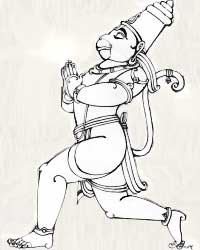 |
tasy˜× tat vacanam þrutv˜ han¨m˜n hari y¨thapa× |
duhkh˜t duhkha abhibh¨t˜y˜× s˜ntam uttaram abravŸt || 5-34-1
1. shrutvaa= hearing; tat= that; vachanam= speech; tasyaaH= of that Seetha; duHkhaat duHkhaabhibhuutayaaH= who was overthrown from one grief to another; hanumaan= Hanumaan; haripuN^gavaH= the best of monkeys; abraviit= spoke; saantvam= in a kindly and affectionate; uttaram= reply.
Hearing those words of Seetha who was overthrown from one grief to another, Hanuma the best of monkeys gave the following reply in a kindly and affectionate manner.
aham r˜masya samdeþ˜t devi d¨ta× tava ˜gata× |
vaidehi kuþalŸ r˜ma× tv˜m ca kauþalam abravŸt || 5-34-2
2. devii= O princess; vaidehi= Seetha, the daughter of the king of Videha Kingdom!; aham= I; aagataH= have come; tava duutaH= as your messenger; raamasya sandeshaat= on the direction of Rama; kusalii= the virtuous; raamaH= Rama; abraviit= enquired; tvaamcha kushalam= about your welfare too.
"O Seetha the daughter of the king of Videha Kingdom! I have come here as your messenger on Rama's directions. The virtuous Rama enquired about your welfare too."
yo br˜hmam astram ved˜n ca veda vedavid˜m vara× |
sa tv˜m d˜þarathŸ r˜mo devi kauþalam abravŸt || 5-34-3
3. devii= O divine lady! saH= such; raamaH= Rama; daasharathiH= the son of Dasaratha; yaH= who; varaH= is excellent; veda vidaam= among the knower of Veda; veda= and who knows; brahmam astram= Brahma's missile (a mythical weapon which deals infallible destruction); vedaamshcha= and Vedas the sacred knowledge; abraviit= enquired; tvaam= you; kaushalam= about your welfare.
"O Divine Lady! Rama the son of Dasaratha, who is excellent among the knowers of Veda and who knows Brahma's missile (a mythical weapon which deals infallible destruction) and Vedas the sacred knowledge, enquired about your welfare."
lakÿmaõa× ca mah˜tej˜ bhartu× te anucara× priya× |
k®tav˜n þoka samtapta× þiras˜ te abhiv˜danam || 5-34-4
4. lakSmaNashcha= also Lakshmana; mahaatejaaH= having a great splendour; priyaH= the favourite brother; anucharaH= and the follower; te bhartuH= of your husband; shoka santaptaH= tormented with grief; kR^itavaan= performed; te abhivaadanam= salutation to you; shirasaa= with his head.
"Also the greatly splendourous Lakshmana, the favourite brother and the follower of your husband, himself tormented with grief, performed salutation to you by bowing his head."
s˜ tayo× kuþalam devŸ niþamya nara simhayo× |
prŸti samh®ÿ÷a sarva angŸ han¨m˜ntam atha abravŸt || 5-34-5
5. nishamya= hearing; tayoH= that; kushalam= (news of) welfare; narasimhayoH= of Rama and Lakshmana the excellent among men; saa devii= that divine lady, Seetha; priiti samhR^iSTa sarvaaNgii= with all her limbs thrilled with joy; atha= then; abraviit= spoke; hanumantam= to Hanuma (as follows).
Hearing that news of welfare of Rama and Lakshmana the excellent of men, the divine lady, with all her limbs thrilled with joy, spoke to Hanuma (as follows):
kaly˜õŸ bata gath˜ iyam laukikŸ pratibh˜ti me |
ehi jŸvantam ˜nado naram varÿa þat˜t api || 5-34-6
6. aanandaH= joy; eti= rushes; jiivantam- to surviving; naram= man; varSashataadapi= even though (it be) at the end of a hundred years; iyam= this; laukikiir= wordly; gaathaa= adage; pratibhaati= appears; kalyaaNi= auspicious; maa= to me.
" 'Joy rushes to surviving man even though (it be) as the end of a hundred years' - this popular adage appears true and and auspicious for me."
tayo× sam˜game tasmin prŸti× utp˜dit˜ adbhut˜ |
paraspareõa ca ˜l˜pam viþvastau tau pracakratu× || 5-34-7
7. tasmin= In that Hanuma; samaagate= who approached (her); adbhutaa= a wonderful; priitiH= friendly disposition; utpaaditaa= was brought forth; tayaa= by her; tau= the two of them; vishvastau= with full of confidence; chakratuH= made; aalaapamcha= conversation; paraspareNa= with each other.
Seetha showed wonderful friendly disposition towards Hanuma who approached her. Both of them also conversed with each other in full confidence.
tasy˜× tat vacanam þrutv˜ han¨m˜n hari y¨thapa× |
sŸt˜y˜× þoka dŸn˜y˜× samŸpam upacakrame || 5-34-8
8. shrutvaa= hearing; tat= that; vachanam= reply; tasyaaH= of that; siitaayaaH= Seetha; shoka diinayaaH= who was afflicted with; hanumaan= Hanuma; hari yuuthapaH= the army-chief of monkeys; upachakrame= endeavoured to draw; samiipam= nearer (to her).
Hearing that reply of Seetha who was afflicted with grief, Hanuma the army-chief of monkeys endeavoured to draw nearer to her.
yath˜ yath˜ samŸpam sa han¨m˜n upasarpati |
tath˜ tath˜ r˜vaõam s˜ tam sŸt˜ pariþankate || 5-34-9
9. yathaa yathaa= in as much as; saH hanumaan= that Hanuma; upasarpati= drew; samiipam= nearer to her; tathaa tathaa= in so much way; saa siitaa= that Seetha; parishaN^kate= suspected; tam= him; raavaNam= as Ravana.
In as much as that Hanuma drew nearer to her, in the same way, that Seetha suspected him as Ravana.
aho dhig dhig k®tam idam kathitam hi yat asya me |
r¨pa antaram up˜gamya sa eva ayam hi r˜vaõa× || 5-34-10
10. aho dhik= O shame!; me duSkR^itam= It was my guilt; kathitam= to tell; asya= him; idam= (all) this; ayam= he; saH raavaNaH hi= is indeed that Ravana; upaagamya= who obtained; ruupaantaram= another guise.
"O shame! It was my guilt to tell him all this to him. He is indeed that Ravana, who obtained another guise."
t˜m aþokasya þ˜kh˜m s˜ vimuktv˜ þoka karþit˜ |
tasy˜m eva anavadya angŸ dharaõy˜m samup˜viþat || 5-34-11
11. saa= that Seetha; anavadyaaN^gii= having faultless limbs; vimuktyaa= leaving; taam= that; shaakhaam= branch; ashokasya= of Ashoka tree; shoka karshitaa= and emaciated with grief; samupaavishat= sat down; tasyaam dharaNyaameva= on that floor itself.
That Seetha, having faultless limbs, leaving that branch of Ashoka tree and as emaciated with grief, sat down on that ground itself.
hanum˜napi du×kh˜rt˜Õ t˜Õ d®ÿ÷v˜ bhayamohit˜m |
avandata mah˜b˜hu× tata× t˜m janaka ˜tmaj˜m || 5-34-12
s˜ ca enam bhaya vitrast˜ bh¨yo na eva abhyudaikÿata |
12. dR^iSTvaa= seeing; taam= her; duHkhaartam= afflicted with grief; bhaya mohitam= and deluded with fear; hanumaanapi= also Hanuma; mahaabaahuH= the grea armed; tataH= then; avandata= saluted; taam janakaatmajam= that Seetha; saa cha= she too; bhaya vitrastaa= trembling with fear; naa abhyudaikSata= did not look towards; enam= him; bhuuyaH= again.
Seeing Seetha afflicted with grief and deluded with fear, the great armed Hanuma also then simply saluted her. She too, trembling with fear, did not look towards him again.
tam d®ÿ÷v˜ vandam˜nam tu sŸt˜ þaþi nibha ˜nan˜ || 5-34-13
abravŸt dŸrgham ucchvasya v˜naram madhura svar˜ |
13. siitaa= Seetha; shashinibhaananaa= with her countenance resmbling the moon; dR^iSTvaa= seeing; tam= him; vandamaanam= saluting her; uchchhvasya= sighed; diirgham= deeply; abraviit= and spoke; vaanaram= to Hanuma; madhura svaraa= in a sweet-sounding voice (as follows):
Seetha, with her countenance resembling the moon, seeing Hanuma saluting her, had a deep sigh and spoke to Hanuma in a sweet-sounding voice (as follows)
m˜y˜m praviÿ÷o m˜y˜vŸ yadi tvam r˜vaõa× svayam || 5-34-14
utp˜dayasi me bh¨ya× samt˜pam tan na þobhanam |
14. tvam raavaNaH yadi= If you are Ravana; praviSTaH= who made use of; maayaam= an illusive guise; svayam= and yourself; maayaavii= a conjurer; utpaadayasi= you are causing; bhuuyaH= a further; samtaapam= agony; me= to me; tat= that; na shobhanam= is not good.
"If you are Ravana, who made use of an illusive guise and yourself a conjurer, you are causing me a further agony. It is no good."
svam parityajya r¨pam ya× parivr˜jaka r¨padh®t || 5-34-15
jana sth˜ne may˜ d®ÿ÷a× tvam sa eva asi r˜vaõa× |
15. yaH raavaNaH= which Ravana; parityajya= leaving; svam= ruupam= his real form; dR^iSTaH= was seen; mayaa= by me; parivraajakaruupavaan= in the guise of a vagrant religious mendicant; janasthaane= in Janasthana; sa eva= that Ravana indeed; tvam asi= you are.
'You are indeed the same Ravana, who, abandoning your real form, appeared to me in the guise of a vagrant religious mendicant in Janasthana."
upav˜sa k®þ˜m dŸn˜m k˜ma r¨pa niþ˜ cara || 5-34-16
samt˜payasi m˜m bh¨ya× samt˜pam tan na þobhanam |
16. nishaachara= O demon; kaamaruupa= who can assume any form at will!; tat= It; shobhanam na= is not good; santaapayasi samtaapam= that you are causing any; bhuuyaH= again; maam= to me; upavaasakR^ishaam= who is emaciated by fasting; diinaam= and very miserable.
"O demon who can assume any form at your will! It is no good that again you are causing agony to me, emaciated because of fasting and feeling very miserable."
athav˜ naitadevaÕ hi yanmay˜ pariþaðkitam || 5-34-17
manaso hi mama prŸtirutpann˜ tava darþan˜t |
17. athavaa= otherwise; yat= whatever; parishaN^kitam= is suspected; mayaa= by me; etat= that; na hi= is not indeed; evam= so; mama manasaH= in my mind; priitiH= a pleasurable sensation; utpannaa hi= occurred indeed; tava darshanaat= by reason of your audience.
"Otherwise, whatever is suspected by me is not indeed true because in my mind, a pleasurable sensation indeed occurred by reason of your audience."
yadi r˜masya d¨ta× tvam ˜gato bhadram astu te || 5-34-18
p®cch˜mi tv˜m hari þreÿ÷ha priy˜ r˜ma kath˜ hi me |
18. tvam aagataH yadi= if you have come; raamasya duutaH= as Rama's messenger; astu te= may you be; bhadram= blessed; harishreSTha= O, the best of monkeys!; me= to me; raama kathaa= Rama's anecdote; piyaa hi= is indeed pleasurable; pR^ichchhaami= (hence) I am asking; tvaam= you (to narrate it).
"If you have come as Rama's messenger, may you be blessed! O the best of monkeys! Rama's anecdote is very pleasurable for me. Hence, I am requesting you to narrate it."
guõ˜n r˜masya kathaya priyasya mama v˜nara || 5-34-19
cittam harasi me saumya nadŸ k¨lam yath˜ raya× |
19. vaanara= O monkeys!; kathaya= Narrate; guNaan= the qualities; priiyasya raamasya= of my beloved Rama; saumya= O gentle one!; harasi= you are eroding; me chittam= my mind; rayaH yathaa= as a rapid course of steram nadii kuulam= (erodes) a river-bank.
"O monkey! Narrate the qualities of my beloved Rama. O gentle one! You are eroding my mind as a rapid course of stream erodes a river bank."
aho svapnasya sukhat˜ y˜ aham evam cira ˜h®t˜ || 5-34-20
preÿitam n˜ma paþy˜mi r˜ghaveõa vana okasam |
20. yaa ham= I, who; chiraahR^itaa= was taken away long ago; pashyaami= is seeing; vanaukasam= a monkey; preSitam naam= sent; raaghavaNa= by Rama; evam= in this way; aho= Alas!; sukhataa= how delightful; sapnasya= of this dream!.
"I, who was taken away long ago, is seeing a monkey sent by Rama in this way. Alas! How delightful this dream is!'
svapne'pi yadyaham vŸraÕ r˜ghavam sahalakÿmaõam || 5-34-21
paþyeyam n˜vasŸdeyam svapno'pi mama matsarŸ |
21. aham pashyeyam yadi= If I have seen; raaghavam= Rama; viiram= the eminent man; saha lakSmaNam= along with Lakshmana; na avasiideyam= I would not have disheartened; mama= in my case; svapno.api= even the dream; matsarii= is wicked.
"If I have seen the eminent Rama together with Lakshmana, I would not have disheartened. In my case, even my dream is wicked!"
na aham svapnam imam manye svapne d®ÿ÷v˜ hi v˜naram || 5-34-22
na þakyo abhyudaya× pr˜ptum pr˜pta× ca abhyudayo mama |
22. aham= I; na manye= do not deem; imam= it; svapnam= as a dream; dR^iSTvaa= seeing; vaanaram= a monkey; svapne= in a dream; na shakyaH= is not fit; praaptum= to get; abhyudayam= prosperity; abhyudayaH= (But) prosperity; praaptashcha= has come; mama= to me.
"I do not deem it as a dream. Seeing a monkey in a dream does not bring about prosperity But prosperity has come to me!"
kim nu sy˜c citta moho ayam bhavet v˜ta gati× tu iyam || 5-34-23
unm˜dajo vik˜ro v˜ sy˜t iyam m®ga t®ÿõik˜ |
23. syaat kim nu= how possibly; ayam= is it; chitta mohaH= a delusion of my mind? iyan bhavet= is it the impending; vaatagatiH= course of a flatulence? vikaarovaa= or change of mental condition; unmaadaja= born out of madness?; syaatiyam= is it a looming; mR^igatR^iSNikaa= mirage?
"How possibly is it a delusion of my mind? Is it an impending course of flatulence or changing mental condition of madness? Is it a looming mirage?"
athav˜ na ayam unm˜do moho api unm˜da lakÿmaõa× || 5-34-24
sambudhye ca aham ˜tm˜nam imam ca api vana okasam |
24. athavaa= Otherwise; ayam= It; na unmaadaH= is neither a madness; moho.api= nor even a delusion; unmaada lakSaNaH= which is a symptom of madness; aham= I; sambudhye= am knowing; aatmaanam= about myself; imam vanonkasam= and this monkey.
"Otherwise, it is neither madness nor even a delusion, which is a symptom of madness. Because I am knowing about myself as also about this monkey."
iti evam bahudh˜ sŸt˜ sampradh˜rya bala abalam || 5-34-25
rakÿas˜m k˜ma r¨patv˜n mene tam r˜kÿasa adhipam |
25. ityevam= thus; sampradhaarya= deliberating upon; balaabalam= the strengths and weaknesses; bahudhaa= in several ways; siita=Seetha; mane= thought; tam= him; raakSasaadhipam= as Ravana; kaamaruupatvaat= as they can change their forms at will.
Thus deliberating upon the strengths and weaknesses in several ways, Seetha finally imagined him to be Ravana, as demons can change their forms at will.
et˜m buddhim tad˜ k®tv˜ sŸt˜ s˜ tanu madhyam˜ || 5-34-26
na prativy˜jah˜ra atha v˜naram janaka ˜tmaj˜ |
26. tadaa= then; saa= that; tanumadhyamaa= slender waisted; siitaa= Seetha; janakaatmajaa= the daughter of Janaka; etaam buddhim kR^itvaa= thus having made up her mind; na prativyaajahaara= did not reply in return; vaanaram= to Hanuma; atha= thereafter.
Then, that slender waisted Seetha, the daughter of Janaka, thus having made up her mind, did not reply in return anything further to Hanuman.
sŸt˜y˜× cintitam buddhv˜ han¨m˜n m˜ruta ˜tmaja× || 5-34-27
þrotra anuk¨lai× vacanai× tad˜ t˜m sampraharÿayat |
27. buddhvaa= understanding; chintitam= the contemplation; siitaayaaH= of Seetha; hanumaan= Hanuma; maarutaatmajaH= the son of wind-god; tadaa= then; sampraharSayat= brought about a great joy; taam= in her; vachanaiH= with his words; shrotraanukuulaiH= favourable to her ears.
Understanding the contemplation of Seetha, Hanuma the son of wind-god then brought about a great joy in her with his words most favourable to her ears (as follows):
˜ditya iva tejasvŸ loka k˜nta× þaþŸ yath˜ || 5-34-28
r˜j˜ sarvasya lokasya devo vaiþravaõo yath˜ |
vikrameõa upapanna× ca yath˜ viÿõu× mah˜yaþ˜× || 5-34-29
28, 29. tejasvii= (Rama) has a great splendour; aaditya iva= like that of the sun; loka kaantaH= pleasing to all; shasiiyathaa= like the moon; raajaa= lord; sarvasya= to the entire; lokasya= world; devo vaishravaNo yathaa= like Kubera the lord of wealth; mahaayashaaH= greatly renowned; viSNuH yathaa= like Vishnu; upapannashcha= and endowed with; vikrameNa= valour.
"Rama has a great splendour like that of the sun. He is pleasing to all like the moon. As Kubera the Lord of wealth, he is a lord to the entire world. Like Vishnu, he is greatly renowned and endowed with valour."
satya v˜dŸ madhura v˜g devo v˜caspati× yath˜ |
r¨pav˜n subhaga× þrŸm˜n kandarpa iva m¨rtim˜n || 5-34-30
30. satyavaadii= (Rama) is a speaker of truth; devaH vaachaspatiryathaa= like lord Brihaspati; madhuravaak= he has a sweet voice; ruupavaan= a handsome man; subhagaH= possessing good fortune; shriimaan= and royal dignity; kandaraH iva= He is like Manmadha, the Lord of love; muurtimaan= personified himself.
"Rama is a speaker of truth. Like Lord Brihaspati, he has a sweet voice. He is a handsome man, possessing good fortune and a royal dignity. He is a personified Manmadha, the lord of love."
sth˜na krodha prahart˜ ca þreÿ÷ho loke mah˜ratha× |
b˜huc c˜y˜m avaÿ÷abdho yasya loko mah˜tmana× || 5-34-31
31. sthaana krodhaH= (Rama) gets anger at the right time; prahartaacha= He strikes a befitting person; shreSThaH= he is an excellent; mahaarathaH= chariot-warrior; yasya= in which; baahu chchhaayaam= shelter of arms; mahaatmanaH= of the high-souled man; lokaH= the world; avasTabdhaH= is resting on.
"Rama gets anger only at right time. He strikes a befitting person at a right time. He is an excellent chariot-warrior. The world is resting under the shelter of arms of this high souled man."
apak®þÿya ˜þrama pad˜n m®ga r¨peõa r˜ghavam |
þ¨nye yena apanŸt˜ asi tasya drakÿyasi yat phalam || 5-34-32
32. yena= by which Ravana; mR^igaruupeNa= by means of an illusory antelope; raaghavam= Rama; apakR^iSya= was taken far away; apraniitaa asi= you were stolen; shuunye aashram padaat= from a deserted hermitage; yat= which; phalam= consequence; tasya= to such Ravana; drakSyasi= you will see (later).
"Showing an illusory antelope, Ravana detracted Rama and took you away from a deserted hermitage. You will see later, the consequence Ravana will get for this act."
nacir˜t r˜vaõam samkhye yo vadhiÿyati vŸryav˜n |
roÿa pramuktai× iÿubhi× jvaladbhi× iva p˜vakai× || 5-34-33
tena aham preÿito d¨ta× tvat sak˜þam iha ˜gata× |
tvat viyogena duhkha ˜rta× sa tv˜m kauþalam abravŸt || 5-34-34
33, 34. yaH viiryavaan= which valiant Rama; achiraat= soon; vadhiSyati= is going to kill; raavaNam= Ravana; samkhye= in battle; iSubhiH= with arrows; jvaladbhiH= strongly shining; paavakaiH iva= like sparkles; roSa pramuktaiH= released with anger; tena= by the same Rama; preSitaH= I was sent; iha= here; duutaH= as a messenger; aagataH= and I came; tvatsakaasham= to your presence; saH= that Rama; duHkhaartaH= pained with grief; tvadviyogena= by your separation; abraviit= enquired; tvaam kaushalam= about your welfare.
"Which valiant Rama with arrows strongly shining like sparkles released with anger, by the same Rama I was sent here as a messenger and I arrived at your presence. That Rama, agonised by your separation wishes to enquire of your welfare."
lakÿmaõa× ca mah˜tej˜× sumitra ˜nanda vardhana× |
abhiv˜dya mah˜b˜hu× so api kauþalam abravŸt || 5-34-35
35. saH lakSmaNashcha= that Lakshmana too; mahaa tejaaH= having a great splendour; sumitraa nanda vardhanaH= who augments the happiness of Sumitra his mother; mahaa baahuH= and having long arms; abhivaadya= saluted; tvaam= you; abraviit= and enquired; kaushalam= about your welfare.
"That long-armed Lakshmana too, having a great splendour and who augments the happiness of Sumitra his mother, saluted you and enquired about your welfare."
r˜masya ca sakh˜ devi sugrŸvo n˜ma v˜nara× |
r˜j˜ v˜nara mukhy˜n˜m sa tv˜m kauþalam abravŸt || 5-34-36
36. devii= O Princess! saH vaanaraH= that monkey; sugriivonaama= named Sugreeva; sakhaa= a companion; raamasya= of Rama; raajaa= and the king; vaanara mukhyaanaam= of the excellent monkeys; abraviit= asked; tvaam kaushalam= about your welfare.
"O princess! That monkey called Sugreeva, a companion of Rama and the king of the excellent monkeys, asked about your welfare."
nityam smarati r˜ma× tv˜m sasugrŸva× salakÿmaõa× |
diÿ÷y˜ jŸvasi vaidehi r˜kÿasŸ vaþam ˜gat˜ || 5-34-37
37. raamaH= Rama; sa sugriivaH= together with Sugreeva; sa lakSmaNaH= along with Lakshmana; nityam= is always; smarati= recollecting; tvaam= you; vaidehi= O Seetha!; aagataa= (eventhough) coming into; raakSasiivasham= the power of female-demons; jiivasi= you are surviving; diSTyaa= by your good luck.
"Rama, together with Sugreeva and Lakshmana, is always recollecting you. O Seetha! Eventhough coming into the control female-demons, you are somehow surviving by your good luck!"
nacir˜t drakÿyase r˜mam lakÿmaõam ca mah˜ratham |
madhye v˜nara ko÷Ÿn˜m sugrŸvam ca amita ojasam || 5-34-38
38. na chiraat= within a few days; drakSyase= you will see; raamam= Rama; mahaabalam= the mighty; lakSmaNam= lakshmana; amitaujasam= and the highly splendorous; sugriivam cha= Sugreeva; madhye= in the presence of; vaanarakoTiinaam= crores of monkeys.
"Within a few days, you will see Rama, the mighty Lakshmana and the highly splendorous Sugreeva, in the presence of crores of monkeys."
aham sugrŸva sacivo han¨m˜n n˜ma v˜nara× |
praviÿ÷o nagarŸm lank˜m langhayitv˜ mah˜udadhim || 5-34-39
39. aham= I; vaanaraH= am a monkey; sugriiva sachivaH= the minister of Sugreeva; humaan naamaH= named Hanuma; praviSTaH= I entered; laN^kaam nagariim= the City of Lanka; laN^ghayitva= by traversing; mahodadhim= the great ocean.
"I am a monkey, the minister of Sugreeva, called Hanuma. I entered the city of Lanka, by traversing the great ocean."
k®tv˜ m¨rdhni pada ny˜sam r˜vaõasya dur˜tmana× |
tv˜m draÿ÷um upay˜to aham sam˜þritya par˜kramam || 5-34-40
40. samaashritya= asserting; paraakramam= my strength; kR^itvaa padnyaasam= and putting down my feet; muurdhni= on the head; duraatmanaH raavaNaH= of the evil-minded Ravana; aham= I; upayaataH= have come; draSTum= to see; tvaam= you.
"Asserting my strength and putting down my feet on the head of the evil minded Ravana, I have come to see you."
na aham asmi tath˜ devi yath˜ m˜m avagacchasi |
viþank˜ tyajyat˜m eÿ˜ þraddhatsva vadato mama || 5-34-41
41. devi= O princess!; yathaa= As; avagachchhasi= you comprehend; maam= about me; aham= I; na asmi= am not; tathaa= so; tyajyataam eSaa vishaNkaa= let this suspicion be given up; shraddhatsva= believe; mama= me; vadataH= who is saying.
"O Princess! I am not so, as you comprehend me (as Ravana). Let your suspicion be given up. Believe me as I say it."
ity˜rÿe þrŸmadr˜m˜yaõe ˜dik˜vye sundarak˜õýe catustrimþa× sarga×
Thus completes 34th Chapter of Sundara Kanda of the glorious Ramayana of Valmiki, the work of a sage and the oldest epic.
© January, 2005, K. M. K. Murthy