
Book V : Sundara Kanda - Book Of Beauty
Stepping down from the tree, Hanuma approached Seetha and asked her to clarify him whether she is the wife of Rama. Seetha then starts to narrate her antecedents and the story of Rama along with circumstances under which she along with Rama and Lakshmana went to Dandaka forest as per the command of King Dasaratha. She also informs Hanuma about her snatching away of Ravana from the forest. | 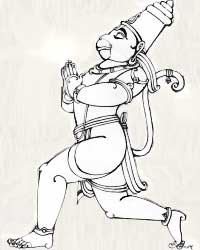 |
so'vatŸrya drum˜ttasm˜dvidrumapratim˜nana× |
vinŸtaveÿa× k®paõa× praõipatyopas®tya ca || 5-33-1
t˜m abravŸn mah˜tej˜ han¨m˜n m˜ruta ˜tmaja× |
þirasi añjalim ˜dh˜ya sŸt˜m madhuray˜ gir˜ || 5-33-2
1, 2. saH hanumaan= that Hanuma; vidruma prati maana naH= with coral-coloured countenance; mahaa tejaa= very bright; maarutaatmajaH= and the so of wind-god; viniita veSaH= with a humble look; kR^ipaNaH= and feeble; upasR^itya= approached; taam siitaam= that Seetha; praNipatya= offered his salutation; aadhaaya= by keeping; aN^jalim= his joined palms; shirasi= on his head; abraviit= and spoke; (the following); madhurayaa= sweet; giraa= words.
That Hanuma, with coral-coloured face, very bright, the son of wind-god, wearing a humble and feeble look, approached Seetha by stepping down from the tree and offered her his salutation by keeping his joined palms on his head and spoke the following sweet words:
k˜ nu padma pal˜þa akÿŸ kliÿ÷a kauþeya v˜sinŸ |
drumasya þ˜kh˜m ˜lambya tiÿ÷hasi tvam anindit˜ || 5-33-3
3. padma palaashakSi= O Lady with your eyes resembling lotus leaves!; kliSTa kaushaya vaasini= wearing worn-out sila cloth; anindita= O the irreproachable one! tiSThasi= you have stood aalambya= taking by the hand; shaakhaam= a branch; drumasya= of the tree; kaanu= who are you?
"O Lady with your eyes resembling lotus leaves, wearing a worn out silken cloth! O, the irreproachable one! You have stood, holding by the hand a branch of the tree who are you?"
kim artham tava netr˜bhy˜m v˜ri sravati þokajam |
puõýarŸka pal˜þ˜bhy˜m viprakŸrõam iva udakam || 5-33-4
4. vaari shokajam= tears of sorrow; sravati= are gushing down; tava= from you; netraabhyaam= eyes; udakam= as water; viprakirNam= scattered down; puNDariika palaashaabhyaam= from two lotus petals; kimartham= why?
"Tears of sorrow are gushing down from your eyes, as water is scattered down from two lotus-petals. Why?"
sur˜õ˜m asur˜õ˜m ca n˜ga gandharva rakÿas˜m |
yakÿ˜õ˜m kimnar˜õ˜m ca k˜ tvam bhavasi þobhane || 5-33-5
5. shobhane= O auspicious lady!; kaa= In whom; tvam= are you; bhavasi= born; suraaNaam= whether in celestials; asuraaNaam vaa= or in ogres; naaga gandharvarakSasaam= or in serpent-demons or in celestial musicians or in demons; yakSaaNaam= or in semi-divine being; kimnaraaNaam= or in mythical beings.
"O auspicious lady! In whom are you born-whether in celestials or in ogres or in serpent-demons or in celestial musicians or in demons or in semi-divine beings or in mythical beings?"
k˜ tvam bhavasi rudr˜õ˜m marut˜m v˜ vara ˜nane |
vas¨n˜m v˜ vara ˜rohe devat˜ pratibh˜si me || 5-33-6
6. varaanane= O Lovely faced woman!; kaa= who; bhavasi= are ; tvam- you; rudraaNaam= among eleven Rudras, who; marutaam vaa= or among Maruts the storm-gods; vasuunaam= or among eight Vasus, the beneficient gods?; varaarohe= O handsome lady with fine hips!; me= to me; pratibhaasi= you appear; devataa= as a deity.
"O lovely-faced woman! Who are you among eleven Rudras who bestow strength, or among Maruts the storm-gods or among eight Vasus the beneficent gods? O Handsome lady with fine hips! You appear to me as a deity."
kim nu candramas˜ hŸn˜ patit˜ vibudha ˜lay˜t |
rohiõŸ jyotiÿ˜m þreÿ÷h˜ þreÿ÷h˜ sarva guõa anvit˜ || 5-33-7
7. rohiNiikimvaa= Are you Rohini; shreSTha sarva guNaanvitaa= endowed with all excellent qualities; patitaa= fallen; vibudhaalayaat= from heaven; hiinaa= left behind; chandramasaa= by moon; shreSThaa= excellent; jyotiSaam= among stars.
"Are you Rohini, endowed with all the best qualities, fallen from heaven, left behind by moon and excellent among stars."
kop˜t v˜ yadi v˜ moh˜t bhart˜ram asita Ÿkÿaõ˜ || 5-33-8
vasiÿ÷ham kopayitv˜ tvam na asi kaly˜õi arundhatŸ |
8. asitekSaNe= O dark eyed lady!; tvam naasi= are you not; kalyaaNii= the auspicious; arundhati= Arundhati; kopayitvaa= who irritated; vasiSTham= the sage Vasishta; bhartaaram= her husband; kopaadvaa yadivaa= either by anger.
"O dark-eyed lady! Are you not the auspicious Arundhati, who irritated her husband, Vasishta the sage either by anger or by error?"
ko nu putra× pit˜ bhr˜ta bhart˜ v˜ te sumadhyame || 5-33-9
asm˜l lok˜t amum lokam gatam tvam anuþocasi |
9. sumadhyame= O the slender waisted lady!; tvam= you; anushochasi= seem to be lamenting; gatam= (about someone) who has gone; asmaat= from thus; lokaat= world; amum lokam= to the other world; te= your; putraH son; pitaa= father; bhraataa= brother; bhartaa vaa= or your husband?
"O the slender waisted lady! You seem to be lamenting over someone who died is he your son, or father or brother or husband."
rodan˜datini×þv˜s˜dbh¨misaÕsparþan˜dapi || 5-33-10
na tv˜m devŸmaham manye r˜jña× sañjñ˜vadh˜raõ˜t |
10. rodanaat= for you lamenting; atiniH shvaasaat= for you long sighs; bhuumi sam sparshanaadapi= also for your touching of the earth; samjJNaavadharaNaat= for holding the signs; raajJNaH= of a king; aham= I; na manye= do not think; tvaam= you; deviim= as a divine woman.
"You are lamenting. You are sighing a lot. You are touching the earth. You have royal insignia in you. According to these things, I do not consider you as a divine woman."
vyañjan˜ni hi te y˜ni lakÿaõ˜ni ca lakÿaye || 5-33-11
mahiÿŸ bh¨mi p˜lasya r˜ja kany˜ asi me mat˜ |
11. yaani= which; vyaN^janaani= marks on your person; te lakSaNaamcha= and your form; lakSaye= I see; (according to that); me= to me; mataa= (your are) believed to be; mahiSii= a queen; bhuumipaalasya= of an emperor; raaja kanyaacha= and a king's daughter.
"Based on the marks on your person and your bodily characteristics, I believe you to be a queen of an emperor and the daughter of a king."
r˜vaõena jana sth˜n˜t bal˜t apah®t˜ yadi || 5-33-12
sŸt˜ tvam asi bhadram te tan mama ˜cakÿva p®cchata× |
12. asi yadi tvam= If you; siitaa= are Seetha; apahR^itaa= stolen; balaat= by force; raavaNena= by Ravana; janasthaanaat= from Janasthana; aachakSya= tell; tat= it; mama= to me; pR^ichchhataH= who is asking; bhadram te= if you please."
"If you are Seetha stolen per force by Ravana from Janasthana, tell it to me who is asking if you please!"
yath˜ hi tava vaidainyam r¨pam c˜pyatim˜nuÿam || 5-33-13
tapas˜ c˜nvito veÿastvaÕ r˜mamahiÿŸ dhruvam |
13. yathaa= according to; tava= your; dainyam= miserable state; ruupam cha= the (beautiful) figure; atimaanuSam= which is super-human; veSaH= your costume; anvitaH= endowed with; tapasaa= austerity; dhruvam= surely; tvam= you are; raama mahiSii= Rama's wife."
"According to your miserable state, the super-human beautiful figure and your costume endowed with austerity, surely you are Rama's wife."
s˜ tasya vacanam þrutv˜ r˜ma kŸrtana harÿit˜ || 5-33-14
uv˜ca v˜kyam vaidehŸ han¨mantam druma ˜þritam |
14. shrutvaa= hearing; tasya= his; vachanam= words; saa vaidehii= that Seetha; raama kiirthana harSitaa= was delighted of Rama's mention; uvaacha= and spoke; vaakyam= (the following) words; hanumantam= to Hanuma; drumaashritam= who was dwelling on a tree.
Hearing his words, Seetha was delighted of Rama's mention and spoke the following words to Hanuma, who was dwelling on a tree.
p®thivy˜Õ r˜jasiÕh˜n˜Õ mukhyasya vidit˜tmana× || 5-33-15
snuÿ˜ daþarathasy˜ham þatrusainyaprat˜pina× |
15. aham= I; snuSaa= am the daughter-in-law; dasharathasya= of Dasaratha; mukhyasya= the eminent; raaja simhaanaam= among the excellent kings; pR^ithi vyaam= on earth; viditaatmanaH= who understands the nature of the spirit; shatrusainya prataapinaH= and who torments the army of the adversary.
"I am the daughter-in-law of Dasaratha, eminent among the excellent kings on earth, who understands the nature of the spirit and who torments the army of the adversary."
duhit˜ janakasya aham vaidehasya mah˜tmana× || 5-33-16
sŸt˜ ca n˜ma n˜mn˜ aham bh˜ry˜ r˜masya dhŸmata× |
16. aham= I; duhitaa= am the daughter; janakasya= of Janaka; vaidehasya= the king of Videha kingdom; mahaatmanaH= having a noble nature; Seetha; naamnaa= by name; bhaaryaa= and wife; raamasya= of Rama; dhiimataH= the wise man.
"I am the daughter of the noble-natured Janaka, the king of Videha kingdom. I am know.
sam˜ dv˜daþa tatra aham r˜ghavasya niveþane || 5-33-17
bhunj˜n˜ m˜nuÿ˜n bhog˜n sarva k˜ma sam®ddhinŸ |
17. aham= I; (stayed); tatra= there; raaghavasya= in Rama's; niveshane= house; dvaadasha= for twelve; samaaH= years; bhuJNaanaa= enjoying; bhogaan= the worldly pleasures; maanuSaan= belonging to mankind; sarvakaama samR^iddhinii= and fulfilling all the desires.
"I stayed in Rama's house there for twelve years, enjoying the worldly pleasures belonging to human kind and fulfilling all my desires."
tata× trayodaþe varÿe r˜jyena ikÿv˜ku nandanam || 5-33-18
abhiÿecayitum r˜j˜ sa up˜dhy˜ya× pracakrame |
18. tataH= thereafter; trayodashe varSe= in the thirteenth year; raajaa= the king Dasaratha; sopaadhyaayaH= along with his preceptors; prachakrame= started; abhiSechayitum= to; anointment; raajyena= of; the kingdom; ikSvaakunandanam= to Rama, a celebrity of Ikshvaku dynasty.
"Thereafter, in the thirteenth year, King Dasaratha along with his preceptors started to perform anointment of the kingdom to Rama, a celebrity of Ikshvaku dynasty."
tasmin sambhriyam˜õe tu r˜ghavasya abhiÿecane || 5-33-19
kaikeyŸ n˜ma bhart˜ram devŸ vacanam abravŸt |
19. tasmin= (While) that; abhiSechane= anointment; raaghavasya= of Rama; sambhriyamaaNe= was being arranged; devii= a queen; kaikeyii naama= called Kaikeyi; abraviit= spoke; vachanam= the (following) words; bhartaaram= to Dasaratha, her husband.
"While that anointment of Rama was being arranged, a queen called Kaikeyi spoke the following words to Dasaratha, her husband.
na pibeyam na kh˜deyam pratyaham mama bhojanam || 5-33-20
eÿa me jŸvitasya anto r˜mo yadi abhiÿicyate |
20. raamaH yadi abhiSichyate= If Rama gets anointed; na pibeyam= I shall not drink water; na khaadeyam= I shall not eat; mama= my; bhojanam= food; pratyaham= daily; eSaH= this is; antaH= the end; me= to my; jiivitasya= life.
"If Rama gets anointed for the kingdom, from now onwards, I shall neither drink water nor take my food daily. This is the end to my life."
yat tat uktam tvay˜ v˜kyam prŸty˜ n®pati sattama || 5-33-21
tac cen na vitatham k˜ryam vanam gacchatu r˜ghava× |
21. nR^ipatisattama= O the excellent king!; yat= which; tat vaakyam= that word; uktam= was uttered; tvayaa= by you; priityaa= with affection; tat yadi= and if that; na kaaryam= for waste; raaghavaH= (let) Rama; gachchatu= go; vanam= to the forest.
"O the excellent king! If that word of pledge was uttered affectionately by you and if it is not going to be a waste, let Rama go to the forest."
sa r˜j˜ satya v˜g devy˜ vara d˜nam anusmaran || 5-33-22
mumoha vacanam þrutv˜ kaikeyy˜× kr¨ram apriyam |
22. shrutvaa= hearing; kruuram= the cruel; apriyam= and the disagreeable; vachanam= words; kaikeyyaaH= of Kaikeyi; anusmaram= and recollecting; varadaanam= the boon given; devyaaH= to the queen; saH raajaa= that king; satyaraak= who was true to his word; mumoha= became unconscious.
"Hearing the cruel and the disagreeable words of Kaikeyi and recollecting the boon given to the queen, King Dasaratha who was true to his word, fell unconscious.
tata× tu sthaviro r˜j˜ satya dharme vyavasthita× || 5-33-23
jyeÿ÷ham yaþasvinam putram rudan r˜jyam ay˜cata |
23. tataH= then; sthaviraH= the aged; raajaa= king; vyavasthitaH= who was firmly established; satye= in truth; dharme= and righteousness; rudan= while weeping; ayaachat= asked for ; raajyam= the kingdom; yashasvinam= from his illustrious; jyeSTham= eldest; putram= son.
"Then, the aged king, who was firmly established in truth and righteousness, regretfully asked his illustrious eldest son to give back the kingdom, which he bestowed him earlier."
sa pitu× vacanam þrŸm˜n abhiÿek˜t param priyam || 5-33-24
manas˜ p¨rvam ˜s˜dya v˜c˜ pratig®hŸtav˜n |
24. shriimaan= the glorious; saH= that Rama; puurvam= first; aasaadya= admitted; pituH= his father's; vachanam= words; manasaa= in mind; param priyam= more dearer; abhiSekaat= than his anointment to the kingdom; pratigR^ihiitavaan= and accepted (them); vaachaa= with his word.
"That glorious Rama first admitted his father's words in mind, considering them more dearer than his anointment to the kingdom and accepted them with his word."
dady˜n na pratig®hõŸy˜n na br¨yat kimcit apriyam || 5-33-25
api jŸvita heto× hi r˜ma× satya par˜krama× |
25. raamaH= Rama; satya paraakramaH= the truly courageous man; dadyaat= (always) gives (to others) na pratigR^ihNiiyaat= and does not take (from others); na bruuyaat= (He) does not speak; kimchit= even a little; apriyam= of disagreeable word; api jiivita hetorvaa= even for the cause of his life.
"The truly courageous Rama always gives anything to others and does not take anything from others. He does not speak just a little of a disagreeable word even for the cause of his life."
sa vih˜ya uttarŸy˜õi mah˜arh˜õi mah˜yaþ˜× || 5-33-26
vis®jya manas˜ r˜jyam jananyai m˜m sam˜diþat |
26. vihaaya= leaving behind; mahaarhaaNi= greatly valuable; uttariiyaaNi= outer garments; (and wearing garments made of bark); saH= that Rama; mahaayashaaH= the highly illustrious one; visR^ijya= gave up; raajyam= his kingdom; manasaa= intentionally; samaadishat= (and) assigned; maam= me; jananyai= to his mother.
"Leaving behind his greatly valuable outer garments and wearing garments made of bark, that highly illustrious Rama gave up his kingdom willingly and assigned me to his mother."
s˜ aham tasya agrata× t¨rõam prasthit˜ vana c˜riõŸ || 5-33-27
na hi me tena hŸn˜y˜ v˜sa× svarge api rocate |
27. hiinaayaaH= bereft; tena= of him; vaasaH= dwelling; svarge.api= even in heaven; na rochate hi= does not indeed give pleasure; saa aham= I, as such; vana chaariNii= (decided) to proceed to the forest; tuurNam= and soon; prasthitaa= was ready to start; agrataH= (even) ahead; tasya= of that Rama.
"To me bereft of him, residing even in heaven does not indeed give pleasure. I, as such, decided to proceed to the forest and soon was ready to start even ahead of Rama."
pr˜g eva tu mah˜bh˜ga× saumitri× mitra nandana× || 5-33-28
p¨rvajasya anuy˜tr˜ arthe druma cŸrai× alamk®ta× |
28. saumitriH= Lakshmana; mahaabhaagaH= the illustrious man; mitra nandanaH= the rejoice of his friends; anuyaatraarthe= for the purpose of following; puurvajasya= of his elder brother; alamkR^itaH= adorned; praageva= even before (me).
"Adorned with clothes of bark, the illustrious Lakshmana, the rejoice of his friends, got ready to follow his elder brother even before (me)."
te vayam bhartu× ˜deþam bahu m˜nya d®ýha vrat˜× || 5-33-29
praviÿ÷˜× sma pur˜t d®ÿ÷am vanam gambhŸra darþanam |
29. bahumaanya= obeying respectfully; aadesham= the command; bhartuH= of Lord Dasaratha; vayam= we; te= as such; dR^iDhavrataaH= firm in our resolution; praviSTaaH= smaH= entered; vanam= the forest; adR^iSTam= not seen; puraa= before; gambhiira darshanam= with its deep and profound appearance.
"Obeying respectfully the command of Lord Dasaratha, we as such with a firm resolution, entered the forest, which we have never seen before and which was deep and profound in appearance."
vasato daõýaka araõye tasya aham amita ojasa× || 5-33-30
rakÿas˜ apah®t˜ bh˜ry˜ r˜vaõena dur˜tman˜ |
30. aham= I; bhaaryaa= the wife; tasya= of Rama; amitaujasaH= of great vigour; vasataH= dwelling; daN^DakaaraNya= in the forest of Dandaka; apahR^itaa= was taken away; raavaNena= by Ravana; rakSasaa duraatmanaa= the evil-minded demon.
While Rama of great vigour was dwelling in the forest of Dandaka, the evil-minded demon, Ravana took me, Rama's wife, away."
dvau m˜sau tena me k˜lo jŸvita anugraha× k®ta× || 5-33-31
¨rdhvam dv˜bhy˜m tu m˜s˜bhy˜m tata× tyakÿy˜mi jŸvitam |
31. me= to me; dvau= two; maasau= months; jiivitaanugrahaH= of favour of survived; kR^itaH= have been given; tena= by him; tataH= for that reason; uurdhvam= after; dvaabhyaam= two; maasaabhyaam= months; tyakSyaami= I shall give up; jiivitam= my life.
"A period of two months of survival-benefit has been given to me by him. For that reason, after the said two months, I shall give up my life."
ity˜rÿe þrŸmadr˜m˜yaõe ˜dik˜vye sundarak˜õýe trayastrimþa× sarga×
Thus completes 33rd Chapter of Sundara Kanda of the glorious Ramayana of Valmiki, the work of a sage and the oldest epic
© December, 2005, K. M. K. Murthy