
Book V : Sundara Kanda - Book Of Beauty
Seetha is shocked to see Hanuma, perched on the branches of a shimshupa tree She is confused whether it is a dream or a reality. Finally, she thinks that as the monkey is talking to her in a manifested form, it is quite a reality. She prays Lord Brihaspati and Brahma to make he words spoken by Hanuma as true. | 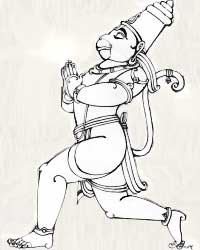 |
tata× þ˜kh˜ antare lŸnam d®ÿ÷v˜ calita m˜nas˜ |
veÿ÷it˜rjunavastram taÕ vidyutsamgh˜tapiðgalam || || 5-32-1
1. tataH= then; (Seetha); chalita maanasaa= had her mind shaken; dR^iSTvaa= seeing; tam= that Hanuma; vidyutsanghaata piV^galam= who was tawny coloured; vidyutsanghaata= like a series of flashing thunder bolts; veSTitaarjuna vastram= and wrapped up in a white cloth; liinam= hiding; shaakhaantare= behind branches of Seetha beheld there a monkey.
Then, seeing Hanuma, who was tawny coloured like a series of flashing thunderbolts wrapped up in a white cloth and hiding behind the branches of a tree, Seetha had her mind shaken.
s˜ dadarþa kapim tatra praþritam priya v˜dinam |
pull˜þokotkar˜bh˜sam taptac˜mikarekÿaõam || || 5-32-2
2. naa= that Seetha; dadarsha= beheld; tatra= there; kapim= a monkey; phulla shokotkaraabhaasam= beaming like a cluster of Ashoka flowers wide opened; tapta chaamiikarekSaNam= with his eyes resembling refined gold; prashritam= humble; priya vaadinam= and speaking agreeably.
Seetha beheld there a monkey, beaming like a cluster of Ashoka flowers wide opened, with his eyes resembling regined gold, humble and speaking agreeable words.
maithilŸ cintay˜m˜sa svapno ayam iti bh˜minŸ |
aho bhŸmamidaÕ r¨paÕ v˜narasya dur˜sadam || 5-32-3
durnirŸkÿamiti jñ˜tv˜ punareva mumoha s˜ |
3. maithilii= Seetha; gataa= got; paramam= a great; vismayam= surise; chintayaamaasa= and thought (as follows): aho= Alas!; idam= this; ruupam= appearance; vaanarasya= of the monkey; duraasadam= is hard to be approached; bhiimama= fearful; durniriikSam= and difficult to be looked at; iti= thus; jJNaatvaa= thinking; saa= she; mumoha= was bewildered; punareva= again.
Seetha got a great surprise and thought (as follows): "Alas! This monkey is hard to be approached, fearful and difficult to be looked at." Thus thinking, she was bewildered again.
vilal˜pa bh®þaÕ sŸt˜ karuõam bhayamohit˜ || 5-32-4
r˜mar˜meti du×kh˜rt˜ lakÿmaõeti ca bh˜minŸ |
ruroda bahudh˜ sŸt˜ mandam mandasvar˜ satŸ || 5-32-5
4, 5. siitaa= Seetha; bhaaminii= the splendid woman; bhaya mohitaa= bewildered by fear; duHkhaartaa= afflicted with grief; vilalaapa= lamented; bhR^isham= most; karuNam= piteously; raama raameti= saying O, Rama! O, Rama!; lakSmaNeti cha= and O Lakshmana; siitaa= Seetha; rurode= wept; mandam= faintly; mandasvaraa= satii= in a low voice; bahudhaa= in many ways.
The splendid woman Seetha, bewildered by fear and afflicted with grief, lamented most piteously saying "O, Rama! O, Rama! and "O Lakshmana!". Seetha wept faintly in a low voice in many ways.
s˜ tam d®ÿ÷v˜ hariþreÿ÷haÕ vinŸtavadupasthitam |
maithilŸ cintay˜m˜sa svapno'yamiti bh˜minŸ || 5-32-6
6. dR^iSTvaa= seeing; tam= that; harishreSTham= excellent monkey; upasthitam= appraoching; viniitavat= humbly; saa= that; bhaaminii= splendid woman; maithilii= Seetha; chintayaamaasa= thought; ayam= it; iti= as; svapnaH= a dream.
Seeing that excellent monkey appraching humbly, that splendid woman Seetha thought it as a dream.
s˜ vŸkÿam˜õ˜ p®thubhugnavaktraÕ þ˜kh˜m®gendrasya yathoktak˜ram |
dadarþa piðgapravaraÕ mah˜rhaÕ v˜t˜tmajaÕ buddhimat˜Õ variÿ÷ham || 5-32-7
7. saa= that Seetha; viikSamaaNaa= looking hither and thither; dadarsha= saw; vaataatmajam= Hanuma; pR^ithubhngnavaktram= who had wide and curved mouth; yathokta kaaram= doing as told; shaakhaamR^igendrasya= by Sugreeva the king of monkeys; piN^ga pravaram= the foremost of monkeys; mahaarham= greatly respectable; variSTham= and excellent; buddhimataam= among the intelligent.
Seetha, looking hither and thither, saw Hanuman, who was having a wide and curved mouth, doing acts as told by sugreeva the king of monkeys, the foremost of monkeys, greatly adored and the best among the inelligent.
s˜ tam samŸkÿya eva bh®þam visamjñ˜ gata asu kalp˜ iva babh¨va sŸt˜ |
cireõa samjñ˜m pratilabhya caiva caiva vicintay˜m˜sa viþ˜la netr˜ || 5-32-8
8. samiikSyaiva= as soon as seeing; tam= that Hanuma; saa siitaa= that Seetha; visamjNaaa= lost her consciousness; bhR^isham= very much; babhuuva= and became; gataasmkalpena= as though lifeless; pratilabhya= regaining; samjJNaam= her cnciousness; chireNa= after a long time; vishaala netraa= the wide-eyed Seetha; bhuuyaH= again; vichintayaamaasa= thought (as follows).
As soon as seeing Hanuma Seetha lost her consciousness very much and became seemingly lifeless. Regaining her consciousness after a long time the wide eyed Seetha moreover thought (as follows)
svapno may˜ ayam vik®to adya d®ÿ÷a× þ˜kh˜ m®ga× þ˜stra gaõai× niÿiddha× |
svasti astu r˜m˜ya salakÿmaõ˜ya tath˜ pitu× me janakasya r˜jña× || 5-32-9
9. adya= today; shaakhaamR^igaH= a monkey; vikR^itaH= in an ugly form; dR^iSTaH= was seen; mayaa= by me; svapne= in a dream; niSiddhaH= which is forbidden; shaastragaNaiH= according to a series of scriptures; svasti astu= May it be well; raamaaya= with Rama; salakSmaNaaya= together with Lakshmana; tathaa= and; together with Lakshmana; tathaa= and; me pituH= with my father; janakasya raajJNaH= king Janaka.
"Today, I saw an ugly monkey in my dream, which is forbidden according to a body of scriptures. May it be well with Rama together with Lakshmana and with my father, King Janaka.
svapno api na ayam na hi me asti nidr˜ |
þokena duhkhena ca pŸýit˜y˜× |
sukham hi me na asti yato asmi hŸn˜ |
tena indu p¨rõa pratima ˜nanena || 5-32-10
10. ayam= this; na asti= is not; svapno.api= a dream too; me= to me; yataH= since; piiDitaayaaH= tormented; shokena= by sorrow; duHkhena cha= and grief; naasti hi nidraa= there is indeed no sleep; me= to me; asmi= who is; hiinaa= bereft; tena= of Rama; indu puurNa pratimaana nena= whose countenance resembles a full moon; naasti hi= there is indeed no; sukham= happiness.
"This is not a dream. To me, tormented by sorrow and grief, there is indeed no sleep. To me, separated from Rama whose countenance resembles a full moon, there is no happiness indeed!"
r˜meti r˜meti sadaiva buddhy˜ vicinty˜ v˜c˜ bruvatŸ tameva |
tasy˜nur¨paÕ ca kath˜Õ tadarth˜ mevaÕ prapaþy˜mi tath˜ þ®õomi || 5-32-11
11. vichintya= (since) I am thinking; buddhyaa= with intellect; tameva= (about) that Rama only; bruvatii= and saying; vaachaa= in my voice; raameti raameti= thus 'Rama! Rama!'; sadaiva= always; anuruupam= conformably; prapashyaami= I am seeing; tathaa= and; shR^iNomi= hearing; kathaam= story; evam= in this way; tadarthaam= with the same object.
"Since I am pondering with my mind about that Rama only, and always saying 'Rama! Rama!' thus, confomably I am seeing and hearing a story thus corresponding to he same thought."
aham hi tasya adya mano bhavena sampŸýit˜ tat gata sarva bh˜v˜ |
vicintayantŸ satatam tam eva tathaiva paþy˜mi tath˜ þ®õomi || 5-32-12
12. sampiiDitaa= tormented; adya= today; manobhavena= by Manmatha, the god of love; tasya= about that Rama; tadgata sarva bhaavaa= having all my feelings directed towards him; vichintayantii= and thinking; satatam= always; tameva= about him; tathaiva= in the like manner; aham pashyaami= I am seeing; tathaiva= and in the like manner; shR^iNomi= I am hearing (the same matters).
"Tormented as I am today by manmatha god of love longing for Rama, my whole feelings directed towards him and constantly thinking of him alone, in the like manner I am seeing him and in the like manner i am hearing of him alone."
mano ratha× sy˜t iti cintay˜mi |
tath˜ api buddhy˜ ca vitarkay˜mi |
kim k˜raõam tasya hi na asti r¨pam |
suvyakta r¨pa× ca vadati ayam m˜m || 5-32-13
13. chintayaami= I am imagining; iti= that; manorathaH= my wish; syaat= will be fulfilled; tathaa= likewise; vitarkayaami= I am reasoning (it); buddhyaapi cha= by my intellect also; naasti hi= there is indeed no; ruupam= form; tasya= for that wish; ayam= He; suvyakta ruupaH= with a well-manifested form; vadati= is speaking; maam= about me; kim= what; kaaraNaam= is the reason?
"I am imagining that my wish will be fulfilled. Likewise, I am reasoning my wish by my intellect also. There is no concrete form indeed for my wish. He, with a well manifested form is speaking to me. for what reason?"
namo astu v˜ca× pataye savajriõe svayambhuve caiva huta aþan˜ya |
anena ca uktam yat idam mama agrato vana okas˜ tac ca tath˜ astu na anyath˜ || 5-32-14
14. namaH= my salutation; vaachaspataye= to Brihaspati the lord of eloquence; savajriNe= together with Indra, wielding a thunderbolt; svayambhuve chaiva= to Brahma, the self-existent Lord; hutaashanaaya cha= and to the Lord of fire, eating the oblations; yat= whatever; idam= these words; uktam= are spoken; agrataH= before me; anena vanaukasaa= by this monkey; astu= let them be so; tat astu= let it be so; tathaa= in the like manner; na anyathaa= let it not be otherwise!.
"My salutation to Brihaspati the Lord of eloquence, together with Indra the wielder of a thunderbolt, to Brahma the self-existent Lord and to the Lord of Fire eating the oblations! Let whatever words spoken by this monkey be true! Let them not be untrue!"
ity˜rÿe þrŸmadr˜m˜yaõe ˜dik˜vye sundarak˜õýe dv˜trimþa× sarga×
Thus completes 32nd Chapter of Sundara Kanda of the glorious Ramayana of Valmiki, the work of a sage and the oldest epic
© November, 2005, K. M. K. Murthy