
Book V : Sundara Kanda - Book Of Beauty
In this chapter Hanuma starts to search for Seetha overcoming the depression. He begins to go towards Ashoka garden to continue his search. | 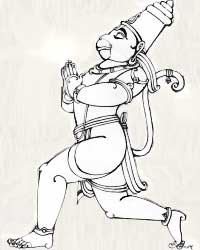 |
vimänät tu susamkramya präkäram hari yüthapaù |
hanümän vegavän äséd yathä vidyud ghana antare || 5-13-1
1. hanuman= Hanuma; hariyuudhapaH= the leader of vanaras; susamkramya= crossed; vimaanaat= from pushpaka; praakaaram= toward the fort wall; aasiit= and became; vegavaan= with speed; vidhyut yathaa= like a lighting; ghanantare= in the middle of cloud.
Hanuma the leader of Vanaras crossed from pushpaka toward the fort wall and became with speed like lighting in the middle of a cloud.
samparikramya hanumän rävaëasya niveçanän |
adåñövä jänakém sétäm abravéd vacanam kapiù || 5-13-2
2. kapiH hanuman= the simian Hanuma; samparikramya= went far; raavaNasya niveshanaat= from the house of Ravana; adR^ishhTvaa= not seeing; siitaam= Seetha; jaanakiim= the daughter of king Janaka; abraviit= said; vachanam= (these)words.
The simian Hanuma went far from the house of Ravana and not seeing Seetha, the daughter of King Janaka, said these words:
bhüyiñöham loòitä lankä rämasya caratä priyam |
na hi paçyämi vaidehém sétäm sarva anga çobhanäm || 5-13-3
3. laN^kaa= the city of Lanka; bhuuyishhTham lolitaa= had been mostly explored; charataa= (by me)attempting; raamasya priyam= the pleasure of Sri Rama; na hi pashyaami= but I am unable to see; siitaam= Seetha; sarvaaN^ga shobhanaam= beautiful in all limbs; vaidehiim= and the daughter of Videha.
“The city of Lanka has been mostly explored by me attempting for the pleasure of Rama. But I am unable to see Seetha, beautiful in all limbs, and the daughter of Videha.”
palvaläni taöäkäni sarämsi saritaù tathä |
nadyo anüpavana antäù ca durgäù ca dharaëé dharäù || 5-13-4
loòitä vasudhä sarvä na ca paçyämi jänakém |
4. sarvaaH vasudaa= all earth; palvaalaani= (consisting of) pools; taTaakaani= ponds; saraamsi= lakes; tathaa= and; saritaH= streams; nadyaH= rivers; anupavanaantashcha= and forest areas; filled with water; dharaNiidharaaH= mountains; durgaaH= difficult of access; Lolitaa= have been explored; na tu pashyaami= but I did not see; jaanakiim= Seetha.
“All earth consisting of pools, ponds, lakes and streams, rivers and forest areas filled with water, mountains difficult of access have been explored but I did not see Seetha.”
iha sampätinä sétä rävaëasya niveçane || 5-13-5
äkhyätä gådhra räjena na ca paçyämi täm aham |
5. akhyaataa= it has been said; gR^idhraraajena sampaatinaa= by the eagle king Sampaati; siitaa= Seetha; iha= (to be) here; raavaNasya niveshane= in the house of Ravana; aham= I; na cha pashyaami= I am unable to see; taam= her.
“It has been said by the eagle King Sampati that Seetha is here in the house of Ravana. I am unable to see her.”
kim nu sétä atha vaidehé maithilé janaka ätmajä || 5-13-6
upatiñöheta vivaçä rävaëam duñöa cäriëam |
6. atha= otherwise; siitaa= Seetha; vaidehii= belonging to Videha; maithilii= born in Mithila; janakaatmaja= and daughter of king Janaka; kim nu upatishhTheta= can she be; vivashaa= helplessly; dushhTachaariNam raavaNam= (together with) the evil minded Ravana.
“Otherwise Seetha belonging to Videha born in Mithila and daughter of king Janaka - Can she be helplessly together with the evil minded Ravana.”
kñipram utpatato manye sétäm ädäya rakñasaù || 5-13-7
bibhyato räma bäëänäm antarä patitä bhavet |
7. manye= I think; rakshasaH= while Ravana; bibhyataH= fearing; raamabaaNaanaam= Rama’s arrows; kshipramutpatataH= flew quickly; siitaam aadaaya= carrying Seetha; patitaa bhavet= (She) might have fallen down; antaraa= in the middle(of the journey).
“I think while Ravana fearing Rama’s arrows flew quickly carrying Seetha, she might have fallen down in the middle of the journey.”
athavä hriyamäëäyäù pathi siddha niñevite || 5-13-8
manye patitam äryäyä hådayam prekñya sägaram |
8. athavaa= or; manye= I think; hR^idayam= the heart; aayraayaaH= of the noble Seetha; hR^iyamaaryaayaaH= being stolen; patii= in the path; sidhhanishhevite= served by Siddhaas; patitam= must have sunk; saagaram prekshya= at the site of the ocean.
“Or I think the heart of the noble Seetha being stolen in the path served by Siddhas must have sunk at the site of the ocean.”
rävaëasya üru vegena bhujäbhyäm péòitena ca || 5-13-9
tayä manye viçäla akñyä tyaktam jévitam äryayä |
9. manye= I think; raavanasya uruvegeNa= due to great speed of Ravana; bhujaabhyaam piiDitenacha= and due to the torture of Ravana’s shoulders; jiivitam chaktam= the life has been given up; tayaa aaryayaa= by that noble one; vishaalaakshyaa= with wide eyes.
“I think due to great speed of Ravana and due to the torture of Ravana’s shoulders the life has been given up by that noble one with wide eyes.”
upari upari vä nünam sägaram kramataù tadä || 5-13-10
viveñöamänä patitä samudre janaka ätmajä |
10. tadaa= then; kramataH= while being flown; saagaram upari upari= upon the surface of the ocean; janakaatmaja= Seetha; nunam= definitely; patitaa= fell down; saagare= in the ocean; viveshhThamaana= while wriggling.
“Then while being flown upon the surface of the ocean, Seetha definitely fell down in the ocean while wriggling.”
äho kñudreëa ca anena rakñanté çélam ätmanaù || 5-13-11
abandhur bhakñitä sétä rävaëena tapasviné |
11. aho= or; tapasvinii siitaa bhakishtaa= has the austere Seetha been eaten; anena raavaNena= by this Ravana; kshudreNa= the evil minded one; atmanaH shiilam rakshantii= while she was protecting her chastity; abandhuH= without any relatives(near her).
“Or has the austere Seetha been eaten by this Ravana, the evil minded one while she was protecting her chastity without any relatives near her.”
athavä räkñasa indrasya patnébhir asita ékñaëä || 5-13-12
aduñöä duñöa bhäväbhir bhakñitä sä bhaviñyati |
12. athavaa= otherwise; adushhTaa= not being evil; asitekshaNaa= with black eyes saa= she; bhakshitaa bhavishhyati= may have been eaten; raakshasendrasya patniibhi= by the wives of Ravana; dushhTabhaavaabhi= with evil thoughts.
“Otherwise not being evil with black eyes, She may have been eaten by the wives of Ravana with evil thoughts.”
sampürëa candra pratimam padma patra nibha ékñaëam || 5-13-13
rämasya dhyäyaté vaktram pancatvam kåpaëä gatä |
13. kR^ipaNaa= the pitiable Seetha; sampuurNachandra pratimam= equaling full moon; padmapatra nibhyekshaNam= with eyes equaling lotus petals; paJNchantvam gataa= must have obtained death; dhyaayatii= while meditating; raamasya vaktram= upon Rama’s face.
“The pitiable Seetha equaling full moon, with eyes equaling lotus petals must have obtained death while meditating upon Rama’s face.”
hä räma lakñmaëa iti eva hä ayodhyeti ca maithilé || 5-13-14
vilapya bahu vaidehé nyasta dehä bhaviñyati |
14. vaidehii= the daughter of Videha; maithilii= Seetha; ha raamaa= O Rama; ha lakshmaNa= O Lakshmana; ha ayodhye= O Ayodhya; iti= thus; bahuvilapya= weeping greatly; nyasta dehaa bhavishhyati= may have given up her body.
“The daughter of Videha, Seetha. ‘O Rama!’ ‘O Lakshmana!’ ‘O Ayodhya!’, thus weeping greatly may have given up her body.”
athavä nihitä manye rävaëasya niveçane || 5-13-15
nünam lälapyate mandam panjarasthä iva çärikä |
15. manye= I think; athavaa= otherwise; nihitaa= being put; raavaNasya niveshane= in the house of Ravana; siitaa= Seetha; nunam laalpyate= is definitely crying; paJNjarastaa shaarikaa iva= like a caged myna.
“I think otherwise being put in the house of Ravana Seetha is definitely crying like a caged myna.”
janakasya kule jätä räma patné sumadhyamä || 5-13-16
katham utpala patra akñé rävaëasya vaçam vrajet |
16. katham= how(can); janakasya sutaa= the daughter of King Janaka; ramapatniim= Rama’s wife; siita= Seetha; su madhyamaa= with a beautiful waist; utpala patraakshi= with eyes like black lotus petals; vrajet= obtain; raavanasya vasam= Ravana’s capture.
“How can the daughter of King Janaka, Rama’s wife Seetha with a beautiful waist, with eyes like black lotus petals obtain Ravana’s capture.”
vinañöä vä pranañöä vä måtä vä janaka ätmajä || 5-13-17
rämasya priya bhäryasya na nivedayitum kñamam |
17. na kshamam= it is not fair; nivedayutum= to let know; raamasya priyabhaaryasya= to Rama who has a dear wife; janakaatmaja= (if) Seetha; vinashhTaa vaa= is lost; praNashhTavaa= or is not to be seen; mR^itaavaa= or has died.
“It is not fair to let know Rama who has a dear wife if Seetha is lost or is not to be seen or has died.”
nivedyamäne doñaù syäd doñaù syäd anivedane || 5-13-18
katham nu khalu kartavyam viñamam pratibhäti me |
18. nivedyamaane= to be let known; syaat doshhaH= becomes an error; anivedane= not to let know; syaat= becomes; doshhaH= an error; khatham= how; kartavyam nu khalu= to perform the duty; me= to me; pratibhaati= (this) seems; vishhamam= dire (situation).
“To be let known becomes an error; not to let know becomes an error how to perform the duty? To me this seems dire situation.”
asminn evam gate karye präpta kälam kñamam ca kim || 5-13-19
bhaved iti matim bhüyo hanumän pravicärayan |
19. asmin kaarye= this task; evam gate= while it goes this way; praaptakaalam= the time is approaching; kim bhavet= what becomes; kshamam= appropriate; iti= thus; hanuman= Hanuma; bhuuyaH pravichaarayat= thought again; matam= (this) view point.
“This task while it goes this way the time is approaching. What becomes appropriate” thus Hanuma thought again this view point.
yadi sétäm adåñövä aham vänara indra purém itaù || 5-13-20
gamiñyämi tataù ko me puruña artho bhaviñyati |
20. yadi aham gamishhyaami= if I go; vaanarendra puriim= towards Sugreeva’s city; ita ha= from here; adR^ishhTvaa= without seeing; siitaam= Seetha; tataH= from that; kaH= (to) what; purushhaarthaH bhavishhyati= avail will this effort be.
“If I go towards Sugreeva’s city from here without seeing Seetha from that to what avail will this effort be?”
mama idam langhanam vyartham sägarasya bhaviñyati || 5-13-21
praveçaù civa lankäyä räkñasänäm ca darçanam |
21. idam= this; mama= my; saagarasya laN^ghanam= crossing of the ocean; laN^kaayaaH praveshascha= entering the city of Lanka; raakshasaanaam darshanam= the site of Rakshasas; vyartham bhavishhyati= (all this) will become waste.
"My crossing of the ocean entering the city of Lanka the site of rakshasas - all this will become waste."
kim vä vakñyati sugrévo harayo va samägatäù || 5-13-22
kiñkindhäm samanupräptau tau vä daçaratha ätmajau |
22. maam= to me; samanupraaptam= reaching; kishkindhaam= Kishkindha; kim vaksyati sugriivaH= what would Sugreeva say; samaagataaH harayaH vaa= or vanaras there; tau dasharaathmajau vaa= or those sons of Dasharatha (what would they say).
“To me reaching Kishkindha what would Sugreeva say or Vanaras there or those sons of Dasharatha what would they say?”
gatvä tu yadi käkutstham vakñyämi param apriyam || 5-13-23
na dåñöä iti mayä sétä tataù tyakñyanti jévitam |
23. gatvaa= going(there); mayaa= by me; kaakustham= for Rama; siitaa na dR^ishhTeti= Seetha has not been seen; iti= thus; vakshaami yadi= if I say; param apriyam= a very unpleasant (word); tataH= thereafter; jiivitam tyakshati= (Rama) will give up life.
“Going there by me for Rama, ‘Seetha has not been seen’ - thus if I say a very unpleasant word thereafter Rama will give up life.”
paruñam däruëam krüram tékñëam indriya täpanam || 5-13-24
sétä nimittam durväkyam çrutvä sa na bhaviñyati |
24. shrutvaa= hearing; durvaakhyam= bad words; siitaa nimittam= belonging to Seetha; parushham= (that is) harsh; daaruNam= horrible; kruram= cruel; tiikshaNam= sharp; indriyataapanam= sense agonizing; saH na bhavishhyati= He will not exist.
“Hearing bad word belonging to Seetha that is harsh, horrible, cruel, sharp, sense agonizing, He will not exist.”
tam tu kåccra gatam dåñövä pancatva gata mänasam || 5-13-25
bhåça anurakto medhävé na bhaviñyati lakñmaëaù |
25. dR^ishhTvaa= seeing; tam= that Rama; kR^ichchhra gatam= being with troubles; paJNchatva gatamaanasam= being with a heart towards death; lakshmaNaH= Lakshmana; bhR^ishaanuraktaH= one with great love; medhaavi= and an intellectual; na bhavishhyati= will not exist.
“Seeing that Rama being with troubles, being with a heart towards death, Lakshmana, one with great love and an intellectual will not exist.”
vinañöau bhrätarau çrutvä bharato api mariñyati || 5-13-26
bharatam ca måtam dåñövä çatrughno na bhaviñyati |
26. shR^itvaa= hearing; braatarau= brothers; vinashhTau= to be dead; bharataH api= Bharata also; marishhyati= will die; dR^ishhTvaa= seeing; mR^itam= the dead; bharatam= Bharata; shatrughnashcha= Shatrughana also; na bhavishhyati= will not exist.
“Hearing brothers to be dead, Bharata also will die. Seeing the dead Bharata, Shatrughana also will not exist.”
puträn måtän samékñya atha na bhaviñyanti mätaraù || 5-13-27
kausalyä ca sumiträ ca kaikeyé ca na samçayaù |
27. atha= thereafter; sa miikshya= seeing; putraan= sons; mR^itaan= to be dead; maataraH= the mothers; kausalyaa cha= Kausalya sumitraa; cha= and Sumitra; kaikeyii cha= and Kaikeyi; na bhavishhyanti= will not exist; samsayaH na= there is no doubt.
“Thereafter seeing sons to be dead the mothers Kausalya, Sumitra and Kaikeyi will not exist - there is no doubt.”
kåtajïaù satya samdhaù ca sugrévaù plavaga adhipaù || 5-13-28
rämam tathä gatam dåñövä tataù tyakñyanti jévitam |
28. kR^itajJNaH= grateful; satyasandhashcha= true to pledge; sugriivaH= Sugreeva; plavagaadhi paH= the leader of Vanaras; dR^ishhTvaa= seeing; raamam= Rama; tathaa gatam= die in that way; jiivitam tyakshyati= will give up life; tataH= thereafter.
“Grateful, true to pledge Sugreeva, the leader of Vanaras, seeing Rama the leader of Vanaras seeing Rama die in that way will give up life thereafter.”
durmanä vyathitä dénä niränandä tapasviné || 5-13-29
péòitä bhartå çokena rumä tyakñyati jévitam |
29. piiDitaa= being tortured; bhartrushokena= by the sorrow of husband; vyathitaa= made sad; durmanaaH= by a gloomy heart; diinaa= disconsolate; niraanandaa= without happiness; tapasvinii= to be pitied; rumaa= Ruma; tyakshati= will give up; jiivitam= life.
“Being tortured by the sorrow of husband, made sad by a gloomy heart, disconsolate without happiness, to be pitied, Ruma will give up life.”
välijena tu duhkhena péòitä çoka karçitä || 5-13-30
pancatva gamane räjïaù tärä api na bhaviñyati |
30. piiDitaa= being distressed; vaalijenadukhena= from the sorrow of Vali; shokakarshitaa= being emaciated from grief; taaraapi= Tara also; na bhavishhyati= will not exist; raajJNi= (while) the king Sugreeva; paJNchatvam gate= is obtaining death.
“Being distressed from the sorrow of Vali, being emaciated from grief, Tara also will not exist while the king Sugreeva is obtaining death.”
mätä pitror vinäçena sugréva vyasanena ca || 5-13-31
kumäro api angadaù kasmäd dhärayiñyati jévitam |
31. kumaaraH= the young; angada api= Angada also; vinaashenaa= from the death; maataa pitro= of mother and father; vyasanena= from the grief; suriivasya= of Sugreeva; kasmaat= why will (he); dhaarayishhyati jiivitam= retain life.
“The young Angada also from the death of mother and father, from the grief of Sugreeva - why will he retain life?”
bhartåjena tu çokena abhibhütä vana okasaù || 5-13-32
çirämsi abhihaniñyanti talair muñöibhir eva ca |
32. vanaukasaH= Vanaras; hyabhibhuutaaH= being rejected; bhatrujena duHkhena= by the sorrow due to their lord; abhihanishhyanti= will strike; shiraamsi= their heads; talaiH= with palms; mushhTibhirevacha= and fists.
“Vanaras being rejected by the sorrow due to their lord will strike their heads with palms and fists.”
säntvena anupradänena mänena ca yaçasvinä || 5-13-33
lälitäù kapi räjena präëämù tyakñyanti vänaräù |
33. vaanaaraaH= Vanaras; laalitaaH= loved; yashasvinaa kapiraajeH= by the famous Sugreeva; saantvenaa= through good words; anupradaanena= through small gifts; maanena= through respect; chakshyanti= will give up praNaan= lives.
“Vanaras loved by the famous king Sugreeva through good words, through small gifts, through respect will give up lives.”
na vaneñu na çaileñu na nirodheñu vä punaù || 5-13-34
kréòäm anubhaviñyanti sametya kapi kunjaräù |
34. kapikuJNjaraaH= best among Vanaras; na anubhavishhyanti= will not enjoy; sametya= together; kriiDaam= sport; vaneshhu= in forest; na shaileshhu= not on mountains; nirodheshhu vaa punaH= not again in covered places.
“Best among Vanaras will not enjoy together sport in forest, not on mountains, not again in covered places.”
saputra däräù sämätyä bhartå vyasana péòitäù || 5-13-35
çaila agrebhyaù patiñyanti sametya viñameñu ca |
35. sa putra dhaaraaH= together with wife and children; saamaatyaaH= and together with ministers; bhartuvyasana piiDitaaH= being tortured by grief of their lord; patishhyanti= they will fall down; shailaagrebhyaH= from top of mountains; sameshhu= on to flat lands; vishhameshhu cha= and on to rugged lands.
“Together with wife and children and together with ministers being tortured by grief of their lord, they will fall down from top of mountains on to flat lands and on to rugged lands.”
viñam udbandhanam vä api praveçam jvalanasya vä || 5-13-36
upaväsam atho çastram pracariñyanti vänaräù |
36. vaanaraaH= Vanaras; pracharishhyanti= will perform(death); vishham= (taking) poison; utbandhanam vaapi= or get hanged; jvalanasya pravesham vaa= or entering fire; upavaasam= or fasting; atho= or; shastram= a weapon.
“Vanaras will perform death by taking poison or getting hanged or entering fire or fasting or a weapon.”
ghoram ärodanam manye gate mayi bhaviñyati || 5-13-37
ikñväku kula näçaù ca näçaù caiva vana okasäm |
37 mayi gate= while I am going; manye= I think; ikshvaaku kula naashashcha= (about) the destruction of Ikshvaaku dynasty; naashashcaiva= and destruction; vanaukasaam= of Vanaras; bhavishhyati= and there will be; ghoram aarodhanam= a terrible wail.
“While I am going I think about the destruction of Ikshvaaku dynasty and destruction of Vanaras and there will be a terrible wail.”
so aham na eva gamiñyämi kiñkindhäm nagarém itaù || 5-13-38
na hi çakñyämi aham drañöum sugrévam maithilém vinä |
38. aham= I; naiva gamishhyaami= will not go; itaH= from here; kishkindhaam nagariim= to the kishkindha city; aham= I; na cha shakshyaamyaham= (am)not capable; drashhTum= to see; sugriivam= Sugreeva; maithiliim vinaa= without Seetha.
“I will not go from here to the Kishkindha city. I am not capable to see Sugreeva without Seetha.”
mayi agaccati ca ihasthe dharma ätmänau mahä rathau || 5-13-39
äçayä tau dhariñyete vanaräù ca manasvinaù |
39. mayii= I; agachchhati= while not going; ihasthe= being here; dharmaatmaanau= those virtuous ones; mahaa rathau= those great warriors; tau= those two Rama and Lakshmana; dharishhyate= will live; aashayaa= by hope; vaanaraashcha= Vanaras also; manasvinaH= who are agile.
“I while not going, being here those virtuous ones, those great warriors those two Rama and Lakshmana will live by hope. Vanaras also who are agile will live.”
hasta ädäno mukha ädäno niyato våkña mülikaù || 5-13-40
vänaprastho bhaviñyämi adåñövä janaka ätmajäm |
sägara anüpaje deçe bahu müla phala udake || 5-13-41
40, 41. adR^ishhtvaa= without seeing; janakaatmajaa= Seetha; hastaa danaH= (subsisting on) whatever falls on hand; mukhaadaanaH= whatever comes to mouth; niyataH= being self restrained; bhavishhyaami= will become; vaana prastaH= a hermit; vR^ikshamuulikaH= living on trees and herbs; saagaraanupaje dese= at a region near ocean; bahumuulaphalodake= which has many roots, fruits and much water.
“Without seeing Seetha subsisting on whatever falls on hand, whatever comes to mouth, being self restrained I will become a hermit living on trees and herbs at a region near ocean which has many roots, fruits and much water.”
citäm kåtvä pravekñyämi samiddham araëé sutam |
upaviñöasya vä samyag linginam sädhayiñyataù || 5-13-42
çaréram bhakñayiñyanti väyasäù çväpadäni ca |
42. pravekshyaami= or I will enter; araNiisutam= fire; samidham= which is glowing; chitaam kR^itvaa= after making a funeral pile; vaa= or; upavishhTasya= while sitting; saadhayishhyataH= performing; liN^gnam= fasting onto death; sariram bhakshayishhyanti= my body will be eaten; vaayasaaH= by crows; shvapadaani cha= and by beasts of prey.
“Or I will enter fire which is glowing after making a funeral pile or while sitting performing fasting onto death my body will be eaten by crows and by beasts of prey.”
idam api åñibhir dåñöam niryäëam iti me matiù || 5-13-43
samyag äpaù pravekñyämi na cet paçyämi jänakém |
43. idam= this; niryaaNam= way to giving up body; dR^ishhTam= has been seen; maharshhibhi= by sages; iti= this; me matiH= is my; opinion; jaanakiim na chetpashyaami= if I do not see Seetha; pravekshyaami= I will enter; samyak aapaH= lot of water.
“This way to giving up body has been seen by sages. This is my opinion if I do not see Seetha, I will enter lot of water.”
sujäta mülä subhagä kérti mälä yaçasviné || 5-13-44
prabhagnä cira rätré iyam mama sétäm apaçyataù |
44. siitaam apashyataH= not seeing Seetha; mama kiirtimaalaa= my garland of glory; chiraraatraaya= of long time; sujaatamuula= with a strong foundation; subhagaa= beautiful one; yashasvinii= together with fame; prabhagnaa= has been destroyed.
“Not seeing Seetha, my garland of glory of long time with a strong foundation, beautiful one together with fame has been destroyed.”
täpaso vä bhaviñyämi niyato våkña mülikaù || 5-13-45
na itaù pratigamiñyämi täm adåñövä asita ékñaëäm |
45. bhavishhyaami= I will become; taapasovaa= as a hermit; niyataH= who is self restrained; vR^ikshamuulikaH= resorting to trees and herbs; na pratigamishhyaami= I will not go; itaH= from here; adR^ishhTvaa= not seeing; taam= Seetha; asitekshanaam= with black eyes.
“I will become a hermit who is self restrained resorting to trees and herbs, I will not go from here not seeing Seetha with black eyes.”
yadi itaù pratigaccämi sétäm anadhigamya täm || 5-13-46
angadaù sahitaiù sarvair vänarair na bhaviñyati |
46. yadi pratigachchhaami= if I go back; itaH= from here; anadhigamyaa= without knowing; taam siitaam= that Seetha; na bhavishhyati= there will not be; angadhaH= Angada; sarvaiH tai vaanaraiH saH= together with all those Vanaras.
“If I go back from here without knowing that Seetha, there will not be Angada together with all those Vanaras.”
vinäçe bahavo doñä jévan präpnoti bhadrakam || 5-13-47
tasmät präëän dhariñyämi dhruvo jévati samgamaù |
47. bahavaH doshhaaH= there are lot of blemishes; vinaashe= in dieing; jiivan= one who is alive; pashyati= sees; bhadraaNi= auspicious things; tasmaat= for that reason; dharishhyaami= I will keep; praaNaan= my life; druvaH= it is definite; jiivitasamgaaH= for the meeting of people who are alive.
“There are lots of blemishes in dying; one who is alive sees auspicious things. For that reason I will keep my life. It is definite for the meeting of people who are alive.”
evam bahu vidham duhkham manasä dhärayan muhuù || 5-13-48
na adhyagaccat tadä päram çokasya kapi kunjaraù |
48. kapikuJNjaraH= Hanuma; dhaarayan= carrying; manasaa= in mind; bahuvidham duHkham= sorrow of various kinds; muhuH= again and again; naadhyagachchhat= did not get; tadaa= then; shokhasya paaram= the crossing of sorrow.
Hanuma carrying in mind sorrow of various kinds again and again did not get then the crossing of sorrow.
rävaëam vä vadhiñyämi daçagrévam mahä balam || 5-13-49
kämam astu håtä sétä pratyäcérëam bhaviñyati |
49. vaa= otherwise; vadhishhyaami= I will kill; raavaNam= Ravana; dashagriivam= with ten heads; mahaabalam= with great prowess; hR^itaa= the stolen; siitaa= Seetha; kaamam astu= whatever happened to her; pratyaachiirNam bhavishhyati= this will be a revenge to that.
“Otherwise I will kill Ravana with ten heads, with great prowess. Whatever happened to the stolen Seetha, this will be revenge to that.”
athavä enam samutkñipya upari upari sägaram || 5-13-50
rämäya upahariñyämi paçum paçu pater iva |
50. athavaa= otherwise; samutkshipyaa= carrying; evam= this Ravana; saagaram uparyupari= over the surface of ocean; upaharishhyaami= I will take him; raamaaya= to Rama; pashum iva= like an animal; pashupate= to the lord of animals.
“Otherwise carrying this Ravana over the surface of ocean I will take him to Rama like an animal to the lord of animals.”
iti cintä samäpannaù sétäm anadhigamya täm || 5-13-51
dhyäna çokä paréta ätmä cintayäm äsa vänaraù |
51. vaanaraH= Hanuma; anadhigamya= not seeing; taam siitaam= that Seetha; iti= thus; samaapannaH= begetting; chintaam= sorrow; chintayaamaasa= thought; dhyaanashokapariitaatma= with a mind cluttered with thoughts and sorrow.
Hanuma not seeing that Seetha thus begetting sorrow, thought with a mind cluttered with thoughts and sorrow.
yävat sétäm na paçyämi räma patném yaçasviném || 5-13-52
tävad etäm purém lankäm vicinomi punaù punaù |
52. yaavat= to wherever; pashyaami= I see; siitaam= Seetha; raamapatniim= the wife of Sri Rama; yashasviniim= and one with fame; tavat= till there; vichinomi= I will search; etaam laN^kaam puriim= the city of Lanka; punaH punaH= again and again.
“To wherever I see Seetha, the wife of Sri Rama and one with fame, till there I will search the city of Lanka again and again.”
sampäti vacanäc ca api rämam yadi änayämi aham || 5-13-53
apaçyan räghavo bhäryäm nirdahet sarva vänarän |
53. sampaati vachanaat= based on words of Sampati; aham aanayaami yadi= if I bring; raamam= Sri Rama(then); raghavaH= Sri Rama; apasyan= not seeing; bhaaryaam= wife; nirdahet= will burn; sarva vaanaraan= all Vanaras.
“Based on words of Sampati if I bring Sri Rama then Sri Rama not seeing wife will burn all Vanaras.”
iha eva niyata ähäro vatsyämi niyata indriyaù || 5-13-54
na mat kåte vinaçyeyuù sarve te nara vänaräù |
54. niyataahaaraH= with limited food; yatendriyaH= and with restrained senses; vatsyaami= and I live; ihaiva= here itself; matkR^ite= by my deed; te naravaanaraaH= those men and vanaras; na vinasheyuH= let they not be destroyed.
“With limited food and with restrained senses, I live here itself. By my deed those men and vanaras - let they not be destroyed.”
açoka vanikä ca api mahaté iyam mahä drumä || 5-13-55
imäm abhigamiñyämi na hi iyam vicitä mayä |
55. yaa= whatever; iyam= this; ashokavanikaa= Ashoka garden; mahaadR^imaa= with great trees; dR^ishyate= is being seen; imam= this; adhigamishhyaami= I will obtain; iyam= this; na vichitaaH= has not been searched; mayaa= by me.
“Whatever this Ashoka garden with great trees is being seen this I will obtain. This has not been searched by me.”
vasün rudrämù tathä ädityän açvinau maruto api ca || 5-13-56
namaù kåtvä gamiñyämi rakñasäm çoka vardhanaù |
56. namaskR^itvaa= saluting; vasuun= the eight Vasus; rudraan= Rudras; tathaa= and; aadityaan= Adityas; aswinau= the two Aswinis; maruto api cha= seven maruts; gamishhyaami= I will go; shokavardhanaH= to increase the grief; rakshasaam= of Rakshasas.
“Saluting the eight Vasus, Rudras and Adityas, the two Aswinis, seven Maruts, I will go to increase the grief of Rakshasas.”
jitvä tu räkñasän devém ikñväku kula nandiném || 5-13-57
sampradäsyämi rämäyä yathä siddhim tapasvine |
57. jitvaatu= defeating; sarvaan rakshasaan= all Rakshasas; sampradaasyaami= I will give; ikshvaaku kulanandinii= Seetha who gives happiness to Ikshvaaku dynasty; raamaya= to Sri Rama; sidhhim yathaa= as the fruit of austerity; tapasvine= to an ascetic.
“Defeating all rakshasas, I will give Seetha, who gives happiness to Ikshvaaku dynasty to Sri Rama as the fruit of austerity to an ascetic.”
sa muhürtam iva dhyätvä cintä vigrathita indriyaù || 5-13-58
udatiñöhan mahä bähur hanümän märuta ätmajaù |
58. mahaa tejaaH= the great gloried; maarutaatmajaH= son of Vayu; saH hanuman= that Hanuma; vudatishhTat= got up; chintaaH grathitedriyaH= with his senses tied by grief; dhyaatvaa= meditating; muhurtam iva= for a moment.
The gloried son of Vayu that Hanuma got up with his senses tied by grief.
namo astu rämäya salakñmaëäya |
devyai ca tasyai janaka ätmajäyai |
namo astu rudra indra yama anilebhyo |
namo astu candra arka marud gaëebhyaù || 5-13-59
59. namaH astu= salutation; raamaaya= to Rama; sa lakShmaNaaya= together with Lakshmana; (Salutation); tasyaiH janakaatmajaayaicha= to that Seetha; devyai= the divine lady; namaH astu= salutations; rudrendra yamaanilebhyaH= to Rudra the god of destruction, Indra the lord of celestials, Yama the lord of Death and the wind-god; namaH astu= salutations; chandraarkamarudgaNebhyaH= to Chandra the moon-god; Arka the sun-god and all the hosts of Maruts, the storm-gods.
"Salutation to Rama, together with Lakshmana Salutation to that Seetha, the divine lady. Salutations to Rudra the god of destruction, Indra the lord of celestials, Yama the lord of Death and the wind-god. Salutations to Chandra the moon-god, Arka the sun-god and all the hosts of Maruts, the strom gods."
sa tebhyaù tu namaù kåtvä sugréväya ca märutiù |
diçaù sarväù samälokya açoka vanikäm prati || 5-13-60
60. saH marutiH= that Hanuma; namaskR^itvaa= saluting; tebhyaH= to all those; sugriivaaya cha= and also to Sugreeva; samaalokya= observing; sarvaaH dishaH= all directions; gataH= went; ashokavanikaam= towards Ashoka garden.
That Hanuma saluting to all those and also to Sugreeva, observing all directions went towards Ashoka garden.
sa gatvä manasä pürvam açoka vanikäm çubhäm |
uttaram cintayäm äsa vänaro märuta ätmajaù || 5-13-61
61. maarutaatmajaH= the son of Vayu; saH vaanara= that Vanara; gatvaa= went; manasaa= by mind; puurvam= before itself; ashoka vanikaam= toward that Ashoka garden; shubham= the auspicious one; chintayaamaasa= pondered; uttaram= the task to be done later.
The son of Vayu, that Vanara went by mind before itself toward that Ashoka garden. The auspicious one pondered the task to be done later.
dhruvam tu rakño bahulä bhaviñyati vana äkulä |
açoka vanikä cintyä sarva samskära samskåtä || 5-13-62
62. ashokavanikaa= the Ashoka garden; dR^ivam= definitely; bhavishhyati= will be; rakshobahulaa= with many rakshasas; vanaakulaa= filled with trees; sarvasamsaara samskR^itaa= adorned with various cultures; puNyaa= and sacred.
“The Ashoka garden definitely will be with many rakshasas, filled with trees, adorned with various cultures and sacred.”
rakñiëaù ca atra vihitä nünam rakñanti pädapän |
bhagavän api sarva ätmä na atikñobham praväyati || 5-13-63
samkñipto ayam mayä ätmä ca räma arthe rävaëasya ca |
63. tatra= there; muulam= definitely; rakshinashcha= guards; rakshyanti= will be protecting; vihitaaha= assigned; paadapaan= trees; sarvaatma= omni present; bhagavaan api= lord Vayu also; pravaati vai= will be blowing by; naatikshobham= without force; mayaa= by me; iyam atmaa= this body; samkshiptaH= has been made small; raamaadhe= for the sake of Sri Rama; ravaNasya cha= and (to avoid) Ravana.
“There definitely guards will be protecting assigned, trees, omnipresent Lord Vayu also will be blowing by without force, and by me this body has been made small for the sake of Sri Rama and to avoid Ravana.”
siddhim me samvidhäsyanti deväù sarñi gaëäù tv iha || 5-13-64
brahmä svayambhür bhagavän deväù caiva diçantu me |
siddhim agniù ca väyuù ca puru hütaù ca vajradhåt || 5-13-65
varuëaù päça hastaù ca soma ädityai tathaiva ca |
açvinau ca mahätmänau marutaù sarva eva ca || 5-13-66
siddhim sarväëi bhütäni bhütänäm caiva yaù prabhuù |
däsyanti mama ye ca anye adåñöäù pathi gocaräù || 5-13-67
64-67. devaaH= Devas; sarshhigaNaaH= together with ascetics; samvidhaasyanti= will make; siddhim= success; me= to me; iha= here; svayambhuuH= self born; brahmaa= Brahma; bhagvaan= the divine one; devaashchaivaa= and devas; agnishcha= and Agni; vaayushcha= and Vaayu; puruhuutashcha= devendra; vajrabhR^it= wearing the weapon of Vajra; varuNashcha= and Varuna ; paashahastaH= with Pasha in hand; tathaiva cha= and also; somaadityau= the Sun and the moon; aswinau cha= and the aswinis; mahaatmaanau= the great ones; marutaH= maruts; sharvaH eva cha= and Eshwara; dishantu= may give; me siddhim= my success; yaH= whoever; prabhuuH= is the lord; bhuutaanaam= of all living creatures; sarvaaNi bhuutaani= among all living beings; anye= others; ye= who; adR^ishhTaaH= being unseen; ghocharaaH= exist; pathi= in the path; daasyanti= may give; sidhhim= success; mama= to me.
“Devas together with ascetics will make success to me here, self born Brahma the divine one and devas and Agni and Vaayu, Devendra wearing the weapon of Vajra and Varuna with Pasha in hand and also the Sun and the moon and the aswinis. The great ones Maruts and Eshwara may give my success. Whoever is the lord of all living creatures among all living beings others who being unseen exist in the path may give success to me.”
tad unnasam päëòura dantam avraëam |
çuci smitam padma paläça locanam |
drakñye tad äryä vadanam kadä nv aham |
prasanna tärä adhipa tulya darçanam || 5-13-68
68. kadaa= when; aham drakshye nu= will I see; tat aarya vadanam= that noble face; unnasam= with a high nose; paaNDuram dantam= with white teeth; avraNam= without any injuries; shuchismitam= with a bright smile; padmaphalaasha lochanam= with eyes resembling lotus petals; prasanna taaradhipa tulya darshanam= with sight equaling the splendor of clear full moon.
“When will I see that noble face with a high nose, with white teeth without any injuries with a bright smile, with eyes resembling lotus petals with sight equaling the splendor of clear full moon?”
kñudreëa päpena nåçamsa karmaëä |
sudäruëa alämkåta veña dhäriëä|
bala abhibhütä abalä tapasviné |
katham nu me dåñöa pathe adya sä bhavet || 5-13-69
69. kadam= how; saa abalaa= that powerless Seetha; tapasvinii= helpless one; balaabhibhuutaa= forcefully taken away; kshudreNa= (by the) mean ; paapena= vile (Ravana); nR^ishamsa karmaNa= with a cruel action; sudaaruNa alankR^ita veshha dhaariNaa= with a horribly decorated form; bhavet nu= will fall; me dR^ishhTipathe= in the range of my sight; adya= today.
“How that powerless Seetha, a helpless one, forcefully taken away by the mean vile Ravana with a cruel action, with a horribly decorated form will fall in the range of my sight today.”
ityärñe çrémadrämäyaëe ädikävye sundarakäëòe trayodaçaù sargaù
Thus, this is the 13th chapter in Sundara Kanda of Valmiki Ramayana, the First Epic poem of India.
| Top of Page | 1 | 2 | 3 | 4 |
| 5 | 6 | 7 | 8 | 9 |
| 10 | 11 | 12 | 13 | 14 |
| 15 | 16 | 17 | 18 | 19 |
| 20 | 21 | 22 | 23 | 24 |
| 25 | 26 | 27 | 28 | 29 |
| 30 | 31 | 32 | 33 | 34 |
| 35 | 36 | 37 | 38 | 39 |
| 40 | 41 | 42 | 43 | 44 |
| 45 | 46 | 47 | 48 | 49 |
| 50 | 51 | 52 | 53 | 54 |
| 55 | 56 | 57 | 58 | 59 |
| 60 | 61 | 62 | 63 | 64 |
| 65 | 66 | 67 | 68 | 69 |
© January 2003, [Revised July 2009] Kishore Kopalle