
Book V : Sundara Kanda - Book Of Beauty
In this chapter Hanuma gets discouraging thoughts about Seetha. He thinks that Seetha might be dead. He thus gets into depression for a moment. | 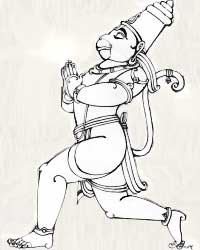 |
s tSy mXye -vnSy vanrae,
lta g!?haM> icÇ g&han! inza g&han!,
jgam sItam! àit dzRn %Tsukae,
n c @v tam! pZyit caé dzRnam!. 5£12£1
1. saH maarutiH= That Hanuma; darshanotsukaH= interested in sight; siitaam prati= toward Seetha; madhye= in the middle of; tasya bhavanasya= that building; jagaama= went; lataagR^ihaan= (towards) houses made of plant creepers; chitragR^ihaan= art houses; nishaagR^ihaan= nocturnal houses; na chaiva pashyati= but did not see; taam= Her; chaarudarshanaam= with a beautiful appearance.
That Hanuma interested in sight of Seetha, in the middle of that building, went towards houses made of plant creepers, art houses, and nocturnal houses but did not see Her with a beautiful appearance.
s icNtyam! Aas ttae mha kip>,
iàyam! ApZyn! r"u nNdnSy tam!,
Øuvm! nu sIta ièyte ywa n me,
ivicNvtae dzRnm! @it mEiwlI. 5£12£2
2. saH mahaakapiH= That great Hanuma; tataH= then later; apashyan= not seeing; taam= that Seetha; priyaam= dear; raghunanadanasya= to Rama; chintayaamaasa= thought thus; me= to me; vichinvataH= searching; maithilii= Seetha; yathaa= in what way; darshanam= appearance; na upayiti= not being obtained(from that); siitaa= Seetha; dhruvam= definitely; mriyate= has died.
That great Hanuma then later not seeing that Seetha dear to Rama thought thus: “to me searching Seetha in whatever way appearance not being obtained, from that Seetha definitely has died.”
sa ra]sanam! àvre[ bala,
Sv zIl sè][ tt! pra stI,
Anen nUnm! àitÊò kmR[a,
hta -vedœ AayR pwe pre iSwta. 5£12£3
3. saa jaanakii= That Seetha; sthitaa= standing; pare aaryapathe= in the best traditional path; vashiilasamrakshaNaa tatparaa satii= being chaste interested in preserving her character; hataabhavet= must have been killed; anena raakshasaanaam pravareNa= by the king of these Rakshasas; pratidushhThakarmaNaa= who performed evil deeds; nuunam= this is certain.
“That Seetha standing in the best traditional path being chaste interested, in preserving her character must have been killed by the king of these Rakshasas who performed evil deeds - this is certain.”
ivêp êpa ivk«ta ivvcRsae,
mha Aanna dI"R ivêp dzRna>,
smIúy sa ra]s raj yaei;tae,
-yadœ ivnòa jnk $ñr AaTmja. 5£12£4
4. saa janakeshwara aatmajaa= that daughter of king Janaka; vinashhTaa= died; bhayaat= of fear; samiikshya= seeing; raakshasa raajayoshhitaH= the wives of Ravana; viruuparuupaaH= with crooked appearances; vikR^itaaH= horrible ones; vivarcha saH= without radiance; mahaananaaH= with great faces; diirgha viruupa darshanaaH= with long and crooked eyes.
“That daughter of King Janaka died of fear seeing the wives of Ravana with crooked appearances - horrible ones without radiance with great faces with long and crooked eyes.”
sItam! Adœ?òœva ih AnvaPy paEé;m!,
ivhœ?Ty kalm! sh vanrE> icrm!,
n me AiSt su¢Iv smIpga git>,
sutIú[ d{fae blvaM> c vanr>. 5£12£5
5. adR^ishhTvaa= without seeing; siitaam= Seetha; anavaapya= not obtaining; paurushham= destiny; vihR^itya= and wandering; chiram kaalam= for a long time; vaanaraiH saH= together with Vanaras; me= to me; gatiH naasthi= there is no path; sugriiva samiipagaa= to go near Sugreeva; vaanaraH= Sugreeva; sutiikshaNadaNDaH= has a sharp punishment; balavaamshcha= and also is strong.
“Without seeing Seetha, not obtaining destiny and wandering for a long time together with Vanaras, to me there is not a path to go near Sugreeva. Sugreeva has a sharp punishment and also is strong.”
†òm! ANt> purm! svRm! †òœva rav[ yaei;t>,
n sIta †Zyte saXvI v&wa jatae mm ïm>. 5£12£6
6. sarvam= all; antaHpuram= inner city; dR^ishhTaam= has been seen; raajayoshhitaH= women of Ravana; dR^ishhTaaH= have been seen; saadhvii= the chaste; siitaa= Seetha; na dR^ishyate= has not been seen; mama shramaH= my effort; jaataH= became; vR^ithaa= wasteful.
“All inner city has been seen. Women of Ravana have been seen. The chaste Seetha has not been seen. My effort became wastefull.”
ikm! nu mam! vanra> sveR gtm! vúyiNt sMgta>,
gTva tÇ Tvya vIr ikm! k«tm! tdœ vdSv n>. 5£12£7
7. maam= to me; gatam= who has gone back; sarve vaanaraaH= all vanaras; samgataaH= after meeting; kim nu= what; vakshyanti= they would say; viiraa= O strong one; gatvaa= going; tatra= there; kim kR^itam= what has been done; tvayaa= by you; tat vadasva= tell that; naH= to us.
“To me who has gone back all Vanaras after meeting what they would say? O strong one! Going there, what has been done by you? Tell that to us.”
A†òœva ikm! àvúyaim tam! Ahm! jnk AaTmjam!,
Øuvm! àaym! %pe:yiNt kalSy VyitvtRne. 5£12£8
8. adR^ishhTvaa= without seeing; tam janakaatmajaam= that Seetha; kim= what; pravakshyaami= can I say; vyativartane= due to passing; kaalasya= of time; dR^ivam= definitely; upaishhyanti= they will obtain; praayam= fire.
“Without seeing that Seetha what can I say? Due to passing of time, definitely they will obtain fire.”
ikm! va vúyit V?Ï> c jaMbvan! ANgd> c s>,
gtm! parm! smuÔSy vanra> c smagta>. 5£12£9
9. gatam= (to me) who had gone; paaram= for the other shore; samudrasya= of the ocean; kim vaa= what will; vR^iddhaH jaambavaan= the old Jambava; vakshyati= say; saH= (what would)that; angadhashcha= Angada and; samaagataaH vaanaraashcha= vanaras who meet(say).
“To me who had gone for the other shore of the ocean what will the old Jambavan say? What would that Angada and vanaras who meet say?”
AinveRd> iïyae mUlm! AinveRd> prm! suom!,
AinveRdae ih sttm! svR AweR;u àvtRk>. 5£12£10
10. airhead= non-depression; mullah= is root; shriyaH= of development; anirvedaH= Absence of despondency; param sukham= is the greatest comfort; anirvedaH= self reliance; satatam = is always; pravartakaH hi= is indeed the promoter; sarvaartheshhu= in all matters.
“Non-depression is root of development. Absence of despondency is the greatest comfort. Self reliance always is indeed the promoter in all matters.”
kraeit s)lm! jNtae> kmR yc! c kraeit s>,
tSmadœ AinveRd K?tm! yÆm! ceòe Ahm! %Ämm!. 5£12£11
A†òaM> c ivce:yaim dezan! rav[ pailtan!,
11. yat= whatever; karma= action; karoti= (human) does; tat= that; jantoH= (action) of man; saphalam saH karoti= is made to be successful by non-depression; tasmaat= for that reason; aham= I; cheshhTe= will perform; uttamam prayatnam= a best effort; anirvedakR^itam= together with non-depression; vicheshhyaam taavat= I will search all those; deshaan= regions; raavanapaalitaan= ruled by Ravana; adR^ishhTaan= not (yet) seen.
“Whatever action a human does that action of man is made to be successful by non-depression. For that reason I will perform a best effort together with non-depression. I will search all those regions ruled by Ravana not yet seen.”
Aapan zala ivicta> twa pu:p g&hai[ c. 5£12£12
icÇ zala> c ivicta -Uy> ³Ifa g&hai[ c,
in:k…q ANtr rWya> c ivmanain c svRz>. 5£12£13
12,13. apaanashaalaaH= bars; vichitaaH= have been searched; tathaa= in the same way; pushhpagR^ihaanicha= flower houses; chitrashaalaashcha= art houses; vichitaaH= have been searched; bhuuyaH= again; kriiDaagR^ihaanicha= pleasure houses; nishhkuTaantararathyaashcha= pathways in the middle of gardens; vimaanaanicha= buildings; sarvashaH= in all directions(have been searched).
“Bars have been searched; in the same way flower houses, art houses have been searched; again pleasure houses, pathways in the middle of gardens, buildings in all directions have been searched.”
#it siMcNTy -Uyae Aip ivcetum! %pc³me,
-UmI g&haM> cETy g&han! g&h Aitg&hkan! Aip. 5£12£14
14. iti= thus; samchintya= thinking; upachakrame= (Hanuma) began; vichetum= to search; bhuuyopi= again; bhuumiigR^ihaan= undergrounds; chaityagR^ihaan= houses at the beginning of street intersections; gR^ihaati gR^ihakaanapi= and also small houses faraway from the main houses.
Thus thinking Hanuma began to search again undergrounds, houses at the beginning of street intersections and also small houses faraway from the main houses.
%Tptn! inptM> c Aip itón! g½n! pun> Kvict!,
Apav&{vM> c Öarai[ kpaqain Av"”yn!. 5£12£15
àivzn! in:ptM> c Aip àptÚ! %TptÚ! Aip,
svRm! Aip Avkazm! s ivccar mha kip>. 5£12£16
15,16. saH mahaakapiH= the great Hanuma; utpatan= flying; punaH punaH= again and again; nishhpatamshchaapi= and jumping down; tishhThan= standing up; ghachchhan= walking; dvaaraaNi apaavR^iNvan= opening doors; kavaaTaani avaghaaTayan= pushing doors; pravishan= and entering(inside); nishhpatamshchaapi= coming out; prapatan= climbing down; utpatan api= climbing up; vichachaara= wandered; sarvam avakaasam= all opportunity.
The great Hanuma flying again and again and jumping down, standing up, walking, opening doors, pushing doors and entering inside, coming out, climbing down, climbing up wandered all opportunity.
cturœ ANgul maÇae Aip n Avkaz> s iv*te,
rav[ ANt> pure tiSmn! ym! kiprœ n jgam s>. 5£12£17
17. saH kapiH= that Hanuma; tasmin ravaNaantaH pure= in that city of Ravana; yam na jagaama= whatever region he did not go; saH= avakaashaH= that region; na vidhyate= was not there; chaturaN^guLa maatro.api= even for four angulas.
That Hanuma in that city of Ravana - whatever region he did not go that region was not there even for four angulas.
àakr ANtr rWya> c veidk> cETy sMïya>,
ñæa> c pu:kir{y> c svRm! ten Avlaeiktm!. 5£12£18
18. prakaarantara radhyaashcha= streets in the middle of fort walls; vedikaaH= platforms; chaitya samshrayaaH= together with the intersection of four streets; diirghikaaH= wells; pushhkariNyashcha= lakes; sarvam= all these; avalokitam= had been seen; tena= by him.
Streets between fort walls, platforms together with the intersection of four streets, wells, lakes all these had been seen by him.
ra]Syae ivivx Aakara ivêpa ivk«ta> twa,
†òa hnUmta tÇ n tu sa jnk AaTmja. 5£12£19
19. raakshasyaH= Rakshasa women; vividhaakaaraaH= of various forms; viruupaaH= with crooked forms; tathaa= and; vikR^utaaH= horrific forms; dR^ishhTaaH= had been seen; tatra= there; hanumataa= by Hanuma; na tu=but not; saa janakaatmajaa= that Seetha.
Rakshasa women of various forms, with crooked forms and horrific forms had been seen there by Hanuma but not that Seetha.
êpe[ Aàitma laeke vra iv*a xr iôy>,
†qa hnUmta tÇ n tu ra"v niNdnI. 5£12£20
20. varaaH= the best; vidhyaadhara striiyaH= Vidhyaadara women; ruupeNa apratimaaH= incomparable by beauty; loke= in the world; dR^ishhTaaH= had been seen; tatra= there; hanumataa= by Hanuma; na tu= but not; raaghavanandinii= Seetha.
The best Vidhyadhara women incomparable by beauty in the world had been seen there by Hanuma, but not Seetha.
nag kNya vr Aaraeha> pU[R cNÔ in- Aanna>,
†òa hnUmta tÇ n tu sIta sumXyma. 5£12£21
21.naagakanyaaH= naaga women; varaaroha= with beautiful buttocks; puurNachandra nibhaananaaH= with faces equaling full moon; dR^ishhTaaH= had been seen; hanumataa= by Hanuma; tatra= there; na tu= but not; siitaa= Seetha; su madhyamaa= with a beautiful waist.
Naaga women with beautiful buttocks, with faces equaling full moon had been seen by Hanuma there, but not Seetha with a beautiful waist.
àmWy ra]s #NÔe[ nag kNya blaΉ ùta>,
†òa hnUmta tÇ n sa jnk niNdnI. 5£12£22
22. naagakanyaaH= naaga women; hR^itaaH= who had been stolen; balata= forcefully; pramathya= being defeated; raakshasendreNa= by Ravana; dR^ishhTaaH= had been seen; tatra= there; hanumataa= by Hanuma; na saa janakanandinii= not that Seetha.
Naaga women who had been stolen forcefully, being defeated by Ravana had been seen there by Hanuma, not that Seetha
sae ApZyM> tam! mha ba÷> pZyM> c ANya vr iôy>,
iv;sad mha ba÷rœ hnUman! maét AaTmj>. 5£12£23
23. saH hanuman= That Hanuma; mahaa baahuH= with great arms; diimaan= the wise one; maarutaatmaja= the son of Vayu; apasyan= not seeing; taam= that Seetha; pasyan= seeing; anyaaH= other; varastriyaH= best women; vishhasaada= became depressed; muhuH= again and again.
That Hanuma with great arms, the wise one, the son of Vayu not seeing that Seetha and seeing other women became depressed again and again.
%*aegm! vanr #NÔa[m! Plvnm! sagrSy c,
VywRm! vIúy Ainl sut> icNtam! punrœ %pagmt!. 5£12£24
24. viikshya= seeing; udyogam= the effort; vaaNarendraaNaam= of the best Vanaras; plavanam cha= and the crossing; saagarasya= of ocean; vyartham= as being wasted; anilasutaH= Hanuma; chintaam upaagamat= got depression; punaH= again.
Seeing the effort of the best Vanaras and the crossing of ocean as being wasted, Hanuma got depression again.
AvtIyR ivmanac! c hnUman! maét AaTmj>,
icNtam! %pjgam Aw zaek %pht cetn>. 5£12£25
25. atha= there after; maarutaatmajaH= the son of Vaayu; hanuman= Hanuma; avatiirya= got down; vimaanaat= from Pushpaka; upaagamat= obtained; chintaam= thought; shokohahatachetanaH= with a mind overcome with grief.
Thereafter the son of Vayu Hanuma got down from Pushpaka, obtained thought with a mind overcome with grief.
#Tya;eR ïImÔamay[e AaidkaVye suNdrka{fe Öadz> sgR
© 2002 Dec, Durga and Kishore Kopalle