
Book V : Sundara Kanda - Book Of Beauty
Realizing that the woman he saw at Ravana's house was not Seetha, Hanuma begins to search again for Seetha. | 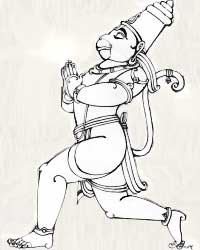 |
avadh¨ya ca t˜m buddhim babh¨va avasthita× tad˜ |
jag˜ma ca apar˜m cint˜m sŸt˜m prati mah˜ kapi× || 5-11-1
1. mahaakapiH= the great Hanuma; tadaa= then; avadhuuya= removing; taam buddhim= that thought; bhabhuuva= became avasthitaH= with the right mind; jagaama= and went; aparaam chintaam= (with)another thought; siitaam prati= about Seetha.
The great Hanuma then removing that thought became with the right mind and had another thought about Seetha.
na r˜meõa viyukt˜ s˜ svaptum arhati bh˜minŸ |
na bhoktum na api alamkartum na p˜nam upasevitum || 5-11-2
na anyam naram upasth˜tum sur˜õ˜m api ca Ÿþvaram |
na hi r˜ma sama× kaþcid vidyate tridaþeÿv api || 5-11-3
any˜ iyam iti niþcitya p˜na bh¨mau cac˜ra sa× |
2,3. saa bhaaminii= that Seetha; na arhate= is not suitable; svaptum= to sleep ; raameNa viyuktaa= separated from Rama; na bhoktum= will not eat; na apyalamkartum api= will not decorate also; na= not suited; upasevitum= to drink; paanam= a beverage; upasthaatum= to reach; anyam naram= another man; suraaNaam eshvaram api= even though he were Indra; hi= because; na vidyate hi= there is indeed no; kashchit= one; raamasamaH= equalling Rama; tridasheshhvapi= even among gods; iyam anyaa= this is another woman; iti= thus; nishchitya= deciding; saH= that Hanuma; chachaara= paced; paanabhuumau= in that banqueting hall.
That Seetha is not suitable to sleep separated from Rama, will not eat, will not decorate also, not suited to drink a beverage, to reach another man even though if he were Indra because there is indeed no one equaling Rama even among gods. This is another woman - thus deciding that Hanuma paced in that banqueting hall.
krŸýitena apar˜× kl˜nt˜ gŸtena ca tath˜ par˜× || 5-11-4
n®ttena ca apar˜× kl˜nt˜× p˜na viprahat˜× tath˜ |
4. aparaaH= some women; klaantaaH= were tired; kriiDitena= from erotic dalliance; tathaa= and then; aparaaH= some other women; giitena= (were tired) from singing; aparaaH= some others; klaantaaH= were weary; nR^ittena= from dance; tathaa= and; paanaviprahataaH= were unconscious from consumption of liquor.
Some women were tired from erotic dalliance and then some other women were tired from singing; some others were weary from dance and were unconscious from consumption of liquor.
murajeÿu mrdangeÿu pŸ÷hik˜su ca samsthit˜× || 5-11-5
tath˜ ˜staraõa mukhyyeÿu samviÿ÷˜× ca apar˜× striya× |
5. samsthitaaH= (some women) were stationed; murajeshhu= on tabors; mR^idaN^geshhu= on mrudangaas; piiThikaasu cha= on seats; aparaaH= some other; striyaH= women; samvishhThaaH= rested; aastaraNamukhyeshhu= on chief carpets.
Some women were stationed on tabors, on Mrudangas, on seats, some other women rested on chief carpets.
aðgan˜n˜m sahasreõa bh¨ÿitena vibh¨ÿaõai× || 5-11-6
r¨pa samll˜pa þŸlena yukta gŸta artha bh˜ÿiõ˜ |
deþa k˜la abhiyuktena yukta v˜kya abhidh˜yin˜ || 5-11-7
rata abhirata samsuptam dadarþa hari y¨thapa× |
6,7. hariyuudhapaH= the warrior among Vanaras; dadarsha= saw; anN^ganaanaam sahasreNa= a thousand of women; bhuushhitena= decorated; vibhuushhaNaiH= by jewellery; ruupasallaapashiilena= with a nature of talking about beauty; yuktagiitaarthabhaashhiNaa= conversing about the correct meaning of songs(being sung) deshakaalaabhiyuktena= behaving according to time and place; yuktavaakyaabhidhaayinaa= wont to speak appropriate words; rathaabhirathasamsuptam= indulged in sleep after sexual dalliance.
The warrior among Vanaras saw a thousand of women decorated by jewellery with a nature of talking about beauty, conversing about the correct meaning of songs being sung, behaving according to time and place, wont to speak appropriate words, indulged in sleep after sexual dalliance.
t˜s˜m madhye mah˜ b˜hu× þuþubhe r˜kÿasa Ÿþvara× || 5-11-8
goÿ÷he mahati mukhy˜n˜m gav˜m madhye yath˜ v®ÿa× |
8. madhye= in the middle; taasaam= of that group of women; rakshasheshvaraH= Ravana; mahaabaahuH= with great arms; shushubhe= shone; vR^ishhabhaiva= like a bull; gavaam madhye= in the middle of cows; mahatighoshhThe= in a big cow-pen.
In the middle of that group of women, Ravana with great arms shone like a bull in the middle of cows in a big cow-pen.
sa r˜kÿasa indra× þuþubhe t˜bhi× pariv®ta× svayam || 5-11-9
kareõubhir yath˜ araõyam parikŸrõo mah˜ dvipa× |
9. saH raakshasendraH svayam= that Ravana himself; parivR^itaH= surrounded; taabhiH= by those women; shushubhe= shone; mahaadvipaH yathaa= like a great elephant; parikiirNaH= surrounded; kareNubhiH= by she elephants; mahaaraNye= in a great forest;
That Ravana himself surrounded by those women, shone like a great elephant surrounded by she elephants in a great forest.
sarva k˜mair upet˜m ca p˜na bh¨mim mah˜tmana× || 5-11-10
dadarþa kapi þ˜rd¨la× tasya rakÿa× pater g®he |
10. harishaardhuulaH= the best among Vanaras; dadarsha= saw; tasya mahaatmanaH rakshaHpateH= in that wealthy Ravana's; gR^ihe= house; paanabhuumim cha= a bar also; upetaam= consisting; sarvakaamaiH= of all desirables.
The best among Vanaras saw in that wealthy Ravana's house a bar also, consisting of all desirables.
m®g˜õ˜m mahiÿ˜õ˜m ca var˜h˜õ˜m ca bh˜gaþa× || 5-11-11
tatra nyast˜ni m˜ms˜ni p˜na bh¨mau dadarþa sa× |
11. saH= Hanuma; dadarsha= saw; tatra= there; paanabhuumau= in that bar; maamsaani= meat; mR^igaaNaam= of dear; mahishhaaNaam cha= and of buffalo; varaahaaNaam cha= of wild boar; nyastaani= kept; bhaagashaH= separately;
Hanuma saw there in that bar, meat of dear and of buffalo, of wild boar kept separately.
raukmeÿu ca viþaleÿu bh˜janeÿv ardha bhakÿit˜n || 5-11-12
dadarþa kapi þ˜rd¨la may¨r˜n kukku÷˜m× tath˜ |
12. harishaarduulaH= the best among Vanaras; dadarsha= saw; ardhabhakshitaan= half eaten; mayuraan= peacocks; tathaa= and; kukuTaan= chicken; vishaaleshhu bhaajaneshhu= in wide vessels; raukmeshhu= of golden colour.
The best among Vanaras saw half eaten peacocks and chicken in wide vessels of golden colour.
var˜ha v˜rdhr˜õasak˜n dadhi sauvarcala ˜yut˜n || 5-11-13
þaly˜n mrga may¨r˜m× ca han¨m˜n anvavaikÿata |
13. hanumaan= Hanuma; anvavaikshata= observed; varaahavaardhraaNashakaan= meat of pigs and goat; shalyaan= porcupines; mR^igamayuuraamshcha= deer and peacocks; dadhisauuvarchalaayutaan= preserved in curds and sochal salt.
Hanuma observed meat of pigs and goats, porcupines, deer and peacocks preserved in curds and sochal salt.
k®kar˜n vividh˜n siddh˜m× cakor˜n ardha bhakÿit˜n || 5-11-14
mahiÿ˜n eka þaly˜m× ca c˜g˜m× ca k®ta niÿ÷hit˜n |
lekhyam ucca avacam peyam bhojy˜ni vividh˜ni ca || 5-11-15
14,15. (Hanuma saw) krakaraan= birds called Krakara; vividhaansiddhaan= cooked ready(to be eaten) in variety of ways; chakoraan= birds called Chakoras; ardhabhakshitaan= half eaten; mahishhaan= wild buffalos; ekashalyaamshcha= fishes called ekashleya; chhaagaamshcha= goats; lehyaan= food to be licked; vuchchaavachaan= of various kinds; peyaan= beverages; vividhaani bhojyaani= (and) various foods.
Hanuma saw birds called Krakara cooked ready to be eaten in variety of ways, birds called Chakoras half eaten, wild buffalos, fishes called ekashleya, goats, food to be licked of various kinds, beverages and various foods.
tath˜ amla lavaõa uttamsair vividhai r˜ga ÿ˜ýavai× |
h˜ra n¨pura key¨rair apaviddhair mah˜ dhanai× || 5-11-16
p˜na bh˜jana vikÿiptai× phalai× ca vividhair api |
k®ta puÿpa upah˜r˜ bh¨r adhikam puÿyati þriyam || 5-11-17
16, 17. tathaa = In the same way; bhuuH = that floor; shriyam pushhyati = was obtaining glory; adhikam = greatly; raagashhaaDabaiH = with Ragas and Shadabas; aamla lavaNottaM saiH = seasoned with sour and salty sauces; haaranuupurakeyuuraiH = with necklaces, anklets and armlets; mahaadhanaiH = of great value; apaviddhaiH = thrown around; vividhaiH phalaishcha = with various fruits; paanabhaajana vikshiptaiH = left in drinking vessels; kR^ita pushhpopa haaraa = with flowers sprinkled.
In the same way that floor was obtaining glory greatly with Ragas and Shadabas seasoned with sour and salty sauces, with necklaces, anklets and armlets of great value thrown around, with various fruits left in drinking vessels, with flowers sprinkled.
tatra tatra ca vinyastai× suþliÿ÷ai× þayana ˜sanai× |
p˜na bh¨mir vin˜ vahnim pradŸpt˜ iva upalakÿyate || 5-11-18
18. paana bhuumiH = That bar; upalakshyate = was seen; pradiipteva = as though radiant; vinaa vahnim = without fire; shayanaasanaiH = with couches and chairs; sushlishhTaiH = well arranged; vinyastaiH = (and) placed; tatra tatra = there and there.
That bar was seen as though radiant without fire, with couches and chairs well arranged and placed there and there.
bahu prak˜rair vividhair vara samsk˜ra samsk®tai× |
m˜msai× kuþala samyuktai× p˜na bh¨mi gatai× p®thak || 5-11-19
19. bahuprakaaraiH maamsaiH = Many meats; vividhaiH = of different kinds; varasamskaara samskR^itaiH = cultured with various best seasonings; kushala saMyuktaiH = well arranged; pR^ithak = separately; paanabhuumigataiH = obtained that bar.
Many meats of different kinds cultured with various best seasonings, well arranged separately obtained that bar.
divy˜× prasann˜ vividh˜× sur˜× k®ta sur˜ api |
þarkara ˜sava m˜dhvŸk˜× puÿpa ˜sava phala ˜sav˜× || 5-11-20
v˜sa c¨rõai× ca vividhair m®ÿ÷˜× tai× tai× p®thak p®thak |
20. divyaaH = excellent; prasannaaH = clear; vividhaaH = various (liquors); suraaH = liquor called Sura; sharkaraa sava = liquor made of sugar; maadhviika = (liquor) made of honey; pushpaa sava = liquor made of flowers; phalaa savaaH = and liquors made of fruits; kR^ita suraaH api = also artificially made liquors; taiH taiH = those and those; mR^ishhTaaH = were cultured; pR^ithak pR^ithak = separate separately; vividhaiH vaasachuurNaiH = with various fragrant powders
Excellent and clear various liquors, a liquor called Sura, liquor made of sugar, liquor made of honey, liquor made of flowers and liquors made of fruits also, artificially made liquors - those and those were cultured separately with various fragrant powders.
samtat˜ þuþubhe bh¨mir m˜lyai× ca bahu samsthitai× || 5-11-21
hiraõmayai× ca karakair bh˜janai× sph˜÷ikair api |
j˜mb¨nadamayaiþc˜ny˜× karakairabhivamv®t˜ || 5-11-22
21,22. bhuumiH = The floor; shushubhe = shone; saMtataa = filled; maalyaishcha = by flower garlands; bahu saMsthitaiH = in a variety of forms; vividhaiH bhaajanaiH = with various vessels; hiraNmayaiH = of golden hue; sphaaTikair api = and also made of crystal; abhisaMvR^itaa = filled; anyaiH karakaiH = with other small vessels; jaambuunadamayaiH = of golden colour.
The floor shone filled by flower garlands in a variety of forms, with various vessels of golden hue and also made of crystal, filled with other small vessels of golden colour.
r˜jateÿu ca kumbheÿu j˜mb¨nadamayeÿu ca |
p˜na þreÿ÷ham tad˜ bh¨ri kapi× tatra dadarþa ha || 5-11-23
23. kapiH = Hanuma; dadarsha ha = saw indeed; tadaa = then; bhuuri paana shreshhTham = lot of best quality liquor; kumbheshhu = in pots; raajateshhu = of silver; jaambuunadamayeshhu = and of golden colour.
Hanuma saw indeed then lot of best quality liquor in pots of silver and of golden colour.
so apaþyat þ˜ta kumbh˜ni þŸdhor maõimay˜ni ca |
r˜jat˜ni ca p¨rõ˜ni bh˜jan˜ni mah˜ kapi× || 5-11-24
24. saH mahaa kapiH = That great Hanuma; apashyat = saw; bhaajanaani = vessels; puurNaani = full; shiidhoH = of liquor; shaatakumbhaani = of golden colour; maNimayaani cha = embedded with gem stones; raajataani cha = and also of silver hue.
That great Hanuma saw vessels full of liquor of golden colour, embedded with gem stones and also of silver hue.
kvacid ardha avaþeÿ˜õi kvacit pŸt˜ni sarvaþa× |
kvacin na eva prapŸt˜ni p˜n˜ni sa dadarþa ha || 5-11-25
25. saH = That Hanuma; dadarsha ha = saw indeed; kvachit = at some places; paanaani = drinks; ardhaava sheshhaaNi = half filled; kvachit = (and) some places; sarvashaH piitaani = completely drunk; kvachit = (and) some places; naiva prapiitaani = not at all drunk.
That Hanuma saw indeed at some places drinks half filled and at some places completely drunk and some places not at all drunk.
kvacid bhakÿy˜m× ca vividh˜n kvacit p˜n˜ni bh˜gaþa× |
kvacid anna avaþeÿ˜õi paþyan vai vicac˜ra ha || 5-11-26
26. vichachaara ha = (Hanuma) paced about; pashyan = seeing; kvachit = (at) some places; vividhaan bhakshaaMshcha = various eatables; kvachit = (and) some places; paanaani = drinks; bhaagashaH = separately; kvachit = some places; annavasheshhaaNi = remnants of cooked rice.
Hanuma paced about seeing at some places various eatables and at some places drinks separately, and at some places remnants of cooked rice.
kvacit prabhinnai× karakai× kvacid ˜loýitair gha÷ai× |
kvacit samp®kta m˜ly˜ni jal˜ni ca phal˜ni ca || 5-11-27
27. kvachit = (Hanuma saw) some places; karakaiH = with vessels; prabhinnaiH = broken; kvachit = some places; ghaTaiH = with pots; aloLitaiH = in shambles; kvachit = some places; jalaani cha = (with) water; saMpR^iktamaalyaani = together with flower garlands; phalaani cha = and fruits.
Hanuma saw some places with vessels broken, some places with pots in shambles, some places with water together with flower garlands and fruits.
þayan˜ni atra n˜rŸõ˜m þ¨ny˜ni bahudh˜ puna× |
parasparam sam˜þliÿya k˜þcit supt˜ vara angan˜× || 5-11-28
28. atra = Here; shayanaani punaH = couches again; naariNaam = of women; bahudhaa shubhraaNi = were varied and clean; kaashchit = some; varaaN^ganaaH = best women; suptaaH = slept; samaashlishhya = hugging; parasparam = one another
Here couches again of women were varied and clean, some best women slept there hugging one another.
k˜cic ca vastram anyasy˜ apahrtya upaguhya ca |
upagamya abal˜ supt˜ nidr˜ bala par˜jit˜ || 5-11-29
29. kaashchit abalaaH = Some women; nidraabalaparaajitaaH = conquered by the power of sleep; aahR^itya = pulled; anyasyaaH svapantyaaH vastram = other sleeping women's clothing; suptaaH = and slept; paridhaaya = covering (themselves).
Some women conquered by the power of sleep pulled other sleeping women's clothing and slept covering themselves.
t˜s˜m uccv˜sa v˜tena vastram m˜lyam ca g˜trajam |
na atyartham spandate citram pr˜pya mandam iva anilam || 5-11-30
30. vastram maalyam cha = Clothing and garland; taasaam gaatrajam = on the throats of those (women); spandate = was moving; na atyartham = slightly; chitram = (and) wonderfully; praapya iva = as though obtaining; anilam = air; uchchhvaasavaatena = from the air of breath.
Clothing and garland on the throats of those women was moving slightly and wonderfully as though obtaining air from the air of breath.
candanasya ca þŸtasya þŸdhor madhu rasasya ca |
vividhasya ca m˜lyasya puÿpasya vividhasya ca || 5-11-31
bahudh˜ m˜ruta× tatra gandham vividham udvahan |
31. tatra = There; maarutaH = wind (blew); udvahan = carrying; bahudhaa = in a lot (of directions); vividham gandham = a variety of fragrances; shiitasya gandhasya = of cool sandal-paste; madhurasasya shiidhoH cha = and of sweet liquor; vividhasya maalyasya = of various flower garlands; vividhasya dhuupasya cha = and of various kinds of agallocum fumes.
There wind blew carrying in a lot of directions, a variety of fragrances of cool sandal-paste and of sweet liquor, of various flower garlands and of various kinds of agallocum fumes.
sn˜n˜n˜m candan˜n˜m ca dh¨p˜n˜m caiva m¨rcita× |
pravavau surabhir gandho vim˜ne puÿpake tad˜ || 5-11-32
32. tadaa = Then; surabhiH gandhaH = the blossoming fragrance; snaanaanaam chandanaanaam cha = from the baths and sandal paste; dhuupaanaam chaiva = and from agallocum fumes; pravavau = blew; muurchitaH = spreading (all around); pushhpake vimaane = in that Pushpaka plane.
Then the blossoming fragrance from the baths and sandal paste and from agallocum fumes blew spreading all around in that Pushpaka plane.
þy˜ma avad˜t˜× tatra any˜× k˜þcit k®ÿõ˜ vara angan˜× || 5-11-33
k˜þcit k˜ncana varõa angya× pramad˜ r˜kÿasa ˜laye |
33. tatra= there; raakshasaalaye= in that Ravana's house; anyaaH= some (women); shyaamaavadaataaH= had fair and white complexion; kaashchit= some; varaaN^ganaaH= best women; kR^ishhnaaH= were black; kaashchit pramadaaH= some women; kaaJNchanavarNaaN^gyaH=had a body of golden complexion.
There in that Ravana's house, some women had fair and white complexion some best women were black, some women had a body of golden complexion.
t˜s˜m nidr˜ vaþatv˜c ca madanena vim¨rcitam || 5-11-34
padminŸn˜m prasupt˜n˜m r¨pam ˜sŸd yathaiva hi |
34. ruupam= appearance; taasaam= of those; prasuptaanaam= sleeping (women); vimuurchitam= tired; nidraavashatvaacha= from being possessed by sleep; madanenacha= and from lust; aasiit= was; yathaiva= like; padminiinaam= lotuses; prasuptaanaam= sleeping.
Appearance of those sleeping women, tired from being possessed by sleep and from lust, was like lotuses sleeping.
evam sarvam aþeÿeõa r˜vaõa anta× puram kapi× || 5-11-35
dadarþa sumah˜ tej˜ na dadarþa ca j˜nakŸm |
35. kapiH= Hanuma; sumahaatejaaH= with great radiance; evam= thus; dadarsha= saw; sarvam= entire; raavaNaatHpuram= Ravana's house; asheshhena= completely; na dadarsha= (but) did not see; jaanakiim cha= Seetha.
Hanuma with great radiance thus saw entire Ravana's house completely but did not see Seetha.
nirŸkÿam˜õa× ca tata× t˜× striya× sa mah˜ kapi× || 5-11-36
jag˜ma mahatŸm cint˜m dharma s˜dhvasa þankita× |
36. tadaa= then; saH mahaakapiH= that Hanuma; niriikshmaaNaH= seeing; taaH striyaH= those women; jagaamaa= obtained; mahatiim chintaam= great anguish; dharmasaadvaHsasheN^kitaH= being in doubt because of fear in the matter of dharma.
Then that Hanuma seeing those women obtained great anguish being in doubt because of fear in the matter of dharma.
para d˜ra avarodhasya prasuptasya nirŸkÿaõam || 5-11-37
idam khalu mama atyartham dharma lopam kariÿyati |
37. mama= my; idam= this; niriikshaNam= seeing; prasuptasya= sleeping; paradaaraavarodhasya= house of other people's wives; karishhyati= will do; atyartham dharmalopam= a great deficit to dharma.
“My seeing sleeping house of other people's wives will do a great deficit to dharma.”
na hi me para d˜r˜õ˜m d®ÿ÷ir viÿaya vartinŸ ||5-11-38
ayam ca atra may˜ d®ÿ÷a× para d˜ra parigraha× |
38. me= my; dR^ishhTaH= sight; na hi= is indeed not; paradaaraaNaam vishhayavartinii= in the matter of others wives; atra= here; ayam= these paradaaraparigrahaH= other's wives; dR^ishhTashcha= have been seen ; mayaa= by me;
“My sight is indeed not in the matter of other wives here. These other’s wives have been seen by me.”
tasya pr˜dur abh¨c cint˜ punar any˜ manasvina× || 5-11-39
niþcita eka anta cittasya k˜rya niþcaya darþinŸ |
39. tasya= to that Hanuma; manasvinaH= with an excellent mind; nishchitaikaantachittasya= with a fixed and concentrated mind; pradurabhuut= was born; anyaa= another; chintaa= thought; punaH= again ; kaaryanishchayadarshinii= showing a fixed resolve in the task at hand.
To that Hanuma with an excellent mind, with a fixed and concentrated mind, was born another thought again, showing a fixed resolve in the task at hand.
k˜mam d®ÿ÷v˜ may˜ sarv˜ viþvast˜ r˜vaõa striya× || 5-11-40
na tu me manasa× kimcid vaik®tyam upapadyate |
40. sarvaaH= all; raavaNastriyaH= Ravana's women; vishvastaaH= who were in faith; kaamam dR^ishhTaaH= could have been seen; mayaa= by me; me manasaH= to my mind; na upajaayate hi= there indeed was not; kimchit= even a little; vaikR^ityam= disturbance.
“All Ravana's women who were in faith could have been seen by me; to my mind there indeed was not even a little disturbance”.
mano hi hetu× sarveÿ˜m indriy˜õ˜m pravartate || 5-11-41
þubha aþubh˜sv avasth˜su tac ca me suvyavasthitam |
41. shubhaashubhaasu= among auspicious or inauspicious; avasthaasu= states; pravartane- in the behavior; sarveshhaanaam indriyaaNaam= of all senses; manaH hetuH= mind is the reason; me= my; tachcha= that mind; suvyavasthitam= is very steady.
“Among auspicious or inauspicious states in the behavior of all senses mind is the reason. My that mind is very steady.”
na anyatra hi may˜ þaky˜ vaidehŸ parim˜rgitum || 5-11-42
striyo hi strŸÿu drþyante sad˜ samparim˜rgaõe |
42. mayaa= by me; na shakhyaa hi= it is not possible; parimaargitum= to search; vaidehii= Seetha; anyatra= at another place; sadaa= always; samparimaargaNe= during search; striyaH= women; dR^ishyante= will be seen; strishhu= among women.
“By me it is not possible to search Seetha at another place. Always during search women will be seen among other women.”
yasya sattvasya y˜ yoni× tasy˜m tat parim˜rgyate || 5-11-43
na þakyam pramad˜ naÿ÷˜ m®gŸÿu parim˜rgitum |
43. yasya sattvasya= to an animal; yaa yoniH= whatever race; tat= that animal; parimaargyate= is searched; tasyaam= in that race; pramadaa= a woman; nashhTaa= missing; na shakhyaa= is not possible; parimaargitum= to be searched; mR^igiishhu= among female deer.
“To an animal of whatever race that animal is searched in that race; a woman missing is not possible to be searched among female deer.”
tad idam m˜rgitam t˜vat þuddhena manas˜ may˜ || 5-11-44
r˜vaõa anta× puram saram d®þyate na ca j˜nakŸ |
44. tat= for that reason; idam sarvam= all this; raavaNaataHpuram= Ravana's house; maargitam= has been search; mayaa= by me; shuddhena= with a pure; manasaa= mind; Aramaic= Seetha alone; na dR^ishyate= cannot be seen.
“For that reason all this Ravana's house has been search by me with a pure mind Seetha alone cannot be seen.”
deva gandharva kany˜× ca n˜ga kany˜× ca vŸryav˜n || 5-11-45
avekÿam˜õo hanum˜n na eva apaþyata j˜nakŸm |
45. viiryavaan= the strong; hanumaan= Hanuma; avekshamaaNaH= observing; devagandharvakanyaashcha= girls from devas, Gandharvas; naagakanyaashcha= and girls from nagas; naivaavaikshata= did not see; jaanakiim= Janaki.
The strong Hanuma observing girls from devas, gandharvas and girls from nagas did not see Janaki.
t˜m apaþyan kapi× tatra paþyam× ca any˜ vara striya× || 5-11-46
apakramya tad˜ vŸra× pradhy˜tum upacakrame |
46. viiraH kapiH= the powerful Hanuma; apashyan= not seeing; taam= Her; tatra= there; pashyamshcha= and seeing; anyaaH varastriyaH= other best women; tadaa= then; upachakrame= started; pradhyaatum= to think deeply; apakramya= going far(from there).
The powerful Hanuma not seeing Her there and seeing other best women then started to think deeply going far from there.
sa bh¨yastu param þrŸm˜n m˜rutiryatnam˜sthita× || 5-11-47
ap˜nabh¨mimuts®jya tadvicetum pracakrame |
47. saH maarutiH= that Hanuma; shriimaan= the glorious one; aastitaH= adopting; param yatnam= a great task; bhuuyaH= again; utsR^ijya = left; aapaanabhuumim= that bar; prachakrame= (and) began; vichetum= to search; tat= that (house).
That Hanuma the glorious one adopting a great task again left that bar and began to search that house.
ity˜rÿe þrŸmadr˜m˜yaõe ˜dik˜vye sundarak˜õýe ek˜daþa× sarga× .
Thus, this is the 11th chapter in Sundara Kanda of Valmiki Ramayana, the First Epic poem of India.
© 2002 Nov, Durga and Kishore Kopalle