
Book V : Sundara Kanda - Book Of Beauty
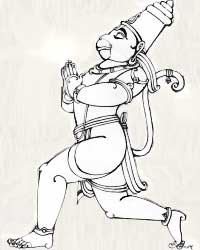 | This first chapter of Sundara Kanda describes Hanuma's preparations to cross the ocean in search of Seetha. Mighty Hanuma's flight over the ocean is described in a glorious detail. Hanuma's encountering of Mainaka, Surasa and Simhika form important phases of His flight. |
tato r˜vaõanŸt˜y˜× sŸt˜y˜× þatrukarþana× |
iyeÿa padamanveÿ÷uÕ c˜raõ˜carite pathi ||5-1-1
1. tataH= after that, shatrukarshanaH= the destroyer of foes (Hanuma), iyeshha= desired to (travel in), pathi= the path, chaaraNaa charite= tread by chaaranas, anveshhTum= to search for, siithayaaH padam= Seetha's place, raavaNa niitaayaaH= taken away by Ravana.
After that, Hanuma, the destroyer of foes, desired to travel in the sky where celestials like chaaranas tread, to search for Seetha, who was taken away by Ravana.
duÿkaraÕ niÿpratidvandvaÕ cikŸrÿan karma v˜nara× |
samudagraþirogrŸvo gav˜mpatiriv˜babhau || 5-1-2
2. vaanaraH= The monkey (Hanuma), chikiirshhan= who desired to perform, karma= a deed, dushhkaram= (which is) impossible to do, babhau= shone, gavaam pati iva= like a bull, nishhpratidvandvam= without any obstacles, samudagrashirogriivaH= with a raised head and neck.
Hanuma who desired to perform a deed done by no one else, shone like a bull without any obstacles, with his stretched neck and raised head.
atha vaiý¨ryavarõeÿu þ˜dvaleÿu mah˜bala× |
dhŸra× salilakalpeÿu vicc˜ra yath˜sukham ||5-1-3
3. atha= after that, mahaabalaH= the mighty one, dhiiraH= the courageous one, vichachaara= roamed about, yathaa sukham= at ease, shaadvaleshhu= on the lawns, vaiDuura varNeshhu= with the hue of an emerald, salilakalpeshhu= and same as (still) water (from a distance).
After that, the mighty and courageous Hanuma roamed at ease on the lawns with the hue of an emerald, which looked like still water from a distance.
dvij˜n vitr˜sayan dhŸm˜nuras˜ p˜dap˜n haran |
m®g˜Õþca sub˜hunnighnan prav®ddha iva kesarŸ|| 5-1-4
4. dhiimaan= the thoughtful (Hanuma), pravR^iddhaH kesarii iva= (trod) like a ramapant lion, dvijaan vitraasayan= making birds to fear, haran= destroying, paadapaan= trees, urasaa= by his breast, nighnan= killing, subahuun= many, mR^igaaMshcha= animals also.
The thoughtful Hanuma tread like a rampant lion, making birds fear, uprooting trees by his breast and also killing many animals.
nŸlalohitam˜ñjiÿ÷hapatravarõai× sit˜sitai× |
svabh˜vavihitaiþcitrairdh˜tubhi× samalaðk®tam ||5-1-5
k˜mar¨pibhir˜viÿ÷amabhŸkÿõaÕ saparicchidai× |
yakÿakinnaragandharvairdevaklpaiþca pannagai× ||5-1-6
sa tasya girivaryasya tale n˜gavar˜yute |
tiÿ÷han kapivarastatra hrade n˜ga iv˜babhau ||5-1-7
5,6,7. saH= that, kapivaraH= great monkey, babhau= shone, naagaH iva= like an elephant, hrade= in a lake, tishhThan= being located, tasya girivarasya= on that great mountain's, tale= foot, naagavaraayute= which had best of elephants, tatra= there, samalaMkR^itam= was decorated by, svabhaavavihitaiH= naturally formed, dhaatubhiH= mineral rocks, chitraiH= of varied hues, sitaasitaiH= (like) black and white, niilalohitamaaJNjishhThapatravarNaiH= blue, red, yellow, leaf color (green), abhiikshNam aavishhTam= surrounded to a great extent by, yakshakinnaragandharvaiH= Yakshas- Kinnaras-Gandharvas, kaamaruupibhiH= who could assume desired form, saparichchhadaiH= together with their families, cha deva kalpaiH pannagaiH= and godly serpents.
That great monkey Hanuma shone like an elephant in a lake, standing on the foot of that great mountain by the name of Mahendra, where many elephants of good breed resided, which was beautifully decorated with many naturally formed mineral rocks of varied hue like black, white, red, blue, yellow and green and which was surrounded by godly serpents and Yakshas, Kinnaras, Gandharvas who were capable of assuming desired form, together with their families.
sa s¨ry˜ya mahendr˜ya pavan˜ya svayambhuve |
bh¨tebhyaþc˜ñjaliÕ k®tv˜ cak˜ra gamane matim || 5-1-8
8. saH= He, kR^itvaa= performed, aJNjaliM= salutation with joined palms, suuryaaya= to Sun-God, mahendraaya= to Lord Indra, pavanaaya= to the God of Wind, svayaMbhuve= to Lord Brahma, cha bhuutebhyaH= and to Bhutas, matim chakaara= (and) set his mind, gamane= to leave.
He saluted with joined palms to the Sun-God, Lord Indra, God of Wind, Lord Brahma and Bhutas and decided to leave.
añjaliÕ pr˜ðmukha× k®tv˜ pavan˜y˜tmayoonayo |
tato hi vav®dhe gantuÕ dakÿiõo dakÿiõ˜Õ diþm || 5-1-9
9. praaN^mukhaH= (Hanuma) facing east, kR^itvaa= offered, aJNjalim= salutation, pavanaaya= Lord of Wind, aatma yonaye= responsible for his own birth, tataH= and then, vavR^idhe hi= increased (his body), gantuM= to go, dakshiNaam dishaM= the southern direction.
Hanuma turned towards east, saluted his father, the Lord of Wind and increased his body to go towards southern direction.
plavaðgapravaraird®ÿ÷a× plavane k®taniþcaya× |
vav®dhe r˜mav®ddhyartham samudra iva parvasu || 5-1-10
10. dR^ishhTaH= being seen, plavaN^gapravaraiH= by best of Vaanaras, kR^ita nishchayaH= with a strong resolve, plavane= to fly, vavR^idhe= grew, raama vR^iddhyarthaM= for Rama's success, samudraH iva= like the ocean, parvasu= on full moon days.
With all the Vaanaras seeing, Hanuma decided to fly and like an ocean swelling on full moon days, grew for Rama's success.
niÿpram˜õaþarŸra× san lilaðghayiÿurarõavam |
b˜hubhy˜Õ pŸýay˜m˜sa caraõ˜bhy˜Õ ca parvatam || 5-1-11
11. lilaN^ghayishhuH= Desiring to leap, arNavam= the ocean, nishhpramaaNa shariiraH= with an immeasurable body, piiDayaamaasa= pressed, parvatam= the mountain, baahubhyaam= with hands, cha charaNaabhyaam= and feet.
With a desire to cross the ocean, Hanuma grew his body immeasurably and pressed the mountain with his feet and hands.
sa cac˜l˜calaþc˜pi muh¨rtaÕ kapipŸýita× |
tar¨õ˜Õ puÿpit˜gr˜õ˜Õ sarvaÕ puÿpamaþ˜tayat || 5-1-12
12. kapipiiDitaH= tormented by Hanuma, saH achalaH api= even that mountain, chachaala= shook, muhuurtam= for an instant, ashaatayat= (and) showered, sarvam= all, pushhpam= flowers, taruuNaam= of trees, pushhpitaagraaNaam= with flowered ends.
Thus tormented by Hanuma, that mountain shook for an instant and showered all flowers of trees on it.
tena p˜dapamuktena puÿpaughena sugandhin˜ |
sarvata× saÕv®ta× þailo babhau puÿpamayo yath˜ ||5-1-13
13. saMvR^itaH= covered, sarvataH= all through, sugandhinaa pushhpaughena= by groups of fragrant flowers, tena paadapamuktena= left by those trees, shailaH= (that) mountain, babhau= shone, yathaa= like, pushhpamayo= being made of flowers.
Covered all through by those fragrant flowers which fell down from the trees, that mountain shone like a mountain made of flowers.
tena cottamavŸryeõa pŸýyam˜na× sa parvata× |
salilaÕ samprasusr˜va madaÕ matta iva dvipa× ||5-1-14
14. saH parvataH= that mountain, saMprasusraava= shed, salilam= water, madam iva= like rut juice, mathaH dvipaH= (from) an elephant in rut, piiDyamaanaH= being pressed, tena uttama viiryeNa= by that powerful Hanuma.
That mountain shed water like an elephant in rut emitting rut juice, after being pressed by the mighty Hanuma.
pŸýyam˜nastu balin˜ mahendrastena parvata× |
rŸtŸrnirvartay˜m˜sa k˜ñcan˜ñjanar˜jatŸ× ||5-1-15
15. piiDyamaanaH= tormented, tena balinaa= by that mighty Hanuma, riitiiH= lines, kaaJNchanaaJNjana raajatiiH= gold, silver and black kind, nirvartayaamaasa= were made to form, mahendraH parvataH= (on) the mountain of Mahendra.
Pressed by that mighty Hanuma, streaks of gold silver and antimony color appeared on the Mahendra mountain.
mumoca ca þil˜× þailo viþ˜l˜× samana×þil˜× |
madhyamen˜rciÿ˜ juÿ÷o dh¨mar˜jŸriv˜nala× ||5-1-16
16. shailaH= mountain, mumocha cha= also emitted, vishaalaaH= vast, shilaaH= boulders, samanaH shilaaH= with rocks of Sulfur, dhuumaraajiiriva= like columns of smoke, analaH= (from a) fire, jushhTaH= with, madhyamena archishhaa= with a medium flame.
Huge Rocks of Sulfur were also shot forth from that mountain, just as a fire burning with a medium flame would emit columns of smoke.
giriõ˜ pŸýyam˜nena pŸýyam˜n˜ni sarvaþ× |
guh˜viÿ÷˜ni bh¨t˜ni vinedurvik®tai× svarai× ||5-1-17
17. piiDyamaanaani= being pressed, sarvashaH= on all sides, giriNaa= by the mountain, piiDyamaanena= which was being tormented (by Hanuma), bhuutaani= creatures, guhaavishhTaani= living in caves, vineduH= shrieked, vikR^itaiH= in horrifying, svaraiH= tones.
Being pressed on all sides by the mountain which itself was being pressed by Hanuma, creatures living in the caves of that mountain shrieked in horrifying tones.
sa mah˜sattvasann˜da× þailapŸý˜nimittaja× |
p®thivŸÕ p¨ray˜m˜sa diþaþcopavan˜ni ca ||5-1-18
18. saH= that, mahaasattvasaMnaadaH= loud noise from creatures, shailapiiDaanimittajaH= formed because of the stress to the mountain, puurayaamaasa= filled, pR^ithiviim= the earth, cha dishaH= all the directions, cha upavanaani= and forests (near that mountain).
That loud noise from creatures which emanated because of stress caused to the mountain, filled the earth and all four directions and forests near that mountain.
þirobhi× p®thubhi× sarp˜ vyaktasvastikalakÿaõai× |
vamanta× p˜vakaÕ ghoraÕ dadaÕþurdaþanai× þil˜× ||5-1-19
19. sarpaaH= Snakes, vyakta svastika lakshaNaiH= with clear swastika signs (on the hoods), vamantaH= spewed out, ghoram paavakam= frightening flame, pR^ithubhiH shirobhiH= with (their) great heads, dadaMshuH= (and) bit, shilaaH= rocks, dashanaiH= with (their) teeth.
Great snakes with clear swastika signs on their hoods, spewed out frightening flames with their great heads and bit the rocks with their teeth.
t˜stad˜ saviÿairdaÿ÷˜× kupitaistairmah˜þil˜×|
jajjvalu× p˜vakoddŸpt˜ bibhiduþca sahasradh˜ ||5-1-20
20. tadaa= then, taaH mahaashilaaH= those great rocks, dashhTaaH= bit, taiH= by those (snakes), kupitaiH= with anger, savishhaiH= (and) with venom, jajvaluH= burned, paavakoddiiptaaH= encouraged by the flame, bibhidushcha= and split, sahasrathaa= into thousand pieces.
Then those great rocks bit by those snakes with anger and venom, burned due to the flame and split into thousand pieces.
y˜ni cauÿadhaj˜l˜ni tasmin j˜t˜ni parvate |
viÿaghn˜nyapi n˜g˜n˜Õ na þeku× þamituÕ viÿam|| 5-1-21
21. yaani aushhadhajaalaani= whatever medicinal herbs, jaataani= born, tasmin parvate= on that mountain, vishhaghnaanyapi= although destroyers of poison, na shekuH= (were) not capable, shamitum= of neutralizing, vishham= poison, naagaanaam= of the snakes.
Medicinal herbs from that mountain, although capable of destroying ordinary poisons, could not neutralize the poison from those snakes.
bhidyate'yaÕ girirbh¨tairiti mattv˜ tapasvina× |
trast˜ vidy˜dhar˜stasm˜dutpetu× strŸgaõai× saha|| 5-1-22
p˜nabh¨migataÕ hitv˜ haimam˜savabh˜janam |
p˜traõi ca mah˜rh˜õi karak˜Õþca hiraõmay˜n ||5-1-23
lehy˜nucc˜vac˜n bhakÿy˜n m˜Õs˜ni vividh˜ni ca |
˜rÿabh˜õi ca carm˜õi khaýg˜Õþca kanakatsar¨n || 5-1-24
22, 23, 24. tapasvinaH= ascetics, mattvaa= thought, iti= that, ayam= this giriH= mountain, bhidyate= is being shattered, bhuutaiH= by bhutas, utpetuH= (and) flew away, vidhyaadharaaH= Vidhyaadharaas, trastaaH= who became afraid, hitvaa= left, haimam= golden, aasavabhaajanam= jugs of wine, paanabhuumigatam= in the liquor house, mahaarhaaNi= golden hued, karakaaMshcha= vases, uchchaavachaan= lot of, lehyaan= sauces to be licked, bhakshyaan= eatables, vividhaani= various, maaMsaani= meats, charmaaNi= skins, aarshhabhaaNi= of oxen, khaDgaaMshcha= and swords, kanakatsaruun= with gold hilts, utpetuH= (and) flew, strii ganaiH saha= along with their women folk.
Ascetics residing on that mountain flew away from there thinking that some demons were destroying it. Vidhyadharas who lived there, became afraid and flew away with their women folk, leaving behind them golden jugs of wine in the liquor house, gold vases, a varieties of sauces that can be licked, eatables, various meats, skins of oxen and swords with golden hilts.
k®takõ÷haguõ˜× kÿŸb˜ rktam˜ly˜nulepan˜× |
rktakÿ˜× puÿkar˜kÿ˜þca gaganaÕ pratipedire ||5-1-25
25. kshiibaaH= the intoxicated (Vidhyadharas), kR^ita kanTha guNaaH= with garlands around neck, rakta maalyaanulepanaaH= with red flower garlands and smeared with sandal paste, raktaakshaaH= with reddened eyes, pushhparaakshaashcha= and with lotus like eyes, pratipedire= obtained, gaganam= the sky.
The intoxicated Vidyadharas with garlands around their neck decked with red flower garlands and smeared with sandal paste, with reddened eyes, and with lotus shaped eyes, obtained the sky.
h˜ran¨purakey¨rap˜rih˜ryadhar˜× striya× |
vismit˜× sasmit˜stasthur˜k˜þe ramaõai× saha ||5-1-26
26. striiyaH= Women, haara nuupura keyuura paarihaarya dharaaH= wearing necklaces, anklets, armlets and bangles, tastuH= stood, aakaashe= in the sky, vishmitaaH= with surprise, sasmitaaH= (and) with smiles, ramaNaiH saH= along with their loved ones.
Vidyadhara women wearing necklaces, anklets, armlets and bangles stood in the sky with surprise and with smiles along with their loved ones.
darþayanto mah˜vidy˜Õ vidy˜dharamaharÿaya× |
sahit˜stasthur˜k˜þe vŸkÿ˜ñcakruþca parvatam|| 5-1-27
27. vidyaadhara maharshhayaH= Vidyadharas and great sages, tastuH= stood, aakaashe= in the sky, sahitaaH= in a group, darshayantaH= showing, mahaavidyaam= great prowess, viikshaaJNchakrushcha= and viewed, parvatam= the mountain.
Vidyadharas and great sages stood in the sky in a group, showing their great prowess and viewed the mountain.
þuþruvuþcatad˜ þabdam®ÿŸõ˜Õ bh˜vit˜tman˜m|
c˜raõ˜n˜Õ ca siddh˜n˜Õ sthit˜n˜Õvimale'mbare|| 5-1-28
28. tadaa= then, shushruvuH= (they) heard, shabdam= words, charaNaanaam= of Charanas, siddhaanaam= Siddhas, cha R^ishhiNaam= and Rishis, bhaavitaatmaanaam= with pure hearts, sthitaanaam= located, vimale ambare= in (that) clear sky.
Then they heard words of Charanas, Siddhas and pure hearted Rishis who were located in that clear sky.
eÿa parvatasaðk˜þo han¨m˜n m˜rut˜tmaja× |
titŸrÿati mah˜vega× samudraÕ makar˜layam ||5-1-29
29. eshhaH= this, hanumaan= Hanuma, parvatasaMkaashaH= who is equal to a mountain, maarutaatmajaH= who is the son of Vayu, mahaavegaH= with great speed, titiirshhati= wants to cross, samudram= the ocean, makaraalayam= which is abode to crocodiles.
"This Hanuma, who is equal to a mountain, who is the son of Vayu, and who has great speed, wants to cross the ocean which is abode to crocodiles."
r˜m˜rthaÕ v˜nar˜rthaÕ ca cikŸrÿan karmaduÿkaram |
samudrasya paraÕ p˜raÕ duÿpr˜paÕ pr˜ptumicchati|| 5-1-30
30. ichchhati= (He) wants, praaptum= to obtain, samudrasya param paaram= the other side of ocean, dushhpraapam= which is hard to obtain, chikiirshhan= (and) has decided to perform, dushhkaram= (this) impossible, karma= task, raamaartham= for Rama, vaanaraaratham= and for Vanaras.
"Hanuma has decided to perform an impossible task for the sake of Rama and Vanaras and wants to obtain the other side of ocean which is hard to obtain."
iti vidy˜dhar˜× þrutv˜ vacasteÿ˜Õ mah˜tman˜m |
tamaprameyaÕ dad®þu× parvate v˜nararÿabham ||5-1-31
31. vidyadharaaH= Vidyadharas, shrutvaa= listened, vachaH= words, teshhaam mahaatmaanaam= of those great people, iti= thus, dadR^ishuH= (and) looked, tam vaanarashhabhaH= (at) that best of Vanaras, aprameyam= who is incomparable, parvate= (standing) on the mountain.
Vidyadharas thus listened to the words of those great people and looked at the incomparable Hanuma, best among Vanaras, standing on the mountain.
dudhuve ca sa rom˜õi cakampe c˜calopama× |
nan˜da sumah˜n˜daÕ sumah˜niva toyada× || 5-1-32
32. saH= He, achalopamaH= equal to a mountain, dudhuve cha= shook, romaaNi= hair, chakampe cha= quivered (his body), nanaada= (and ) sounded, sumahaanaadam= a great roar, iva sumahaan toyadaH= like a vast cloud.
He, who is equal to a mountain, shook his hair, quivered his body and let out a great roar like from a vast cloud.
˜nup¨rvyeõa v®ttaÕ ca l˜ðg¨laÕ lomabhiþcitam |
utpatiÿyan vicikÿepa pakÿir˜ja ivoragam ||5-1-33
33. utpatishhyan= About to fly, vichikshepa= (Hanuma) jolted, laaN^guulaM= tail, aanupuurvyeNa vR^ittam= (rolled) in a circle from top to bottom, chitam= covered, lomabhiH= with hair, yathaa= like, pakshi raajaH= the king of birds (Garuda), uragam= (jolts) a snake.
About to fly, Hanuma jolted his tail, which was rolled into a circle from top to bottom, and which was covered with hair, just as Garuda, the king of birds would jolt a snake.
tasya l˜ðg¨lam˜viddham˜ttavegasya p®ÿ÷hata× |
dad®þe garuýeneva hriyam˜õo mahoraga× || 5-1-34
34. tasya aattavegasya= receiving his vigor, laaN^guulam= tail, aaviddham= curled, pR^ishhThataH= (at) his back, dadR^ishe= was seen, mahoragaH iva= like a great serpent, hriyamaaNaH= being stolen, garudena= by Garuda.
Receiving his vigor, the tail curled at his back was seen like a great serpent being stolen by Garuda.
b˜h¨ saÕstambhay˜m˜sa mah˜parighasannibhau |
sas˜da ca kapi× k÷y˜Õ caraõau sañcukoca ca ||5-1-35
35. kapiH= Hanuma (lit. monkey), saMstambhayaamaasa= supported,, baahuu= his arms, mahaa parigha sannibhau= which resembled huge iron clubs, sasaada= crouched, kaTyaam= the waist, cha saMchukocha= and contracted, charaNau= feet.
Hanuma firmly supported his arms (on the mountain surface) which resembled huge iron clubs, crouched the waist and contracted his feet.
saÕh®tya ca bhujau þrŸm˜Õstathaiva ca þirodhar˜m |
teja× sttvaÕ tath˜ vŸryam˜viveþa sa vŸryav˜n ||5-1-36
36. saMhR^itya= bending, bhujau cha= shoulders, tathaiva cha= and also, shirodharaam= neck, saH= that (Hanuma), shrimaan= (who is) glorious, viiryavaan= mighty, aavivesha= increased, tejaH= energy, sattvam= strength, tathaa= and, viiryam= courage.
Bending shoulders and neck, that mighty and glorious Hanuma, increased his energy, strength and courage.
m˜rgam˜lokayand¨r˜d¨rdhvaÕ praõihitekÿaõa× |
rurodha h®daye pr˜õ˜n˜k˜þamavalokayan || 5-1-37
37. uurdhvam praNihitekshaNaH= With eyes raised up, aalokayan= seeing, maargam= the way, dooraat= from a distance, avalokayan= viewing, aakaasham= the sky, rurodha= (he) held, praaNaan= breath, hR^idaye= in heart.
With his eyes raised up, seeing the way from a distance, viewing the sky, he held his breath in his heart.
padbhy˜Õ d®ýhamavasth˜naÕ k®tv˜ sa kapikuñjara× |
nikuñcya karõau hanum˜nutpatiÿyan mah˜bala× |
v˜nar˜n v˜naraþreÿ÷ha idaÕ vacanamabravŸt || 5-1-38
38. saH hanumaan= that Hanuma, kapikuJNjaraH= who is equal to an elephant among monkeys, mahaabalaH= the mighty one, vaanarashreshhThaH= the best among Vaanaraas, kR^itvaa= performed, avasthaanam= standing, dR^iDham= firmly, padbhyaam= with his feet, nikuJNchya= bending, karNau= ears, utpatishhyan= before flying, abraviit= spoke, idam vachanam= these words, vaanaraan= to Vaanaraas.
That mighty Hanuma, equal to an elephant among monkeys and the best among Vaanaraas, stood firmly with his legs, bent his ears and before flying spoke these words to the Vaanaraas.
yath˜ r˜ghavanirmukta× þara× þvasanavikrama× |
gaccettadvadgamiÿy˜mi laðk˜Õ r˜vaõap˜lit˜m || 5-1-39
na hi drakÿy˜mi yadi t˜Õ laðk˜y˜Õ janak˜tmaj˜m |
anenaiva hi vegena gamiÿy˜mi sur˜layam || 5-1-40
yadi v˜ tridive sŸt˜Õ na drakÿy˜myak®taþrama× |
baddhv˜ r˜kÿasar˜j˜nam˜nayiÿy˜mi r˜vaõam || 5-1-41
sarvath˜ k®tak˜ryo'hameÿy˜mi saha sŸtay˜ |
˜nayiÿy˜mi v˜ laðk˜Õ samutp˜÷ya sar˜vaõ˜m || 5-1-42
39-42. gamishhyaami= I will go, laN^kaaM= to Lanka, raavaNapaalitaam= ruled by Ravana, yathaa= as, sharaH= an arrow, raaghava nirmuktaH= released by Rama, gachchhet= will go, tadvat= like that, shvasana vikramaH= with wind-like speed, yadi= if, na hi drakshyaami= I do not see, taam janakaatmajaam= that daughter of Janaka, laN^kaayaam= in Lanka, anena vegenaina hi= with the same speed, gamishhyaami= I will go, suraalayam= to the abode of gods, yadi= if, na drakshyaami vaa= I do not see, siitaam= Seetha, tridive= in heaven, aanayishhyaami= I will get, raavaNam= Ravana, raakshasaraajaanam= the king of raakshasaas, baddhvaa= tied up (in chains), akR^ita shramaH= without effort, aham eshhyaami= I will return, sarvathaa= in all events, kR^itakaaryaH= successfully, siitayaa saha= along with Seetha, vaa= or, aanayishhyaami= I will get, laN^kaaM= Lanka, saraavaNaam= along with Ravana, samutpaaTya= (after) uprooting (it).
"I will go to the city of Lanka, ruled by Ravana just like an arrow released by Rama will go, with wind-like speed. If I do not see the daughter of Janaka there, I will go with the same speed to the abode of gods. If I do not see Seetha there in heaven, I will get Ravana the king of raakshasaas tied up in chains without any effort. I will, in all events, return successfully along with Seetha or I will get Lanka along with Ravana after uprooting it."
evamuktv˜ tu hanum˜nv˜nar˜nv˜narottama× || 5-1-43
utpap˜t˜tha vegena vegav˜navic˜rayan |
suparõamiva c˜tm˜naÕ mene sa kapikuñjara× || 5-1-44
43-44. vaanarottamaH= the best among Vaanaraas, hanumaan= Hanuma, uktvaa tu= spoke, evam= this, vaanaraan= to Vaanaraas, atha= (and) after that, avichaarayan= without thinking (anything else), utpapaata= flew up, vegena= with speed, mahaa vegavaan= (being) with lot of vigor, saH kapikuJNjaraH= that great monkey, mene cha= also thought, aatmaanam= himself, suparNamiva= as being equal to Garuda.
The best among Vaanaraas, Hanuma, spoke in this way to Vaanaraas and then without thinking about anything else, flew up with lot of vigor. That great monkey also thought himself equal to Garuda, the king of birds.
samutpatati tasmiÕstu veg˜tte nagarohiõa× |
saÕh®tya vi÷ap˜n sarv˜n samutpetu× samantata× || 5-1-45
45. tasmin samutpatati= while he was rising up, vegaat= due to the force, te nagarohiNaH= trees on that mountain, samutpetuH= flew away, samantataH= in all directions, saMhR^itya= drawing together, sarvaan viTapaan= all branches.
While he was flying up, due to that force, all trees on that mountain flew away in all directions, drawing together all their branches.
sa mattakoyaÿ÷ibhak˜n p˜dap˜n puÿpaþ˜lina× |
udvahann¨ruvegena jag˜ma vimale'mbare || 5-1-46
46. saH= He, ambare jagaama= went in the sky, udvahan= taking aloft (with him), uuruvegena= with the force of his thighs, paadapaan= trees, pushhpashaalinaH= shining with flowers, matta koyashhTi bhakaan= (and) with fattened lapwing birds.
While flying in the sky, he took along with him, because of the force of his thighs, trees shining with flowers and with fattened lapwing birds.
¨ruvegotthit˜ v®kÿ˜ muh¨rtaÕ kapimanvayu× |
prasthitaÕ dŸrghamadhv˜naÕ svabandhamiva b˜ndhav˜× || 5-1-47
47. vR^ikshaaH= the trees, uuruvegotthitaaH= held aloft by the force of thighs, anvayuH= followed, kapim= Hanuma, muhuurtam= for some time, baandhavaaH iva= like relatives, svabandhum= (following) a relative, prasthitam= embarking, diirgham maargam= on a long distance.
The trees thus being held aloft by the speed of Hanuma's thighs, followed him for a while just as relatives would follow their loved ones embarking on a long journey.
tam¨ruvegonmathit˜×s˜l˜þcanye nagottam˜×|
anujagmurhan¨mantaÕ sainy˜ iva mahŸpatim || 5-1-48
48. uuruvegonmathitaaH= uprooted by the force of (Hanuma's) thighs, saalaashcha= Sal and, anye nagottamaaH= other excellent trees, anujagmuH= followed, hanuumantam= Hanuma, sainyaaH mahiipatim iva= like soldiers (following their) king.
Uprooted by the force of Hanuma's thighs, Sal and other excellent trees followed Hanuma like soldiers following their king.
supuÿpit˜grairbahubhi× p˜dapairanvita× kapi× |
hanum˜n parvat˜k˜ro babh¨v˜dbhutadarþana× || 5-1-49
49. hanumaan= Hanuma, kapiH= the monkey, babhuuva= became, adbhuta darshanaH= a wonderful sight, parvataakaaraH= with a mountain-like appearance, anvitaH= together with, paadapaiH= trees, supushhpitaagraiH= with well flowered ends.
Hanuma the great monkey presented a wonderful sight, with his mountain-like appearance together with the well flowered trees.
s˜ravanto'tha ye v®kÿ˜ nyamajjan lavaõ˜mbhasi |
bhay˜diva mahendrasya parvat˜ varuõ˜laye || 5-1-50
50. atha= after that, ye= whatever, vR^ikshhaaH= trees, saaravantaH= (which were) powerful, nyamajjan= sank, lavaNaambhasi= in the salt ocean, iva= like, parvataaH= mountains, varuNaalaye= in ocean, bhayaat= due to fear, mahendrasya= of Mahendra.
After that, powerful trees sank into the salt ocean like mountains sinking into ocean due to fear of Mahendra.
sa n˜n˜kusumai× kŸrõa× kapi× s˜ðkurakorakai× |
þuþubhe meghasaðk˜þa× khadyotairiva parvata× || 5-1-51
51. saH kapiH= that Hanuma, meghasaMkaashaH= equal to a cloud, kiirNaH= covered, saaN^kurakorakaiH= shoots and buds, naanaakusumaiH= (and) flowers of various kinds, shushubhe= shone, iva= like, paravataH= a mountain, khadyotaiH= with fireflies.
That Hanuma who was equal to a cloud, covered with flowers of various kinds, shoots and buds, shone like a mountain with fireflies.
vimukt˜stasya vegena muktv˜ puÿp˜õi te drum˜× |
avaþŸryanta salile niv®tt˜× suh®do yath˜ ||5-1-52
52. te drumaaH= those trees, vimuktaaH= released, tasya vegena= by His (Hanuma's) speed, muktvaa= dropped, pushhpaaNi= flowers, avashiiryanta= (and) fell down, salile= in water, yathaa= like, suhR^ido= friends, nivR^ittaaH= going back.
Those trees which were released by Hanuma's speed, dropped flowers and fell down in the water like friends going back after bidding farewell to their dear one.
laghutvenopapannaÕ tadvicitraÕ s˜gare'patat |
drum˜õ˜Õ vividhaÕ puÿpaÕ kapiv˜yusamŸritam || 5-1-53
t˜r˜citamiv˜k˜þaÕ prababhau ca mah˜rõava× |
53. kapi vaayu samiiritam= set in motion by the wind (from the movement) of Hanuma, tat= that, vividham= variety of, pushhpam= blossom, drumaaNaam= of the trees, vichitram= with different hues, apatat= fell down, saagare= in sea, mahaarNavaH= (That) great ocean, prababhau cha= also shone, aakaashamiva= like the sky, taaraachitam= filled with stars.
Set in motion by the wind from the movement of Hanuma, that variety of blossom, with various hues, from the trees fell down into the sea. That great ocean shone like the sky filled with stars.
puÿpaughen˜nubaddhena n˜n˜varõena v˜nara× |
babhau megha iv˜k˜þe vidyudgaõavibh¨ÿita× || 5-1-54
54. vaanaraH= Hanuma, babhau= shone, meghaH iva= like a cloud, aakaashe= in the sky, vidyudgaNavibhuushhitaH= decorated by lightening, naanaavarNena pushhpaughena= by flowers of various hues, anubaddhena= attached (to his body).
Hanuma shone like a cloud in the sky decorated by lightening, with flowers of various hues sticking to his body.
tasya vegasam˜dh¨tai× puÿpaistoyamad®þyata ||5-1-55
t˜r˜bhirabhir˜m˜bhirudit˜bhiriv˜mbaram |
55. toyam= (sea) water, adR^ishyata= looked, ambaramiva= like the sky, abhiraamaabhiH taaraabhiH= with delightful stars, uditaabhiH= rising up, pushhpaiH= with the flowers, tasya vega samaadhuutaiH= being flown up by His (Hanuma's) speed.
That sea water looked like the sky with delightful stars rising up, with flowers flown up by Hanuma's speed.
tasy˜mbaragatau b˜h¨ dad®þ˜te pras˜ritau || 5-1-56
parvat˜gr˜dviniÿkr˜ntau pañc˜sy˜viva pannagau |
56. tasya ambaragatau= That sky-borne Hanuma's, baahuu= arms, prasaaritau= which were spread out, dadR^ishaate= were seen, panchasyau pannagau iva= like five-headed serpents, vinishhkraantau= coming out of, parvataagraat= a mountain's peak.
That sky-borne Hanuma's arms which were spread out, were seen like five-headed serpents coming out of a mountain's peak.
pibanniva babhau c˜pi soormim˜laÕ mah˜rõavam || 5-1-57
pip˜suriva c˜k˜þaÕ dad®þe sa mah˜kapi× |
57. saH mahaakapiH= that great monkey Hanuma, babhau= shone, pibanniva= like one who is drinking, mahaarNavam= the great sea, sormimaalam= together with waves, dadR^ishe= (He also) looked, pipaasuriva= like one who desires to drink, aakaasham= the sky.
That great monkey shone like one who is drinking the great sea together with its waves. He also seemed like one who desires to drink the whole of sky.
tasya vidyutprabh˜k˜re v˜yum˜rg˜nus˜riõa× ||5-1-58
nayane viprak˜þete parvatasth˜viv˜nalau |
58. nayane= The eyes, tasya vaayumaarganusaariNaH= of that Hanuma who was following the path of sky, vidyutprabhaakaare= with a brilliance equal to that of lightening, viprakaashete= were shining, parvatasthau analau iva= like two fires on a mountain.
The eyes of that Hanuma, who was following the path of sky, which had a brilliance equal to that of lightening, were shining like two fires on a mountain.
piðge piðg˜kÿamukhyasya b®hatŸ parimaõýale || 5-1-59
cakÿuÿŸ samprak˜þete candras¨ry˜vivoditau |
59. chakshhushhii= eyes, piN^gaaksha mukshasya= of the best among the reddish brown eyed monkeys, piN^ge= were reddish brown, bR^ihatii= wide, parimaNDale= round, saMprakaashete= shone, uditau chandra suuryaaviva= like fully risen sun and moon.
The round, wide, reddish brown eyes of Hanuma, the best among the monkeys shone like fully risen sun and moon.
mukhaÕ n˜sikay˜ tasya t˜mray˜ t˜mram˜babhau || 5-1-60
sandhyay˜ samabhisp®ÿ÷aÕ yath˜ tats¨ryamaõýalam |
60. taamram mukham= ruddy face, tasya= of Hanuma, taamrayaa naasikayaa= with reddish nose, aababhau= shone, suurya manDalam yathaa= like the Sun, samabhispR^ishhTam= touched, sandhyayaa= by twilight.
The ruddy face of Hanuma, with His reddish face shone like the Sun touched by twilight.
l˜ðg¨laÕ ca sam˜viddhaÕ plavam˜nasya þobhate ||5-1-61
ambare v˜yuputrasya þakradhvaja ivocchrita× |
61. laaNguulam= tail, vaayuputrasya= of the son of Vayu, plavamaanasya= floating, ambare= in sky, samaaviddham= which was risen up, shobhate= was shining, shakra dhvajaH iva= like the pillar of Indra, ucchritaH= standing straight.
The tail of Hanuma, the son of Vayu floating in the sky, being risen up looked like the pillar erected in honour of Indra.
l˜ðg¨lacakreõa mah˜n þukladaÕÿ÷ro'nil˜tmaja× || 5-1-62
vyarocata mah˜pr˜jña× pariveÿŸva bh˜skara× |
62. anilaatmajaH= Son of Vayu (Hanuma), mahaan= with his great body, shukla daMshhTraH= with white teeth, mahaapraajJNaH= with great intellect, vyarochata= shone, bhaaskaraH iva= like the Sun, pariveshhii= surrounded by, laaJNuula chakreNa= by his circle shaped tail.
The great intellectual Hanuma, with his great body, and with white teeth, shone like the Sun, being surrounded by his circular tail.
sphigdeþen˜bhit˜mreõa rar˜ja sa mah˜kapi× || 5-1-63
mahat˜ d˜riteneva girirgairikadh˜tun˜ |
63. saH mahaa kapiH= that great monkey Hanuma, abhitaamreNa sphigdeshena= with his red colored buttocks, raraaja= shone, daaritena giriH iva= like a mountain, mahataa gairika dhaatunaa= with great 'gairika' herb, daaritena= broken apart.
That great monkey Hanuma, with his red colored buttocks, shone like a mountain with a large deposit of red Gairika herb broken into pieces.
tasya v˜narasiÕhasya plavam˜nasya s˜garam || 5-1-64
kakÿ˜ntaragato v˜yurjŸm¨ta iva garjati |
64. vaayuH= Air, tasya vaanara siMhasya kakshaantaragataH= passing through the lion among monkeys Hanuma's armpits, plavamaanasya= who was crossing, saagaram= the ocean, garjati= is roaring, jiimuutaH iva= like a cloud (during lightening)
Air passing through the lion among monkeys Hanuma's arm pits sounded like a thundering cloud.
khe yath˜ nipatantyulk˜ hyuttar˜nt˜dvini×s®t˜ ||5-1-65
d®þyate s˜nubandh˜ ca tath˜ sa kapikuñjara× |
65. yathaa= how, ulkaa= meteor, saanubandhaa cha= which is darting, viniHsR^itaa= with great speed, khe= in the sky, uttaraantaat= from the northern direction, dR^ishyate= will be seen, saH kapikuJNjaraH= that best among monkeys Hanuma, tathaa= (was seen) just like that.
The best among monkeys Hanuma flying thus in the sky, looked like a meteor darting away with great speed in the sky from northern direction.
patatpataðgasaðk˜þo vy˜yata× þuþubhe kapi× || 5-1-66
prav®ddha iva m˜taðga× kakÿyay˜ badhyam˜nay˜ |
66. patatpataN^gasaMkaashaH= With a fast pace equal to that of Sun god, vyaayataH= the tall one, kapiH= Hanuma, shushubhe= shone, maataN^gaH iva= like an elephant, pravR^iddhaH= increased in size, badhyamaanayaa= (when) being festered, kakshyaa= by a rope.
With a fast pace equaling that of Sun god, the tall Hanuma shone like an elephant which increases its size when being festered by a rope.
upariÿ÷˜ccharŸreõa ch˜yay˜ c˜vag˜ýhay˜ |
s˜gare m˜rut˜viÿ÷˜ nauriv˜sŸttad˜ kapi× || 5-1-67
67. tadaa= then, kapiH= Hanuma, uparishhTaat shariireNa= with His body on the above, cha saagare avagaaDhayaa chaayayaa= and with his shadow immersed in the sea below, aasiit nauriva= like a boat, maarutaavishhTaa= driven by wind.
Then Hanuma who was flying above the ocean with his body above the ocean and his shadow being immersed in the sea below, looked like a boat being driven by wind.
yaÕ yaÕ deþaÕ samudrasya jag˜ma sa mah˜kapi× |
sa sa tasyoruvegena sonm˜da iva lakÿyate | 5-1-68
68. yam yam desham= whatever place, samudrasya= of the ocean, saH mahaakapiH= that great monkey, jagaama= went, saH saH= that place, lakshyate= was seen, sonmaadaH= to be in agitation, tasya uuruvegena= by the force of His thighs.
Whatever place Hanuma went towards on the ocean, that place became agitated due to the force of thighs.
s˜garasyoormij˜l˜n˜muras˜ þailavarÿmaõ˜m |
abhighnaÕstu mah˜vega× pupluve sa mah˜kapi× |5-1-69
69. saH mahaavegaH mahaakapiH= that great monkey with great speed, pupluve= flew, abiGhnan= striking, urasaa= with his chest, uurmijaalaanaam= series of waves, saagarasya= of the sea, shailavarshhmaNaam= with a body like that of mountains.
That great monkey with great speed flew in the sky striking with his chest series of waves which had a great body like that of mountains.
kapiv˜taþca balav˜n meghav˜taþca ni×s®ta× |
s˜garaÕ bhŸmanirghoÿaÕ kampay˜m˜saturbh®þam || 5-1-70
70. balavaan kapivaatashcha= wind from the mighty Hanuma, meghavaashcha niHsR^itaH= wind released from the clouds, kaMpayaamaasatuH= caused to shake, bhR^isham= a lot, saagaram= the ocean, bhiima nirGhoshham= with a fearful sound.
Wind from the mighty Hanuma and the wind released from the clouds caused the ocean with a fearful sound to shake a lot.
vikarÿann¨rmij˜l˜ni b®hanti lavaõ˜mbhasi |
pupluve kapiþ˜rd¨lo vikiranniva rodasŸ || 5-1-71
71. kapishaarduulaH= Hanuma, pupluve= flew, vikarshhan= dragging, bR^ihanti uurmijaalaani= big waves, lavaNaaMbhasi= in the ocean, vikiranniva= as though sprinkling (them), rodasii= in the sky.
Hanuma flew in the sky dragging along with him big waves from the ocean as though he were sprinkling them in the sky.
merumandarasaðk˜þ˜nuddhat˜n sa mah˜rõave |
atyakr˜manmah˜vegastaraðg˜n gaõayanniva || 5-1-72
72. mahaavegaH= Hanuma with great speed, atyakraamat= crossed, taraN^gaan= waves, merumandarasaMkaashaan= equal in height to the mountains Meru and Mandara, uddhataan= (that had) risen up, mahaarNave= in the ocean, gaNayanniva= as if counting them.
Hanuma with great speed crossed waves which were equal to Mount Meru and Mount Mandara, that had risen up in the sea, as if counting them.
tasya vegasamuddh¨taÕ jalaÕ sajaladaÕ tad˜ |
ambarsthaÕ vibabhr˜ja þ˜rad˜bhramiv˜tatam || 5-1-73
73. tadaa= then, jalam sajaladam= water together with clouds, samuddhuutam= which was driven up, tasya vegam= by Hanuma's speed, ambarastham= being in the sky, vibabhraaja= shone, shaaradaabhramiva= like autumnal cloud, atatam= stretched out.
Then the water together with clouds which was driven up by the force of Hanuma, shone like a stretched autumnal cloud in the sky.
timinakrajhaÿ˜× k¨rm˜ d®þyante viv®t˜stad˜ |
vastr˜pakarÿaõeneva þarŸr˜õi þarŸriõ˜m || 5-1-74
74. tadaa= then, timinakrajhushhaaH= whales, crocodiles, fish and turtles, vivR^itaaH dR^ishyante= were being seen, shariiraaNiiva= like the bodies, shariiriNaam= of humans, vastraapakarshheNa= due to removal of clothes.
Then various whales, fishes, turtles and crocodiles were being seen clearly in the sea just as bodies of humans would be seen when clothes are removed.
plavam˜naÕ samŸkÿyatha bhujaðg˜× s˜gar˜lay˜× |
vyomni taÕ kapiþ˜rd¨laÕ suparõa iti menire || 5-1-75
75. atha= after that, bhujaN^gaaH= serpents, saagaraalayaaH= living in the sea, samiikshya= saw, tam kapishaarduulam= the best among monkeys Hanuma, plavamaanam= flying, vyomni= in the sky, menire= (and) thought, suparNaH iti= that it was Garuda, the king of birds.
Serpents living in the sea saw Hanuma flying in the sky and thought that it was Garuda, the king of birds.
daþayojanavistŸrõ˜ triÕþadyojanam˜yat˜ |
ch˜y˜ v˜narasiÕhasya jale c˜rutar˜bhavat || 5-1-76
76. chaayaa= shadow, vaanara siMhasya= of Hanuma, dasha yojana vistiirNaa= which was ten yojanas wide, trimshat yojanam aayataa= (and) thirty yojanas long, abhavat= appeared, chaarutaraa= very beautiful, jale= on water.
Hanuma's shadow which was ten yojanas wide and thirty yojanas long appeared very beautiful on water.
Comment : "Yojana" is a measure of length in ancient India like the modern mile. However its value does not seem to be a standard even within India. Some consider it as six miles, some as eight miles and some as two and half miles. Hence it is difficult to have an accurate conversion from yojanas to miles.
þvet˜bhraghanar˜jŸva v˜yuputr˜nug˜minŸ |
tasya s˜ þuþubhe ch˜y˜ vitat˜ lavaõ˜mbhasi || 5-1-77
77. saa chaayaa= that shadow, tasya= of His, vaayuputraanugaaminii= which was following the son of Vayu - Hanuma, vitataa= spread, lavaNaaMbhasi= on the sea, shushubhe= shone, shvetaabhraghana raajiiva= like a series of dense white clouds.
That shadow which was following Hanuma and spread on the ocean, shone like a series of dense white clouds.
þuþubhe sa mah˜tej˜ mah˜k˜yo mah˜kapi× |
v˜yum˜rge nir˜lambe pakÿav˜niva parvata× || 5-1-78
78. saH mahaakapiH= that great monkey, mahaatejaaH= the great resplendent one, mahaakaayaH= with a great body, shushubhe= shone, parvataH iva= like a mountain, pakshavaan= with wings, vaayumaarge= in the path of Vayu - the God of wind, niraalambe= without any support.
That great monkey Hanuma, the great resplendent one with a huge body, shone like a mountain with wings flying in the sky without any support underneath.
yen˜sau y˜ti balav˜n vegena kapikuñjara× |
tena m˜rgeõa sahas˜ droõŸk®ta iv˜rõava× || 5-1-79
79. yena maargeNa= whatever path, asau kapikuJNjaraH= this Hanuma, balavaan= the mighty one, yaati= went, tena= in that path, aarNavaH= the ocean (beneath), sahasaa= immediately, droNiikr^itaH iva= appeared like trough.
In whatever path Hanuma the mighty one went, in that path, there immediately appeared a trough in the ocean below.
˜p˜te pakÿisaðgh˜n˜Õ pakÿir˜ja iva vrajan |
hanum˜n meghaj˜l˜ni prakarÿan m˜ruto yath˜ || 5-1-80
80. hanumaan= Hanuma, vrajan= coursing, pakshi saMghaanaam aapaate= through the sky (the path of birds), pakshiraajaH iva= like the king of birds - Garuda, prakarshhan= dragging (with him), meghajaalaani= series of clouds, maaruto yathaa= like the god of wind.
Hanuma while coursing through the path of birds like the king of birds Garuda, dragged with him series of clouds like the god of wind.
p˜õýur˜ruõavarõ˜ni nŸlam˜ñjiÿ÷hak˜ni ca |
kapin˜k®ÿyam˜õ˜ni mah˜bhr˜õi cak˜þire || 5-1-81
81. mahaabhraaNi= Great clouds, paaNDuraarunNa varNaani= with white and red colors, cha niilamaaJNjashhTakaani= and also blue and madder colored ones, chakaashire= shone, aakR^ishhyamaaNaani= being dragged, kapinaa= by Hanuma.
Great clouds with white, red, blue and madder colors shone on being dragged by Hanuma.
praviþannabhraj˜l˜niniÿpataÕþca puna× puna× |
praccannaþca prak˜þaþca candram˜ iva lakÿyate || 5-1-82
82. punaH punaH= repeatedly, pravishan= entering, nishhpataMshcha= and leaving, abhrajaalaani= series of clouds, lakshyate= (Hanuma) is being seen, chandramaaH iva= like moon, prachchhannashcha= (who is) being covered, prakaashashcha= and shining (alternately).
Hanuma who is repeatedly entering and leaving series of clouds as He flies in the sky, is being seen like the moon who shines and is hidden alternately.
plavam˜naÕ tu taÕ d®ÿ÷v˜ plavaðgaÕ tvaritaÕ tad˜ |
vavarÿu× puÿpavarÿaõi devagandharvad˜nav˜× || 5-1-83
83. tadaa= then, deva gandharva daanavaaH= Devas - Gandharvas - Danavas, vavarshhuH= showered, pushhpavarshhaaNi= a rain of flowers, dR^ishhTvaa= seeing, tam plavaN^gaM= that Hanuma, tvaritam plavamaanam= flying quickly.
Then, on seeing Hanuma flying quickly in the sky, Devas, Gandharvas and Danavas showered flowers on him.
tat˜pa na hi taÕ s¨rya× plavantaÕ v˜narottamam |
siÿeve ca tad˜ v˜y¨ r˜mak˜ry˜dthasiddhaye || 5-1-84
84. tadaa= then, suuryaH= Sun God, na hi tataapa= did not scorch, tam vaanarottamam= that best of Vanaras, plavantam= who was flying, raama kaaryaarthasiddhaye= for Rama's benefit, vaayuH cha= Vayu also, sishheve= served (Him).
Then, the Sun did not scorch Hanuma, the best among Vanaras, who was flying for Rama's welfare. The wind god Vayu also served him with a delightful breeze.
®ÿayastuÿ÷uvuþcaiva plavam˜naÕ vih˜yas˜ |
jaguþca devagandharv˜× praþaÕsanto mahaujasam || 5-1-85
85. R^ishhayaH= Sages, tushhTuvushchaiva= praised, mahaujasam= the great resplendent Hanuma, plavamaanam= flying, vihaayasaa= by sky, devagandharvaaH= Devas and Gandharvas, jagushcha= also sang, prashaMsantaH= praising Him.
Sages praised the great resplendent Hanuma flying in the sky. Devas and Gandharvas also sang in His praise.
n˜g˜þca tuÿ÷uvuryakÿ˜ rakÿ˜Õsi vibudh˜× khag˜× || 5-1-86
prekÿya sarve kapivaraÕ sahas˜ vigataklamam |
86. sahasaa= immediately, naagaaH= Nagas, cha yakshaaH= and Yakshas, rakshaaMsi= Rakshasas, vibudhaaH= Devas, khagaaH= birds, sarve= all, tushhTuvuH= praised, prekshya= seeing, kapivaram= best among monkeys Hanuma, vigataklamam= (flying) without any effort.
Immediately on seeing the best among monkeys, Hanuma, flying without any effort, Nagas, Yakshas, Rakshasas, Devas and birds all praised Him.
tasmin plavagaþ˜rd¨le plavam˜ne han¨mati || 5-1-87
ikÿv˜kukulam˜n˜rthŸ cintay˜m˜sa s˜gara× |
87. tasmin hanuumati= (while) that Hanuma, plavaga shaarduule= best among monkeys, plavamaane= was flying, saagaraH= the god of ocean, chintayaamaasa= thought (thus), ikshvaaku kula maanaarthii= for the respect of Ikshvaaku dynasty.
While that best among vanaras, Hanuma, was flying, the god of ocean thought thus for the respect of Ikshvaaku dynasty:
s˜h˜yyaÕ v˜narendrasya yadi n˜haÕ han¨mata× || 5-1-88
kariÿy˜mi bhaviÿy˜mi sarvav˜cyo vivakÿat˜m |
88. yadi= if, aham= I, na saahaayyam karishhyaami= do not do help, hanuumataH= to Hanuma, vaanarendrasya= the best among vanaras, bhavishhyaami= I shall become, sarva vaachyaH= (prone to) all kinds of ill-talk, vivakshataam= for those who want to speak (against me).
"If I do not help this best among vanaras Hanuma, I shall become prone to all kinds of ill-talk by those who want to speak against me."
ahamikÿv˜kun˜thena sagareõa vivardhata× || 5-1-89
ikÿv˜kusacicaþc˜yaÕ n˜vasŸditumarhati |
89. aham= I, vivardhitaH= was developed, sagareNa= by Sagara, ikshvaakunaathena= of Ikshvaku dynasty, ayam= this Hanuma, ikshvaaku sachivaH= who is helping that descendant of Ikshvaaku, na arhati= is not eligible, avasiiditum= to become tired.
"I was developed by Sagara of Ikshvaaku dynasty. This Hanuma who is helping a descendant of that dynasty should not become tired."
tath˜ may˜ vidh˜tavyaÕ viþrameta yath˜ kapi× || 5-1-90
þeÿaÕ ca mayi viþr˜nta× sukhen˜tipatiÿyati |
90. yathaa= how, kapiH= Hanuma, vishrameta= will take rest, tathaa= in that way, vidhaatam= to be behaved, mayaa= by me, vishraantaH= after resting, mayi= in me, atipashhyati= (He) can cross, seshham= the remaining (distance), sukhena= with comfort.
"I have to behave in such a way that Hanuma would take rest. After resting in me for a while, He can cross the remaining distance with comfort."
iti k®tv˜ matiÕ s˜dhvŸÕ samudraþcannamambhasi || 5-1-91
hiraõyan˜bhaÕ main˜kamuv˜ca girisattamam |
91. samudraH= Samudra, iti= thus, saadhviim matim kR^itvaa= making a good thought, uvaacha= spoke, mainaakam= to Mainaka, giri sattamam= best among mountains, hiraNyanaabham= with gold in the middle, chhannam= covered, ambhasi= in water.
Samudra thus making a good thought, spoke to Mainaka, the best among mountains with gold in the middle hidden in water.
tvamih˜surasaðgh˜n˜Õ p˜t˜¹atalav˜sin˜Õ || 5-1-92
devar˜jñ˜ giriþreÿ÷ha parigha× sanniveþita× |
92. giri shreshhTha= O best among mountains, tvam= you, saMniveshitaH= have been positioned, iha= here, devaraajJNaa= by Devendra, parighaH= as an obstacle, asurasaMghaanaam= to the groups of asuras, paataaLatalavaasinaam= living in paataala.
"O best among mountains Mainaka! You have been positioned here by Devendra as an obstacle to the groups of asuras living in paataala."
tvameÿ˜Õ j˜tavŸry˜õ˜Õ punarevotpatiÿyat˜m || 5-1-93
p˜t˜¹asy˜prameyasya dv˜ram˜v®tya tiÿ÷hasi |
93. tvam= you, tishhThasi= are standing, aavR^itya= surrounding, dvaaram= the entrance, paataaLasya= of patala, aprameyasya= which is immeasurable, eshhaam= (when) these (asuras), jaataviiryaaNaam= courageous by birth, utpatishhyataam= are trying to rise up, punareva= again.
"You are standing at the entrance of paataala which is difficult to measure, fully covering it, when asuras courageous by birth are trying to rise up again."
tiryag¨rdhvamadhaþcaiva þaktiste þaila vardhitum || 5-1-94
tasm˜tsañcoday˜mi tv˜muttiÿ÷ha girisattama |
94. shaila= O mountain, te shaktiH= there is capability to you, vardhitum= to grow, tiryak= wide, uurdhvam= up, adhashchaiva= and down, girisattama= O best among mountains, tasmaat= for that reason, saMchodayaami= I am encouraging, tvaam= you, uttishhTha= raise up.
"O mountain, you have capability to grow wide, up or down. O best among mountains, for that reason I am encouraging you. Raise up."
na eÿa kapiþ˜rd¨lastvamuparyeti vŸryav˜n || 5-1-95
han¨m˜nr˜mak˜ry˜rthaÕ bhŸmakarm˜ kham˜pluta× |
95. kapishaarduulaH= the best among monkeys, viiryavaan= courageous one, bhiima karmaa= with a fearful task, saH eshhaH= such this, hanumaan= Hanuma, aaplutaH= flying, kham= in the sky, raama kaaryaartham= for Rama's task, eti= is coming, tvaam upari= over you.
"Hanuma, the best among monkeys, the courageous one, who has taken up a fearful task for the benefit of Rama, that such Hanuma while flying in the sky is coming over you."
asya s˜hyaÕ may˜ k˜ryamikÿv˜kukulavartina× || 5-1-96
mama hŸkÿv˜kava× p¨jy˜× paraÕ p¨jyatam˜stava |
96. adya= now, asya= to this Hanuma, ikshvaaku kula vartinaH= who is a follower of the Iksvaaku dynasty, saahyam= help, kaaryam= should be done, mayaa= by me, ikshvaakavaH= descendants of Ikshvaaku, puujyaaH= are repectable, mama= to me, puujyatamaaH= even more respectable, tava= to you.
"To this Hanuma, who is a follower of the Ikshvaaku dynasty, help should be done by me now. Descendants of Ikshvaaku are repectable to me. They are even more respectable to you."
kuru s˜civyamasm˜kaÕ na na× k˜ryamatikramet || 5-1-97
kartavyamak®taÕ k˜ryaÕ sat˜Õ manyumudŸrayet |
97. kuru= do, saachivyam= help, asmaakam= to us, naH= our, kaaryam= task, na atikramet= may not be miscarried, kaaryam= a task, kartavyam= which needs to be performed, akR^itam= not done, udiirayet= will increase, manyum= the anger, sataam= of good people.
"Do help to us. Our task may not be miscarried. A task which needs to be performed and not done, will increase the anger of good people."
salil˜d¨rdhvamuttiÿ÷ha tiÿ÷hatveÿa kapistvayi || 5-1-98
asm˜kamatithiþcaiva p¨jyaþca plavat˜Õ vara× |
98. uttishTha= get up, uurdhvam= above, salilaat= from water, eshhaH kapiH= this Hanuma, varaH= best, plavataam= among fliers, atithishchaiva= (is a) guest, puujyashcha= and one to be worshipped, asmmakam= for us, tishhThatu= let Him stand, tvayi= on you.
"Raise up above from the water. This Hanuma is the best among fliers and is a guest to be worshipped for us. Let him stand on you."
c˜mŸkaramah˜n˜bha devagandharva sevita ||5-1-99
hanum˜Õstvayi viþr˜ntastata× þeÿaÕ gamiÿyati |
99. chaamiikara mahaanaabha= O (mountain) with golden hued huge middle area, devagandharva sevita= O one who is served by Devas and Gandharvas, hanumaan= Hanuma, vishraantaH= can take rest, tvayi= on you, tataH= and then, gamishhyati= can go, sheshham= the rest (of the distance).
"O mountain with golden hued middle area and one who is served by Devas and Gandharvas! Hanuma can take rest on you and then traverse rest of the distance."
k˜kutthsasy˜n®þaÕsyaÕ ca maithily˜þca viv˜sanam || 5-1-100
þramaÕ ca plavagendrasya samŸkÿyotth˜tumarhasi |
100. arhasi= (you are) fit, utthaatum= to raise up, samiikshya= after seeing, aanR^ishamsyam cha= the gentleness of, kaakutthasya= of Sri Rama, vivaasanam cha= and the exile, maithilyaaH= of Sita, shhramam cha= and the effort, plavagendrasya= of Hanuma.
"You are fit to raise up after seeing the gentleness of Sri Rama, and the exile of Seetha, and the effort of Hanuma."
hiraõya n˜bho main˜ko niþamya lavaõ˜mbhasa× || 5-1-101
utpap˜ta jal˜tt¨rõaÕ mah˜drumalat˜yuta× |
101. hiraNyanaabhaH= The mountain with golden central area, mainaakaH= Mainaka, nishamya= listening, lavaNaambhasaH= the words of the salty ocean, utpapaata= got up, jalaat= from the water, tuurNam= quickly, mahaa druma lataa yutaH= together with great trees and creepers.
The mountain with gold in the middle, Mainaka, listening to the words of the salty ocean, got up quickly from the water, together with great trees and creepers.
sa s˜garajalaÕ bhittv˜ babh¨v˜bhyutthitastad˜ || 5-1-102
yath˜ jaladharaÕ bhittv˜ dŸptaraþmirdiv˜kara× |
102. tadaa= then, saH= that Mainaka, babhuuva= became, abhyutthitaH= risen up, bhittvaa= passing through, saagara jalam= the ocean water, yathaa= like, divaakaraH= the Sun, bhittvaa= piercing through, jaladharam= a cloud, diipta rashmiH= with shining rays.
Then that Mainaka became in the risen state, passing through the ocean water, just like the Sun piercing through a cloud with His shining rays.
sa mah˜tm˜ muh¨rtena sarvata× salil˜v®ta× || 5-1-103
drþay˜m˜sa þ®ðg˜õi s˜gareõa niyojita× |
þ˜takumbhamayai× þ®ðgai× sakinnaramahoragai× || 5-1-104
˜dityodayasaðk˜þair˜likhadbhiriv˜mbaram |
103, 104. saH mahaatmaa= that great Mainaka, shR^iN^gaiH= (with) peaks, sakinnaramahoragaiH= which had Kinnaras and great serpents, aadityodaya saMkaashaiH= which were equal to sunrise, ambaram aalikhadbhiH iva= which seemed to touch the sky, shaata kumbha mayaiH= which had a golden hue, salilaavR^itaH= (and) who was covered by water, sarvataH= in all directions, niyojitaH= (being) ordered, saagareNa= by the ocean, darshayaamaasa= showed, shR^iN^gaaNi= (his) peaks, muhuurtena= in an instant.
That great Mainaka who was covered by water in all directions, who had peaks with Kinnaras and great serpents, which were equal to a sun rise, which were touching the sky, and which had a golden hue, being ordered by the ocean, showed his peaks in an instant.
taptaj˜mb¨nadai× þ®ðig˜× parvatasya samutthitai× || 5-1-105
˜k˜þaÕ þastrasaðk˜þamabhavatk˜ñcanaprabham |
105. aakaasham= sky, shastrasaMkaasham= which had a bluish hue like that of sword, abhavat= became, kaaJNchana prabham= shining with a golden color, shR^iN^gaiH= by the peaks, parvatasya= of the mountain, samutthitaiH= which rose up, taptajaambuunadaiH= (and) which was like molten gold.
The sky which had a bluish tinge like that of a sword, shone with a golden hue because of the peaks of the mountain which rose up and which was like molten gold.
j˜tar¨pamayai× þ®ðgairbhr˜jam˜nai× svayamprabhai× || 5-1-106
˜dityaþatasaðk˜þa× so'bhavadgirisattama× |
106. saH= that, girisattamaH= best among mountains, abhavat= became, aaditya shata saMkaashaH= equal to a hundred suns, shR^iN^gaiH= with peaks, jaataruupamayaiH= which had a golden hue, bhraajamaanaiH= and which were shining, svayamprabhaiH= with self generated shine.
That best among mountains became equal to a hundred suns with its peaks which had a golden hue and which were shining with a self generated shine.
tamutthitamasaðgena hanum˜nagrata× sthitam || 5-1-107
madhye lavaõatoyasya vighno'yamiti niþcita× |
107. hanumaan= Hanuma, nishchitaH= decided, tam= (that) the mountain, agrataH= which stood before Him, asangena= suddenly, utthitam= rising up, lavaNatoyasya madhye= from the middle of the salty ocean, viGhnaH iti= (as) an obstacle.
Hanuma on seeing the mountain which stood before Him, rising up from the middle of the salty ocean suddenly, decided that it as an obstacle.
sa tamucchrita matyarthaÕ mah˜vego mah˜kapi× || 5-1-108
uras˜ p˜tay˜m˜sa jŸm¨tamiva m˜ruta× |
108. saH mahaa kapiH= that great monkey Hanuma, mahaa vegaH= one with a great speed, paatayaamaasa= brought down, tam atyartham ucchritam= that great tall mountain, urasaa= with His chest, maarutaH jiimuutamiva= like the God of wind to a cloud.
That great monkey Hanuma with a great speed, brought that great tall mountain with His chest just as the God of wind would a cloud.
sa tath˜ p˜titastena kapin˜ parvatottama× || 5-1-109
buddhv˜ tasya kapervegaÕ jaharÿa ca nananda ca |
109. saH parvatottamaH= that best among mountains - Mainaka, tathaa= thus, paatitaH= fell down, tena kapinaa= by Hanuma, buddhvaa= recognized, vegam= speed, tasya kapeH= of Hanuma, jaharshha cha= lauded Him, nananda cha= and was also pleased.
That best among mountains Mainaka, thus being fell down by that Hanuma, recognized Hanuma's speed and lauded him with pleasure.
tam˜k˜þagataÕ vŸram˜k˜þe samupasthita× || 5-1-110
prŸto h®ÿ÷aman˜ v˜kyamabravŸtparvata× kapim |
m˜nuÿaÕ dh˜rayan r¨pam˜tmana× þikhare sthita× || 5-1-111
110, 111. parvataH= Mount Mainaka, priitaH= with love, hR^ishhTamanaaH= and with gladdened heart, dhaarayan= obtaining, maanushham ruupam= human form, sthitaH= and standing, aatmanaH shikhare= on its peak, abraveet= spoke, vaakyam= (these) words, samupasthitaH= approaching, aakaashe= in the sky, taM viiram kapim= that courageous Hanuma, aakaashagatam= who was in the sky.
Mount Mainaka with love and with gladdened heart obtained a human form and standing on its own peak, spoke these words approaching that courageous Hanuma in the sky.
duÿkaraÕ k®t˜vankarma tvamidaÕ v˜narottama |
nipatya mama þ®ðgeÿu viþramasva yath˜sukham || 5-1-112
112. vaanarottama= O best among Vanaras!, tvam= you, kR^itavaan= have done, idam= this, dushhkaram= impossible, karma= task, nipatya= get down, mama shR^ingeshhu= on my peaks, vishramasva= and rest, yathaa sukham= for comfort.
"O the great Vanara! You have performed this impossible task of flying over the ocean. Do come down on to my peaks and rest for a while to your comfort."
r˜ghavasya kule j˜tairudadhi× parivardhita× |
sa tv˜Õ r˜mahite yuktaÕ pratyarcayati s˜gara× || 5-1-113
113. udadhiH= the ocean, parivarthitaH= has been developed, raaghavasya kule jaataiH= by people born in the dynasty of Sri Rama, saH saagaraH= that such ocean, pratyachayati= is worshipping (in lieu of Sri Rama), tvaam= you, raama hite yuktam= who is desirous of Sri Rama's welfare.
"The ocean was developed by people born in Sri Rama's dynasty. That such ocean is worshipping in lieu of Sri Rama, you who is desirous of Sri Rama's welfare."
k®te ca pratikartavyameÿa dharma× san˜tana× |
so'yaÕ tatpratik˜r˜rthŸ tvatta× samm˜namarhati || 5-1-114
114. kR^ite= when a service has been done, pratikartavyam= a return service needs to be done, eshhaH= this is, sanaatanaH= ancient, dharmaH= law, saH ayam= such this ocean, tatpratikaaraarthii= who wants to do service to the Raghu dynasty, arhati= is suitable, saMmaanam= for respect, tvattaH= from you.
"When a service is done, a return service needs to be rendered. This is an ancient tradition. Such this ocean who wants to do a return service to the Raghu dynasty, is suitable for respect by you."
tvannimittamanen˜haÕ bahum˜n˜tpracodita× |
yojan˜n˜Õ þataÕ c˜pi kapireÿa sam˜pluta× ||5-1-115
tava s˜nuÿu viþr˜nta× þeÿaÕ prakramat˜miti |
tiÿ÷ha tvaÕ hariþ˜rd¨la mayi viþramya gamyat˜m || 5-1-116
115, 116. samaaplutaH= (after) flying, yojanaanaam shatam= a hundred yojanas, eshhaH kapiH= (let) this Hanuma, vishraantaH= rest, tava saanushhu= on your peak, prakramataam= (and) travel, seshham= the rest (of the distance), iti= thus, aham= I, prachoditaH= have been encouraged, anena= by this samudra, bahumaanaat= due to great respect, tvannimittam= for your sake, hari shaarduula= O best among Vanaras - Hanuma, tvam= you, tishhTha= stop, gamyataam= (and you) shall leave, vishramya= (after) resting, mayi= on me.
""After flying a hundred yojanas, let this Hanuma rest on your peak and then travel the rest of distance." - Thus I have been encouraged by this ocean for your sake due to His great respect for you. O best among vanaras! Stop for a while and then go after resting on me."
tadidaÕ gandhavatsv˜du kandam¨laphalaÕ bahu |
tad˜sv˜dya hariþreÿ÷ha viþr˜nto'nu gamiÿyasi || 5-1-117
117. hari shreshhTha= O best among vanaras!, tat= for that (reason), idam= here is, bahu= lot of, kandamuulaphalam= (a mass of) roots, fruits and others, gandhavat= (which is) fragrant, svaadu= (and) sweet, gamishhyasi= may you leave, anu= after, aasvaadya= eating, tat= that, vishraantaH= (and) resting.
"O best among vanaras! For that reason, here is lots of roots, fruits and other eatables which are fragrant and sweet. May you leave after eating that and resting here for a while."
asm˜kamapi sambandha× kapimukhya tvay˜sti vai |
prakhy˜tastriÿu lokeÿu mah˜guõaparigraha× || 5-1-118
118. kapi mukhya= O chief among vanaras!, asti vai= there exists, saMbandhaH= a relationship, prakhyaataH= which is famous, trishhu lokeshhu= in all the three worlds, mahaaguNaparigrahaH= based on great virtues, asmaakamapi= for us also, tvayaa= with you.
"O chief among vanaras! Besides this, there also exists a relationship which is famous in all the three worlds, which is based on great virtues, for us with you."
vegavanta× plavanto ye plavag˜ m˜rut˜tmaja |
teÿ˜Õ mukhyatamaÕ manye tv˜mahaÕ kapikuñjara || 5-1-119
119. maarutaatmaja= O son of Vayu, kapi kuJNjara= best among vanaras, aham= I, manye= am thinking, tvaam= you, mukhyatamam= as being very important, ye teshhaam= (among) those vanaras, vegavantaH= who are fast, plavantaH= (and) who can fly.
"O son of Vayu, the god of wind! O best among vanaras! I am thinking you as being very important among those vanaras who are fast and who are capable of flying."
atithi× kilap¨j˜rha× pr˜k®to'pi vij˜nat˜ |
dharmaÕ jijñ˜sam˜nena kiÕ punastv˜d®þo mah˜n || 5-1-120
120. jijJNaasa maanena= By one who wants to know, dharmam= dharma, vijaanataa= by one who knows dharma, atithiH= a guest, praakR^ito api= even though ordinary, puujaarhaH= is suitable to be respected, mahaan= (for) a great man, tvaadR^ishaH= like you, kiM punaH= what else to say.
"By a person who wants to know dharma or by one who knows dharma, a guest even though ordinary is to be respected. What else can I say in the case of a great guest like you."
tvaÕ hi devavariÿ÷hasya m˜rutasya mah˜tmana× |
putrastasyaiva vegena sad®þa× kapikuñjara || 5-1-121
121. kapi kuJNjara= O best among vanaras!, tvam= you, putraH hi= are son indeed, maarutasya= of Vayu, mahaatmanaH= the great one, devavarishhThasya= and the best among Devas, vegena= in speed, sadR^ishaH= (you are) equal, tasyaiva= to him alone.
"O best among vanaras! You are the son of the great Vayu - the God of wind, who is best in speed among the Devas. In speed you are equal to him alone."
p¨jite tvayi dharmajña p¨j˜Õ pr˜pnoti m˜ruta× |
tasm˜ttvaÕ p¨janŸyo me þ®õu c˜pyatra k˜raõam || 5-1-122
122. dharmajJNa= O one who knows dharma! tvayi puujite= if you are being worshipped, maarutaH= Vayu, praapnoti= gets, puujaam= worship, tasmaat= for that reason, tvam= you, puujaniiyaH= are to be respectable, me= to me, shR^iNu= (also) listen, kaaraNam cha= to the reason, atra= in this matter.
"O knower of Dharma! If you are worshipped, Vayu also gets worship. For that reason you are to be worshipped by me. Also listen to another reason in this matter."
p¨rvaÕ k®tayuge t˜ta parvat˜× pakÿiõo'bhavan |
te hi jagmurdiþa× sarv˜ garuý˜nilavegina× || 5-1-123
123. taata= O son! puurvam= earlier, kR^ita yuge= in the Krita yuga, parvataaH= mountains, abhavan= became, pakshiNaH= with wings, te= those, garuDaanilaveginaH= having speed equal to Garuda and Vayu, jagmuH= went, sarvaaH dishaH= in all directions.
"O son! Earlier in the Krita yuga, mountains had wings. With speed equal to that of Garuda and Vayu, they went in all directions."
tatasteÿu pray˜teÿu devasaðgha× saharÿibhi× |
bh¨t˜ni ca bhayaÕ jagmusteÿ˜Õ patanaþaðkay˜|| 5-1-124
124. tataH= after that, teshhu prayaateshhu= when they were going, deva saMghaaH= groups of devas, bhuutaani cha= and living creatures, saharshhibhiH= together with sages, jagmuH= obtained, bhayam= fear, patana shaN^kayaa= due to the doubt of destruction, teshhaam= of those mountains.
"After that when those mountains were thus flying freely, Devas and living creatures together with sages obtained fear in the doubt that those mountains might fall down."
tata× kruddha× sahasr˜akÿa× parvat˜n˜Õ þatakratu× |
pakÿ˜n ciccheda vajreõa tatra tatra sahasraþa× ||5-1-125
125. tataH= after that, kruddhaH= angry, sahasraakshaH= Devendra, shata krataH= with a hundred yajnas, chichheda= cut off, pakshaan= wings, sahasrashaH parvataanaam= of thousands of mountains, vajreNa= by his weapon vajra, tatra tatra= then and there.
"Then the angry Devendra who performed a hundred Asvamedha rituals, cut off the wings of thousands of mountains by his weapon vajra then and there."
sa m˜mup˜gata× kruddho vajramudyamya devar˜÷ |
tato'haÕ sahas˜ kÿipta× svasanena mah˜tman˜ || 5-1-126
126. saH= that, devaraaT= Devendra, upaagataH= reached, maam= me, kruddhaH= with anger, udyamya= raising, vajram= vajra, tataH= then, aham= I, kshiptaH= was thrown away, sahasaa= immediately, mahaatmanaa shvasanena= by the great Vayu.
"That Devendra angrily reached me with raised vajra. Then I was thrown away immediately by the great Vayu."
asminlavaõatoye ca prakÿipta× plavagottama |
guptapakÿasamagraþca tava pitr˜bhirakÿita× || 5-1-127
127. plavagottama= O best among vanaras! gupta paksha samagrashcha= with saved full wings, prakshiptaH= being thrown down, asmin lavaNatoye= in this salt ocean, abhirakshitaH= I have been protected, tava pitraa= by your father.
"O best among vanaras! With saved full wings, being thrown down into this salt ocean, I have been protected by your father."
tato'haÕ m˜nay˜mi tv˜Õ m˜nyo hi mama m˜ruta× |
tvay˜ me hyeÿa sambandha× kapimukhya mah˜guõa× || 5-1-128
128. kapi mukhya= O chief among vanaras! maarutaH= Vayu, maanyaH hi= is indeed respectable, mama= to me, tataH= for that reason, aham= I, maanayaami= am respecting, tvaam= you, me= my, eshhaH= this, saMbandhaH= relationship, tvayaa= with you, mahaa guNaH= has great virtues.
"O chief among vanaras! Vayu is thus indeed respectable to me. For that reason I am respecting you. My this relationship with you has great virtues."
asminnevaðgate k˜rye s˜garasya mamaiva ca |
prŸtiÕ prŸtaman˜× kartuÕ tvamarhasi mah˜kape || 5-1-129
129. mahaa kape= O great vanara ! asmin kaarye= (because) this matter, evaMgate= goes like this, tvam= you, arhasi= are suitable, kartum= to do, priitim= happiness, saagarasya= to Sagara, mamaiva cha= and to me, priitamanaaH= with a gladdened heart.
"O great Vanara! Because this matter is like this, you are suitable to make myself and Sagara happy, with a gladdened heart."
þramaÕ mokÿaya p¨j˜Õ ca g®h˜õa kapisattama |
prŸtiÕ ca bahumanyasva prŸto'smi tava darþan˜t || 5-1-130
130. kapisattama= O best among Vanaras! mokshaya= reduce, shramam= tiredness, gR^ihaaNa= accept, puujaam cha= (our) worship also, bahumanyasva= respect, priitim= (our) love, priitaH asmi= I am happy, tava darshanaat= by your appearance.
"O best among Vanaras! Reduce your fatigue. Accept our worship also. Respect our love. I am happy by your manifestation."
evamukta× kapiþreÿ÷hastaÕ nagottamamabravŸt |
prŸto'smi k®tam˜tithyaÕ manyureÿo'panŸyat˜m || 15-1-131
131. kapi shhreshhThaH= Hanuma, evam uktaH= thus being talked to, abraviit= spoke (thus), taM nagottamam= to that best among mountains, priitaH asmi= I am happy, aatithyam= hospitality, kR^itam= has been done, esshaH manyuH= (let) this anger (or ill feeling), apaniiyataam= be removed.
Hanuma listening to the best mountain's words, spoke thus : "I am happy. Hospitality has been done. Let this ill feeling be removed."
tvarate k˜ryak˜lo me ahaþc˜pyativartate |
pratijñ˜ ca may˜ datt˜ na sth˜tavyamih˜nttare || 5-1-132
132. kaalaH= time, me kaaryaH= (to perform) my duty, tvarate= is hastening (me), ahaH cha= the day too, ativartate= is passing, pratijJNaa= a promise, dattaa cha= has also been given, mayaa= by me, na sthaatavyam= (I) should not stand, antare= in the middle, iha= here (neglecting my duty).
"The time to perform my duty is hastening me. The day too is passing. A promise has also been given by me. I should not stand here in the middle neglecting my duty."
ityuktv˜ p˜õin˜ þailam˜labhya haripuðgava× |
jag˜m˜k˜þam˜viþya vŸryav˜n prahasanniva || 5-1-133
133. viiryavaan= the courageous, haripuN^gavaH= Hanuma, uktvaa= saying, iti= thus, aalabhya= touching, shailam= the mountain, paaNinaa= with His hand, aavishhya= entering sky, jagaama= went, prahasanniva= with a smile.
The courageous Hanuma saying thus, touched the mountain with His hand, entered the sky and flew on with a smile.
sa parvatasamudr˜bhy˜Õ bahum˜n˜davekÿita× |
p¨jitaþcopapann˜bhir˜þŸrbhiranil˜tmaja× || 5-1-134
134. saH= that, anilaatmajaH= Hanuma, avekshitaH= was seen, bahumaanaat= with great respect, parvata samudraabhyaam= by the ocean and the mountain, puujitaH= and also worshipped, upapannabhiH aashiirbhiH= with suitable blessings.
That Hanuma was thus seen with great respect by the ocean and the mountain, and also worshipped with suitable blessings.
athordhvaÕ d¨ramutplutya hitv˜ þailamah˜rõavau |
pitu× panth˜nam˜sth˜ya jag˜ma vimale'mbare || 1-5-135
135. atha= after that, hitvaa= leaving, shaila mahaarNavau= the mountain and the great ocean, utplutya= flying, uurdhvam= up, duuram= far, vimale ambare= in the clear sky, jagaama= went, aasthaaya= following, panthaanam= the path, pituH= of (His) father.
After that leaving the mountain and the great ocean, and flying up far into the clear sky, Hanuma followed the path of his father.
bh¨yaþcordhvaÕ gatiÕ pr˜pya giriÕ tamavalokayan |
v˜yus¨nurnir˜lambe jag˜ma vimale'mbare || 1-5-136
136. vaayu suunuH= the son of Vayu, praapya= obtained, gatim= speed, uurdhvam= in the upper portion, bhuuyaH cha= again, avalokayan= seeing, tam girim= that mountain (below), jagaama= went, vimale ambare= in the clear sky, niraalambe= which had no support.
The son of Vayu obtained the speed to fly still higher into the sky and seeing that mountain below, went in the clear sky which had no support.
taddvitŸyaÕ hanumato d®ÿ÷v˜ karma suduÿkaram |
praþþaÕsu× sur˜× sarve siddh˜þca paramarÿaya× || 1-5-137
137. dR^ishhTvaa= seeing, hanumataH= Hanuma's, tat= that, sudushhkaram= very difficult,dvitiiyam= second, karma= task, sarve= all, suraaH= Devas, siddhaashcha= Siddhas and, paramarshhayaH= great sages, prashashaMsuH= praised (Him).
Seeing Hanuma perform that very difficult second task (first one being the flight over ocean), all Devas, Siddhas and great sages praised Him.
devat˜þc˜bhavan h®ÿ÷˜statrasth˜stasya karmaõ˜ |
k˜ñcanasya sun˜bhasya sahasr˜kÿaþca v˜sava× || 1-5-138
138. devataashcha= Devas and, sahasraakshaH= the thousand eyed, vaasavashcha= Devendra, tatrasthaaH= who were there, abhavan= became, hR^ishhTaaH= happy, karmaNaa= by the task, tasya kaaJNchanasya= of that golden hued, sunaabhasya= Mainaka.
Devas and the thousand eyed Devendra who were there, became happy by the task of that golden hued Mainaka.
uv˜ca vacanaÕ dhŸm˜n paritoÿ˜tsagadgadam |
sun˜bhaÕ parvataþreÿ÷haÕ svayameva þacŸpati× || 1-5-139
139. dhimaan= the wise, shachiipatiH= Devendra, svayameva= himself, uvaacha= spoke, vachanam= words, sagadgadam= through faltering tones, paritoshhaat= due to intense happiness, sunaabham= to Mainaka, parvata shreshhTham= the best among mountains.
The wise Devendra himself spoke these words through faltering tones due to extreme happiness, to Mainaka, the best among mountains.
hiraõyan˜bha þailendra parituÿ÷o'smi te bh®þam |
abhayaÕ te prayacch˜mi tiÿ÷ha saumya yath˜sukham || 5-1-140
140. hiraNya naabha= O Mainaka! shailendra= the king of mountains! bhR^isham paritushhtaH asmi= I am very happy, te= in you, saumya= O gentle one! prayachhaami= I am giving, abhayam= protection, te= to you, yathaa sukham tishhTha= proceed according to your comfort.
"O Mainaka, the king of mountains! I am very happy with you. O gentle one! I am giving protection to you. Proceed according to your comfort."
s˜hyaÕ te sumahadvikr˜ntasya han¨mata× |
kramato yojanaþataÕ nirbhayasya bhaye sati || 5-1-141
141. hanuumataH= (To) Hanuma, vikraantasya= who is courageous, kramataH= crossing, yojana shatam= hundred yojanas, nirbhayasya= who is fearless, bhaye sati= even when there is reason to be afraid, sumahat= great, saahyam= help, kR^itam= has been done, te= (by) you.
To the dauntless Hanuma crossing hundred yojanas, who is fearless even when there is reason to be afraid, a great help has been done by you.
r˜masyaiÿa hit˜yaiva y˜ti d˜þaratherhari× |
satkriy˜Õ kurvat˜ tasya toÿito'smi d®ýhaÕ tvay˜ || 5-1-142
142. eshhaH hariH= this Vanara, yaati= is going, hitaayaiva= for the benefit, raamasya= of Sri Rama, daasaratheH= the son of Dasaratha, dR^idham toshhitaH asmi= I am very happy, tvayaa= with you, kurvataa= (who is) doing, satkriyaam= respect, tasya= to Him.
This Vanara Hanuma is going for the benefit of Sri Rama, the son of Dasaratha. I am very happy with you who is doing respect to Him.
tata× praharÿamagamadvipulaÕ parvatottama× |
devat˜n˜Õ patiÕ d®ÿ÷v˜ parituÿ÷aÕ þatakratum || 5-1-143
143. tatH= thereafter, parvatottamaH= the best among mountains, agamat= obtained, vipulam= great, praharshham= happiness, dR^ishhTvaa= seeing, shatakratum= Devendra, patim= lord, devataanaam= of Devas, paritushhTam= being happy.
Thereafter, the best among mountains obtained great happiness on seeing Devendra, the lord of Devas being happy.
sa vai dattavara× þailo babh¨v˜vasthitastad˜ |
hanum˜Õþca muh¨rtena vyaticakr˜ma s˜garam || 5-1-144
144. tadaa= then, saH= that, shailaH= mountain, datta varaH= with a given boon, babhuuva= became, avasthitaH= situated there, hanumaamshcha= Hanuma also, vyatichakraama= crossed, saagaram= (over that portion of) the ocean, muhuurtena= in an instant.
Then that mountain with a given boon from Devendra stood still there. Hanuma also leaped over that part of the ocean in an instant.
tato dev˜× sagandharv˜× siddh˜þca paramarÿaya× |
abr¨van s¨ryasaðk˜þ˜Õ suras˜Õ n˜gam˜taram || 5-1-145
145. tataH= after that, devaaH= Devas, sagandharvaaH= together with Gandharvas, siddhaashcha= Siddhas, paramarshhayaH= and great sages, abruvan= spoke (thus), surasaam= to Surasa, naagamaataram= mother of the Nagas, suuryasaMkaasham= equal to the Sun (in brilliance).
Thereafter, Devas together with Gandharvas, Siddhas and great sages spoke thus to Surasa, the mother of Nagas, equal to the Sun in brilliance.
ayaÕ v˜t˜tmaja× þrŸm˜nplavate s˜garopari |
hanum˜nn˜ma tasya tvaÕ muh¨rtaÕ vighnam˜cara || 5-1-146
r˜kÿasaÕ r¨pam˜sth˜ya sughoraÕ parvatopamam |
daÕÿ÷rakar˜¹aÕ piðg˜kÿaÕ vaktraÕ k®tv˜ nabha×samam || 5-1-147
146, 147. ayam= this, shriimaan= glorious one, vaataatmajaH= son of Vayu, hanumaannaama= with the name of Hanuma, plavate= is flying, saagaropari= on the ocean, tvam= you, aasthaaya= obtain, sughoram= a horrible, parvatopamam= mountain like, raakshasam= demonic, ruupam= appearance, kR^itvaa= (and) make, vaktram= a face, daMshhTraakaraaLam= (with) fearful tusks, piN^gaaksham= red-brown eyes, nabham samam= and (vast) like the sky, aachara= (and) create, vighnam= an obstacle, tasya= to Him, muhuurtam= for an instant.
"This glorious son of Vayu, going by the name of Hanuma is flying over the ocean. You obtain a horrible mountain like demonic appearance and make a face with fearful tusks, red-brown eyes and as vast as the sky, and create an obstacle to Him for an instant."
balamicch˜mahe jñ˜tuÕ bh¨yaþc˜sya par˜kramam |
tv˜Õ vijeÿyatyup˜yena viÿ˜daÕ v˜ gamiÿyati || 5-1-148
148. icchaamahe= (We are) desiring, jJNaatum= to find out, asya= (if) by His, balam= strength, bhuuyaH= and also, paraakramam cha= and courage, upaayena= and intelligence, vijeshhyati= (can He) win, tvaam= you, vaa= or, gamishhyati= get, vishhadam= sorrow.
"We are desiring to find out if by His strength and also courage and intelligence He can win over you or obtain sorrow."
evamukt˜ tu s˜ devŸ daivatairabhisatk®t˜ |
samudramadhye suras˜ bibhratŸ r˜kÿasaÕ vapu× || 5-1-149
vik®taÕ ca vir¨paÕ ca sarvasya ca bhay˜vaham |
plavam˜naÕ han¨mantam˜v®tyedamuv˜ca ha || 5-1-150
149,150. saa devii= that Goddess, surasaa= Surasa, evam= thus, uktaa= spoken to, daivataiH= by Devas, abhisatkR^itaa= and also respected (by them), bibhratii= wearing, vikR^itam= a horrible, viruupam cha= disfigured, raakshasam vapuH= appearance of a demon, samudra madhye= in the middle of the ocean, bhayaavaham= causing fear, sarvasya= to all, aavR^itya= and stopping, hanuumantam= Hanuma, plavantam= who was flying, uvaacha ha= (and) spoke, idam= these words.
That Goddess Surasa, thus spoken to by Devas and also being respected by them, wearing a horrible disfigured appearance of a demon in the middle of the ocean which caused fear to all, and stopping Hanuma who was flying, spoke these words.
mama bhakÿa× pradiÿ÷astvamŸþvarairv˜nararÿabha |
ahaÕ tv˜ bhakÿayiÿy˜mi praviþedaÕ mam˜nanam || 5-1-151
151. vaanararshhabha= O best among Vanaras! tvam= you, pradishhTaH= have been given, eesvaraiH= by Devas, mama= (as) my, bhakshaH= food, aham= I, bhakshayishhyaami= will eat, tvaam= you, pravisha= enter, idam= (in) this, mama= my, aananam= face.
"O best among Vanaras! You have been given by Devas as my food. I will eat you. Enter inside my mouth."
evamukta× surasay˜ pr˜ñjalirv˜nararÿabha× |
prah®ÿ÷avadana× þrŸm˜nidaÕ vacanamabravŸt || 1-5-152
152. evam= thus, uktaH= spoken to, surasayaa= by Surasa, shriimaan= the glorious, vaanararshhabhaH= best among Vanaras, prahR^ishhTa vadanaH= with a happy face, praaJNaliH= (and) with folded hands, abraviit= spoke, idam vachanam= this sentence.
Thus spoken to by Surasa, the glorious Hanuma, with a happy face and with folded hands, spoke these words to Surasa.
r˜mo d˜þarathirn˜ma praviÿ÷o daõýak˜vanam |
lakÿmaõena saha bhr˜tr˜ vaidehy˜ c˜pi bh˜ryay˜ || 5-1-153
153. daasharathiH= the son of Dasaratha, raamo naama= with the name of Rama, pravishhTaH= entered, daNDakaavanam= the forest of Dandaka, saha= together with, bhraatraa= His brother, lakshmaNena= Lakshmana, bharyayaa= (and with His) wife, vaidehyaa= Seetha.
"The son of Dasaratha, with the name of Rama entered the forest of Dandaka together with His brother Lakshmana and wife Seetha."
anyak˜ryaviÿaktasya baddhavairasya r˜kÿasai× |
tasya sŸta h®t˜ bh˜ry˜ r˜vaõena yaþasvinŸ || 5-1-154
154. tasya= that Sri Rama, baddha vairasya= with a bitter enmity, raakshasaiH= with Rakshasas. anya kaarya vishhaktasya= being diverted in another task, bharyaa= His wife, siitaa= Seetha, yashasvinii= the famous one, hR^itaa= had been stolen, raavaNena= by Ravana.
"When that Sri Rama, with a bitter enmity towards Rakshasas, was diverted in another task, His famed wife Seetha had been taken away by Ravana."
tasy˜× sak˜þaÕ d¨to'haÕ gamiÿye r˜mak˜raõ˜t |
kartumarhasi r˜masya s˜hyaÕ viÿayav˜sini || 5-1-155
155. aham= I, gamishhye= can go, raama kaaraNaat= for Rama's sake, duutaH= as a messenger, tasyaaH= (to find) Her, sakaasham= presence, vishhaya vaasinii= O subject (of Sri Rama)! arhasi= (you are) suited, kartum= to do, saahyam= help, raamasya= of Rama.
"I am going for Rama's sake as a messenger to find Her presence. O subject of Sri Rama! You are suited to help Rama."
athav˜ maithilŸÕ d®ÿ÷v˜ r˜maÕ c˜kliÿ÷ak˜riõam |
˜gamiÿy˜mi te vaktraÕ satyaÕ pratiþ®õomi te || 5-1-156
156. athavaa= otherwise, dR^ishhTvaa= (after seeing), maithiliim= Seetha, raamam cha= and Rama, aklishhTa kaariNam= who makes (Seetha) without troubles, aagamishhyaami= (I will) obtain, te= your, vaktram= face, pratishR^iNomi= I am promising, satyam= truthfully, te= to you.
"Otherwise after seeing Seetha and informing that to Sri Rama who makes Seetha without troubles, I will obtain your mouth. I am promising truthfully to you."
evamukt˜ hanumat˜ suras˜ k˜mar¨piõŸ |
abravŸnn˜tivarteta kaþcideÿa varo mama || 5-1-157
157. evam= thus, uktaa= spoken to, hanumataa= by Hanuma, surasaa= Surasa, kaamaruupiNii= with power to take desired form, abraviit= spoke (thus), kashchit= No one, naativarteta= can overcome (me), eshhaH= this, mama= (is) my, varaH= boon.
Thus being spoken to by Hanuma, Surasa with power to take desired form, spoke thus: "No one can overcome me. This is my boon."
taÕ pray˜ntaÕ samudvŸkÿya suras˜ v˜kyamabravŸt |
balaÕ jijñ˜sam˜n˜ vai n˜gam˜t˜ han¨mata× || 5-1-158
158. naaga maataa= Mother of Nagas, surasaa= Surasa, jijJNaasamaanaa vai= desiring to know, balam= strength, hanuumataH= of Hanuma, abraviit= spoke, vaakyam= (these) words, samudviikshya= seeing, tam= Him, prayaantam= going away.
Mother of Nagas, Surasa, desiring to know the strength of Hanuma, spoke these words on seeing Him going away.
praviþya vadanaÕ me'dya gantavyaÕ v˜narottama |
vara eÿa pur˜ datto mama dh˜treti satvar˜ || 5-1-159
vy˜d˜ya vipulaÕ vaktraÕ sthit˜ s˜ m˜rute× pura× |
159,160. vaanarottama= O best among Vanaras! adya= now, gantavyam= (you) have to go, pravishya= after entering, me= my, vadanam= face, eshhaH varaH= this boon, dattaH= had been given, mama= to me, puraa= long back, dhaatraa= by Brahma, iti= (speaking) thus, satvaraa= with quickness, saa= she, vyaadaaya= opened, vipulam vaktram= wide mouth, sthitaa= (and) stood, puraH= before, maaruteH= Hanuma.
"O best among Vanaras! You are bound to go only after entering my mouth. This boon had been given to me long ago by Brahma." - speaking thus, with quickness she opened her wide mouth and stood before Hanuma.
evamukta× surasay˜ kruddho v˜narapuñgava× || 5-1-160
abravŸtkuru vai vaktraÕ yena m˜Õ viÿahiÿyase |
160. tadaa= then, hanumaan= Hanuma, iti uktvaa= speaking thus, surasaam= to Surasa, kruddhaH= became angry, babhuuva= and became, dasha yojanam= ten yojanas, aayataH= long, dasha yojana vistaaraH= (and) ten yojanas wide.
Then Hanuma speaking thus to Surasa, became angry and became ten yojanas long and ten yojanas wide.
praviþya vadanaÕ me'dya gntavyaÕ v˜narottama |
vara eÿa pur˜ datto mamam dhr˜treti satvar˜ || 5-1-161
vy˜d˜ya vipulaÕ vaktraÕ sthit˜ s˜ marute× pura× |
161. dR^ishhTvaa= seeing, tam= Him, megha saMkaasham= equal to a cloud, dasha yojanam aayatam= ten yojanas long, surasaa cha= Surasa also, chakaara= made, aasyam= (Her) mouth, vimshadyojanam aayatam= twenty yojanas long.
Seeing Hanuma, who looked like a cloud, being ten yojanas long, Surasa also made her mouth twenty yojanas long.
taÕ d®ÿh÷v˜ meghasaðk˜þaÕ daþayojanam˜yatam || 5-1-162
cak˜ra suras˜ c˜syaÕ viÕþadyojanam˜yatam |
162. tataH= thereafter, hanumaaMstu= Hanuma, kruddhaH= became angry, triMshadyojanam aayataH= became thirty yojanas long, surasaa= Surasa, chakaara= made, vaktram= mouth, chatvaariMshat= forty yojanas, ucchritam= high, viiraH= the courageous, hanumaan= Hanuma, babhuuva= became, paJNchaashadyojanocchritaH= fifty yojanas high.
Thereafter, Hanuma got angry and became thirty yojanas long. Surasa made her mouth forty yojanas high. The courageous Hanuma then became fifty yojanas high.
hanum˜Õstu tata× kruddhastriÕþadyojanam˜yata× || 5-1-163
cak˜ra suras˜ vaktraÕ catv˜riÕþattathocchritam |
babh¨va hanum˜nvŸra× pañc˜þadyojanocchrita× || 5-1-164
163,164. 163, 164. tataH= thereafter, hanumaaMstu= Hanuma, kruddhaH= became angry, triMshadyojanam aayataH= became thirty yojanas long, surasaa= Surasa, chakaara= made, vaktram= mouth, chatvaariMshat= forty yojanas, ucchritam= high, viiraH= the courageous, hanumaan= Hanuma, babhuuva= became, paJNchaashadyojanocchritaH= fifty yojanas high.
Thereafter, Hanuma got angry and became thirty yojanas long. Surasa made her mouth forty yojanas high. The courageous Hanuma then became fifty yojanas high.
cak˜ra suras˜ vaktraÕ ÿaÿ÷iyojanam˜yatam |
tathaiva hanum˜nvŸra× saptatŸyojinocchrita× || 5-1-165
165. surasaa= Surasa, chakaara= made, vaktram= her mouth, shhashhTi yojanam aayatam= sixty yojanas long, viiraH= the courageous, hanumaan= Hanuma, tathaiva= in the same way, saptatii yojanocchritaH= became seventy yojanas high.
Surasa then made her mouth sixty yojanas long. The mighty Hanuma in the same fashion, became seventy yojanas high.
cak˜ra suras˜ vktramþŸtŸyojanocchritam |
hanum˜nacalaprakhyo navatŸyojanocchrita× || 5-1-166
166. surasaa= Surasa, chakaara= made, vaktram= her mouth, ashiitii yojanaocchritam= eighty yojanas high, achala prakhyaH= the mountain-like, hanumaan= Hanuma, navatii yojanocchritaH= became ninety yojanas high.
Surasa made her mouth eighty yojanas high. The mountain-like Hanuma then became ninety yojanas high.
tadd®ÿ÷v˜ vy˜ditaÕ tv˜syaÕ v˜yuputra× subuddhim˜n |
dŸrghajihvaÕ surasay˜ sughoraÕ narakopamam || 5-1-167
susaðkÿipy˜tmana× k˜yaÕ babh¨v˜ñguÿ÷ham˜traka× |
167. subuddimaan= the great wise, vaayuputraH= Hanuma, dR^ishhTvaa= seeing, tat aasyam= that mouth, diirgha jihvam= with a long tongue, sughoram, which was horrible, narakopamam= equal to hell, vyaaditam surasyaa= opened by Surasa, susaMkshipya= greatly reducing, aatmanaH kaayam= His own body, babhuuva= became, angushhTha maatraH= the size of a thumb.
The great wise Hanuma seeing that mouth with a long tongue which was horrible and equal to hell being opened by Surasa, greatly reduced His own body and became the size of a thumb.
so'bhipaty˜þu tadvaktraÕ niÿpatya ca mah˜java× |
antarikÿe sthita× þrŸm˜nidaÕ vacanamabravŸt || 5-1-168
168. shrimaan= the glorious one, mahaajavaH= with great speed, saH= that Hanuma, ashu= quickly, abhipatya= obtained, tadvaktram= that mouth of Surasa, nishhpatya cha= and came out, sthitaH= and standing, antarikshe= in the sky, abraviit= spoke, idam= this, vachanam= word.
The glorious Hanuma with great speed, quickly entered Surasa's mouth and came out of it and standing in the sky spoke these words to Surasa.
praviÿ÷o'smi hi te vaktraÕ d˜kÿ˜yaõi namo'stu te |
gamiÿye yatra vaidehŸ satyaÕ c˜sŸdvarastava ||5-1-169
169. daakshaayaNii= O daughter of Daksha! asmi hi= I indeed, pravishhTaH= entered, te= your, vaktram= mouth, namaH astu= (my) regards, te= to you, gamishhye= I will go, yatra= where, vaidehii= Seetha (is located), tava= your, varaH cha= boon also, aasiit= became, satyam= true.
"O daughter of Daksha! I indeed entered your mouth. My regards to you. I will now go where Seetha is. Your boon also came true."
taÕ d®ÿ÷v˜ vadan˜nmuktaÕ candraÕ r˜humukh˜diva |
abravŸtsuras˜ devŸ svena r¨peõa v˜naram || 5-1-170
170. dR^ishhTvaa= seeing, tam vaanaram= that Vanara, muktam= being released, vadanaat= from (her) mouth, chandramiva= like the moon, raahumukhaat= from the mouth of Rahu, surasaa devii= the goddess Surasa, abraviit= spoke, svena= with her own, ruupeNa= form.
Seeing that Vanara being released from her mouth like the moon from the mouth of Rahu, goddess Surasa spoke these words assuming her normal form.
arthasiddhyai hariþreÿ÷ha gaccha saumya yath˜sukham |
sam˜nayasva vaidehŸÕ r˜ghaveõa mah˜tman˜ || 5-1-171
171. saumya= O gentle, harishreshhTha= best among Vanaras, gaccha= go, yathaa sukham= according to your comfort, artha siddhyai= for the (desired) task, samaanayasva= bring together, vaidehiim= Seetha, mahaatmanaa raaghaveNa= with the great Sri Rama.
"O gentle Hanuma! Go according to your comfort to achieve the desired task. Bring Seetha together with the great Sri Rama."
tatt®tŸyaÕ hanumato d®ÿ÷v˜ karma suduÿkaram |
s˜dhu s˜dhviti bh¨t˜ni praþþaÕsustad˜ harim || 5-1-172
172. dR^ishhTvaa= seeing, tat tR^itiiyam= that third, sudushhkaram= very difficult, karma= task, hanumato= of Hanuma, tadaa= then, bhuutaani= all creatures, prashashaMsuH= praised, harim= Hanuma, saadhu saadhu iti= saying "good! good!".
Seeing that third very difficult task of Hanuma, all the creatures then praised Hanuma saying "Good! Good!".
sa s˜garaman˜dh®ÿyamabhyetya varuõ˜layam |
jag˜m˜k˜þam˜viþya vegena garuýopama× || 5-1-173
173. saH= that Hanuma, garuDopamaH= equal to Garuda, vegena= in speed, abhyetya= neared, saagaram= the ocean, varuNaalayam= abode of Varuna, aavishya= entered, aakaasham= the sky, jagaama= (and) went (in his path).
That Hanuma, equal to Garuda in speed, neared the ocean which is the abode of Varuna, entered the sky and went in His original path.
carite kaiþik˜c˜ryairair˜vataniÿevite || 5-1-174
siÕhakuñjaraþ˜rd¨lapatagoragav˜hanai× |
vim˜nai× sampatadbhiþca vimalai× samalaðk®te || 5-1-175
vajr˜þanisam˜gh˜tai× p˜vakairupaþobhite |
k®tapuõyairmah˜bh˜gai× svargajidbhiralaðk®te || 5-1-176
vahat˜ havyamatyarthaÕ sevite citrabh˜nun˜ |
grahanakÿatracandr˜rkat˜r˜gaõavibh¨ÿite || 5-1-177
maharÿigaõagandharvan˜gayakÿasam˜kule |
vivikte vimale viþve viþv˜vasuniÿevite || 5-1-178
devar˜jagaj˜kr˜nte candras¨ryapathe þive |
vit˜ne jŸvalokasya vitate brahmanirmite || 5-1-179
bahuþa× sevite vŸrairvidy˜dharagaõairvarai× |
jag˜ma v˜yum˜rge tu garutm˜niva m˜ruti× || 5-1-180
174-180. maarutiH= Hanuma, jagaama= went, vaayumaarge= in the sky, garutmaaniva= like Garuda, sevite= served, vaaridhaaraabhiH= by streams of water, nishhevite= served, patagaishcha= also by birds, charite= tread, kaishikaachaaryaiH= by masters of music and dancing (Tumbura and others), airaavata nishhevite= served by Airavata, siMhakunjarashaarduulapatagoragavaahanaiH= (borne by) lions, elephants, tigers, birds and serpents, samalaMkR^ite= decorated, vimalaiH vimaanaiH= by clear Vimanas, saMpatadbhiH= moving with great speed, upashobhite= shone, paavakaiH= by fires, vajraashanisamaaghaataiH= with thunderous jolt equal to Vajra, alaMkR^ite= decorated, kR^itapuNyaiH= by people with good deeds, mahaabhaagaiH= people with great luck, svargajidbhiH= who conquered heaven, sevite= served, chitrabhaanunaa= by the God of fire, vahataa= carrying, atyartham havyam= great quantities of oblations, grahanakshatrachandraarkataaraagaNavibhuushhite= shone by planets, stars, moon, sun and starlets, maharshhigandharvanaagayakshasamaakule= occupied by groups of great sages, Gandharvas, Nagas, Yakshas, vivikte= unpopulated (by humans), vimale= (which is) clear, vishve= all pervasive, vishvaavasu nishevite= served by the gandharva king called Vishvaavasu, devaraajagajaakraante= roamed by the elephants of Devendra, chandra suurya pathe= (which is the) path of moon and the sun, shive= auspicious one, vitate vitaane= a wide canopy, brahma nirmite= constructed by Brahma, jiiva lokasya= of the earth, sevite= served, bahushaH= in various ways, varaiH= (by) excellent, viiraiH= courageous, vidyaadhara gaNaiH= groups of Vidyadharas.
Hanuma went, like Garuda, in the sky served by clouds (or streams of water), served also by birds, tread by masters of music Tumbura and other Gandharvas, served by Airavata, borne by lions, elephants, tigers, birds and serpents, decorated by clear Vimanas moving with great speed, shone by fires with thunderous jolt equal to that of Vajra - the weapon of Devendra, decorated by people with good deeds, people with great luck who conquered the heavens, served by the God of fire carrying great quantities of oblations, shone by planets, stars, moon, sun and starlets, occupied by groups of great sages, Gandharvas, Nagas, Yakshas but unpopulated by humans, clear and all pervasive, served by the gandharva king Vishvaavasu, roamed by elephants of Devendra, the path of the moon and the sun, the auspicious one, a wide canopy of the earth constructed by Brahma, served in various ways by excellent courageous groups of Vidyadharas.
prad®þyam˜na× sarvatra hanum˜nm˜rut˜tmaja× |
bheje'mbaraÕ nir˜lambaÕ lambapakÿa iv˜drir˜÷ || 5-1-181
181. hanumaan= Hanuma, maarutaatmajaH= the son of Vayu, pradR^ishyamaanaH= being shown, sarvatra= everywhere, bheje= obtained, ambaram= the sky, niraalambam= without any support, adriraaT iva= like the king of birds, lamba pakshaH= with long wings.
Hanuma, the son of Vayu, visible everywhere, obtained the sky without support, like the king of birds with long wings.
plavam˜naÕ tu taÕ d®ÿ÷v˜ siÕhik˜ n˜ma r˜kÿasŸ |
manas˜ cintay˜m˜sa prav®ddh˜ k˜mar¨piõŸ || 5-1-182
182. raakshasii= A demoness, simhikaa naama= by the name of Simhika, kaamaruupiNii= with the power to assume desired form, dR^ishhTvaa= seeing, tam= Him, plavamaanam= flying, pravR^iddhaa= increased in size, chintayaamaasa= and thought, manasaa= in her mind.
A demoness by the name of Simhika with the power to assume desired form, saw Hanuma flying, increased in size and thought thus in her mind.
adya dŸrghasya k˜lasya bhaviÿy˜myah˜m˜þit˜ |
idaÕ hi me mahatsattvaÕ cirasya vaþam˜gatam || 5-1-183
183. chirasya= (after) a long time, idam= this, mahat= great, sattvam= animal, aagatam= came, me= (into) my, vasham= grasp, diirghasya= (after) long, kaalasya= time, adya= today, bhavishyaami= I will, aashitaa= have (my) meal.
"After a long time, this great animal came into my grasp. After long time, today I will enjoy my meal."
iti sañcintya manas˜ ch˜y˜masya sam˜kÿipat |
ch˜y˜y˜Õ g®hyam˜õ˜y˜Õ cintay˜m˜sa v˜nara× || 5-1-184
184. iti= thus, samchintya= thinking, manasaa= with mind, samaakshipat= (she) attracted, asya= His, chaayaam= shadow, chaayaayaam gR^ihyamaaNaayaam= while the shadow was being grasped, vaanaraH= Hanuma, chintayaamaasa= thought (thus).
Thinking thus in her mind, Simhika attracted His shadow. While the shadow was thus being grasped, Hanuma thought thus.
sam˜kÿipto'smi taras˜ pañ¨k®tapar˜krama× |
pratilomena v˜tena mah˜nauriva s˜gare || 5-1-185
185. mahaa nauriva= like a great boat, saagare= in the ocean, pratilomena= (with) opposing, vaatena= wind, asmi= I am becoming, samaakshiptaH= pulled, tarasaa= forcefully, paJNuutaparaakramaH= with disabled power.
"Like a great boat in the ocean with opposing winds, I am being pulled back forcefully, with disabled power."
tiryag¨rdhvamadhaþcaiva vŸkÿim˜õastata× kapi× |
dadarþa sa mahatsattvamutthitaÕ lavaõ˜mbhasi || 5-1-186
186. tataH= after that, kapiH= Hanuma, viikshamaaNaH= looking, tiryak= sideways, uurdhvam= upwards, athashchaiva= and downwards, dadarsha= saw, mahat= big, sattvam= animal, utthitam= raised up, lavaNaambhasi= in the salty ocean.
After that, Hanuma looking sideways, upwards and downwards, saw a big animal raised up in the salty ocean.
ch˜ytaddh®ÿ÷v˜ cintay˜m˜sa m˜rutirvik®t˜nanam |
kapir˜jena kathitaÕ sattvamadbhutadarþanam || 5-1-187
187. maarutaH= Hanuma, dR^ishhTvaa= saw, tat= that (animal), vikR^itaananam= with a horrible face, chintayaamaasa= and thought, idam= this animal, adbhutadarshhanam= with a strange appearance, mahaaviiryam= with great strength, chaayaagraahi= attracting shadow, tat= (is indeed) that, sattvam= animal, kathitam= as told, kapiraajena= by Sugriva, na= no, saMshayaH= doubt, atra= in this.
Hanuma saw that animal with a horrible face and thought: "This animal with a strange appearance, with great strength attracting shadow, is indeed the animal that had been told by Sugriva. There is no doubt in that."
˜gr˜hi mah˜vŸryaÕ tadidaÕ n˜tra saÕþaya× |
sa t˜Õ buddhv˜rthatattvena siÕhik˜Õ matim˜nkapi× |
vyavardhata mah˜k˜ya× prav®ÿŸva val˜haka× || 5-1-188
188. saH matimaan= that wise, kapiH= Hanuma, buddhvaa= recognizing, taam= that, artatattvena= correctly, simhikaam= as Simhika, vyavarthata= grew, mahaa kaayaH= (into) one with great body, valaahakaH iva= like a cloud, praavR^ishi= in rainy season.
That wise Hanuma recognizing that animal correctly as Simhika, increased His body greatly, like a cloud in rainy season.
tasya s˜ k˜yamudvŸkÿya vardham˜naÕ mah˜kape× || 5-1-189
vaktraÕ pras˜ray˜m˜sa p˜t˜¹˜ntarasannibham |
189. saa= that Simhika, udviikshya= seeing, vardhamaanam= growing, kaayam= body, mahaakapeH= of the great Hanuma, prasaarayaamaasa= spread, vaktram= mouth, paataaLaantara sannibham= (to be) equal to the middle of Patala.
That Simhika seeing the growing body of the great monkey Hanuma, spread her mouth to be equal to the middle of Patala.
ghanar˜jŸva garjantŸ v˜naraÕ sambhidravat || 5-1-190
sa dadarþa tatastasy˜ viv®taÕ sumahanmukham |
k˜yam˜traÕ ca medh˜vŸ marm˜õi ca mah˜kapi× || 5-1-191
190, 191. garjantii= roaring, ghanaraajiiva= like a dense cloud, samabhidravat= (she) ran, vaanaram= (towards) the Vanara, tataH= then, medhaavii= the wise, mahaakapiH= great Hanuma, dadarsha= saw, tasyaaH= her, vivR^itam= opened, sumahat= very big, mukham= mouth, kaayamaatram= equal to (His own) body, marmaaNi cha= and also the internal organs.
Roaring like a dense cloud, she ran towards the Vanara. Then the wise Hanuma saw her opened very big mouth equal to His own body and also her internal organs.
sa tasy˜ viv®te vaktre vajrasaÕhanana× kapi× |
saðkÿipya muhur˜tm˜naÕ niÿpap˜ta mah˜bala× || 5-1-192
192. saH kapiH= that Hanuma, mahaabalaH= one with great strength, vajrasaMhananaH= with a body equal (in strength) to a diamond, muhuH= repeatedly, saMkshipya= contracting, aatmaanam= Himself, nishhpapaata= fell, tasyaaH vivR^ite vaktre= into her opened mouth.
That Hanuma with great strength and with a body equal to a diamond, repeatedly contracted His body and fell into her opened mouth.
˜sye tasy˜ nimajjantaÕ dad®þu× siddhac˜raõ˜× |
grasyam˜naÕ yath˜ candraÕ p¨rõaÕ parvaõi r˜huõ˜ || 5-1-193
193. siddha chaaraNaaH= Siddhas and Charanas, dadrushuH= saw, nimajjantam= (Hanuma) sinking, tasyaaH= in her, aasye= mouth, puurNam chandram yathaa= like the full moon, parvaNi= on a full moon day, grasyamaanam= being swallowed, raahuNaa= by Rahu.
Siddhas and Charanas saw Hanuma sinking in her mouth, like the full moon on a full moon day being swallowed by Rahu.
tatastasy˜ nakhaistŸkõairmarm˜õyutk®tya v˜nara× |
utpap˜t˜tha vegena mana× samp˜tavikrama× || 5-1-194
194. tataH= then, vaanaraH= Hanuma, utkR^itya= rending, marmaaNi= internal organs, tasyaaH= of Simhika, tiikshNaiH nakhaiH= with sharp nails, atha= and after that, utpapaata= flew up, manaH sampaata vikramaH vegena= with a speed equal to that of thought.
Then Hanuma rend her internal organs with His sharp nails and after that flew up with a speed equal to that of thought.
t˜Õ tu d®ÿ÷v˜ ca dha®ty˜ ca d˜kÿiõyena nip˜tya ca |
sa kapipravaro veg˜dvav®dhe punar˜tmav˜n || 5-1-195
195. saH aatmavaan= that wise, kapipravaraH= Hanuma, nipaatya= felling, taam= her, dR^ishhTyaa cha= with His vision, dhR^ityaa cha= courage, daakshiNyena cha= and ability, vavR^idhe= developed, punaH= again, vegaat= by speed.
That wise Hanuma felling Simhika down with His vision, courage and ability, developed again by speed.
h®tah®ts˜ hanumat˜ pap˜ta vidhur˜mbhasi |
t˜Õ hat˜Õ v˜nareõ˜þu patit˜Õ vŸkÿya siÕhik˜m || 5-1-196
bh¨t˜ny˜k˜þac˜rŸõŸ tam¨cu× plavagottamam |
196. saa= that Simhika, hR^ita hR^it= with heart rend, hanumataa= by Hanuma, papaata= fell, ambhasi= in water, vidhuraa= with sorrow, viikshya= seeing, simhikaam= Simhika, hataam= killed, vaanareNa= by Hanuma, bhutaani= creatures, aakaasha chaariNii= roaming in the sky, uuchuH= spoke (thus), tam plvagottamam= to that best among Vanaras.
That Simhika with heart rend by Hanuma fell in water with sorrow. Seeing Simhika killed by Hanuma, creatures roaming in the sky spoke thus to that best among Vanaras.
bhŸmamadya k®taÕ karma mahatsattvaÕ tvay˜ hatam || 5-1-197
s˜dhay˜rthamabhipretamariÿ÷aÕ plavat˜Õ vara |
197. plavataam vara= O best among Vanaras! mahat= a huge, sattvam= animal, hatam= has been killed, tvayaa= by you, adya= now, bhiimam= a great, karma= task, kR^itam= has been done, saadhaya= perform, artham= the task, abhipretam= dear to you, arishhTam= auspiciously.
"O best among Vanaras! A huge animal has been killed by you. A great task has been done. Perform the task dear to you auspiciously."
yasya tvet˜ni catv˜ri v˜narendra yath˜ tava || 5-198
dh®tird®ÿ÷irmatird˜kÿyaÕ sa karmasu na sŸdati |
198. vaanarendra= O best among Vanaras! yasya= whoever, dhR^itiH= ( has) courage, dR^ishhTiH= vision, matiH= intellect, daakshyam= skill, etaani= (all) these, chatvaari= four (virtues), tava yathaa= like you, saH= that (him), na siidati= will not fail, karmasu= in (any) tasks.
"O best among Vanaras! Whoever has the four qualities of courage, vision, intellect and skill, all these four virtues like you, such a person will not fail in any task."
sa tai× sambh˜vita× p¨jya× pratipannaprayojana× || 5-1-199
jag˜m˜k˜þam˜viþya pannag˜þanavatkapi× |
199. saH kapiH= that Hanuma, puujyaH= the respectable one, sambhaavitaH= (thus) respected, taiH= by them, pratipanna prayojanaH= with a determined goal, aavishya= entered, aakaasham= the sky, jagaama= and went, pannagaashanavat= like the Garuda.
That Hanuma the respectable one, thus respected by them, entered the sky and went like the Garuda with a determined goal.
pr˜ptabh¨yiÿ÷hap˜rastu sarvata× pratilokayan || 5-1-200
yojan˜n˜Õ þatasy˜nte vanar˜jiÕ dadarþa sa× |
200. saH= that Hanuma, praaptabhuuyishhTha paarastu= almost reaching the other shore, pratilokan= looking, sarvataH= in all directions, dadarsha= saw, vanaraajim= a series of trees, ante= at the end, shatasya yojanaanaam= of hundred yojanas.
Hanuma after almost reaching the other shore, looked in all directions and saw a series of trees at the end of his journey of hundred yojanas.
dadarþa ca patanneva vividhadrumabh¨ÿitam || 5-1-201
dvŸpaÕ þ˜kh˜m®gaþreÿ÷ho malayopavan˜ni ca |
201. shaakhaa mR^iga shreshhThaH= the best among Vanaras, patanneva= immediately after getting down, dadarsha cha= also saw, dviipam= an island, vividha druma bhuushhitam= decorated by various trees, malayopa vanaani cha= and also forests in the region of Malaya.
The best among Vanaras, Hanuma, immediately after getting down also saw an island decorated by a variety of trees and also the forests in the region of Malaya.
s˜garaÕ s˜gar˜n¨paÕ s˜gar˜n¨paj˜n drum˜n || 5-1-202
s˜garasya ca patnŸn˜Õ mukh˜nyapi vilokayan |
sa mah˜meghasaðk˜þaÕ samŸkÿy˜tm˜nam˜tmav˜n || 5-1-203
nirundhantamiv˜k˜þaÕ cak˜ra matim˜n matim |
202, 203. saH= that Hanuma, aatmavaan= with controlled senses, matimaan= with good thoughts, vilokayan= looking, saagaram= the ocean, saagaraanuupam= bay, drumaan= trees, saagaraanupajaan= born in the bay, mukhaanyapi cha= and also the faces, saagarasya patniinaam= of the wives of the ocean (rivers), samiikshya= observed, aatmaanam= Himself, mahaameghasaMkaasham= equal to a great cloud, nirundhantamiva= as though stopping, aakaasham= the sky, chakaara= made, matim= thought (thus).
That Hanuma with controlled senses and with good thoughts looked at the ocean, the bay and the trees born in the bay, and also the faces of the wives of the ocean (rivers are considered wives of ocean), observed Himself to be equal in size to a great cloud as though stopping the sky, and thought thus.
Comment : It is considered an auspicious sign to be welcomed by married women. Hanuma seeing the wives of Sagara coming to meet their husband thus bodes well for Hanuma.
k˜yav®ddhiÕ pravegaÕ ca mama d®ÿ÷vava r˜kÿas˜× || 5-1-204
mayi kaut¨halaÕ kuryuriti mene mah˜kapi× |
204. dR^ishhTvaiva= after seeing, mama= my, kaayavR^iddhim= grown body, pravegam cha= and speed, raakshsaaH= Rakshasas, kuryuH= will do, kautuuhalam= curiousness, iti= thus, mene= thought, mahaakapiH= the great Hanuma.
"After seeing my huge body and the speed, Rakshasas will become curious." - thus thought the great Hanuma.
tata× þarŸraÕ saðkÿipya tanmahŸdharasannibham|| 5-1-205
puna× prak®tim˜pede vŸtamoha iv˜tmav˜n |
205. tataH= for that reason, saMkshipya= reducing, tat= that, mahiidhara sannibham= mountain-like, shariiram= body, aapede= obtained, prakR^itim= nature, aatmavaaniva= like one who realized self, viitamohaH= free from infatuations.
For that reason, Hanuma reduced His mountain-like body and obtained the nature of one who reached self-realization, free from infatuations.
tadr¨pamatisaðkÿipya hanum˜n prak®tau sthita× || 5-1-206
trŸn kram˜niva vikramya balivŸryaharo hari× |
206. hanumaan= Hanuma, atisaMkshipya= greatly reducing (His size), prakR^itau sthitaH= became (normal) in nature, tat= (regaining) that, ruupam= (original) appearance, hariH iva= lie Vishnu, baliviiryaharaH= who mitigated the strength of Bali, triin kramaan vikramya= by taking three strides.
Hanuma greatly reducing His size became normal in nature regaining His original form, like Vishnu who mitigated the strength of Bali by taking three strides.
sa c˜run˜n˜vidhar¨padh˜rŸ |
paraÕ sam˜s˜dya samudratŸram |
parairaþakya× pratipannar¨pa× |
samŸkÿit˜tm˜ samavekÿit˜rtha× || 5-1-207
207. saH= Hanuma, chaarunaanaavidharuupadhaarii= capable of assuming many different beautiful forms, ashakyaH paraiH= who cannot be defeated by enemies, samaasaadya= obtained, param samudra tiiram= the other side of ocean, samiikshitaatmaa= cognizant of Himself, pratipanna ruupaH= with restored form, samavekshitaarthaH= (and became) with a decided mission.
Hanuma capable of assuming many different beautiful forms, who cannot be defeated by enemies, obtained the other side of ocean and being cognizant of Himself restored His own form and became with a decided mission.
tata× sa lambasya gire× sam®ddhe |
vicitrak¨÷e nipap˜ta k¨÷e |
saketakodd˜lakan˜¹ikere |
mah˜bhrak¨÷apratimo mah˜tm˜ || 5-1-208
208. tataH= after that, saH= that, mahaatmaa= great one, mahaabhrakuuTa pratimaH= (who looked) like a huge mass of clouds, nipapaata= alighted, lambasya gireH kuuTe= on the mountain peak of Lamba, vichitra kuuTe= with wonderful (lower) peaks, samR^iddhe= abundant with various things, saketa koddaalakanaaLikere= filled with Ketaka, Uddaalaka and Coconut trees.
After that great one who looked like a huge mass of clouds, alighted on the mountain peak of Lamba with wonderful lower peaks, abundant with various things and filled with Ketaka, Uddalaka and coconut trees.
tatastu sampr˜pya samudratŸraÕ |
samŸkÿya laðk˜Õ girivaryam¨rdhni |
kapistu tasminnipap˜ta parvate |
vidh¨ya r¨paÕ vyathayanmr®gadvij˜n || 5-1-209
209. tataH= after that, kapiH tu= Hanuma for His part, sampraapya= obtained, samudra tiiram= ocean shore, samiikshya= observed, laN^kaam= Lanka, girivaryamuurdhni= from the top of the mountain, vidhuuya= leaving, ruupam= (His original) form, vyathayan= tormenting, mR^iga dvijaan= animals and birds, nipapaata= alighted, tasmin parvate= on that mountain.
After that Hanuma for His part obtained the ocean shore, observed the city of Lanka from the top of the mountain, leaving His original form, tormenting animals and birds, alighted on that mountain.
sa s˜garaÕ d˜navapannag˜yutaÕ |
balena vikramya mahormim˜linam |
nipatya tŸre ca mahodadhestad˜ |
dadarþa laðk˜mamar˜vatŸmiva || 5-1-210
210. vikramya= having crossed; balena= by the dint of his strength; saagaram= over the ocean; daanava pannagaayutam= infested with demons and reptiles; mahormimaalinam= and endowed with series of huge waves; nipatya= and alighting; tire mahodadheH= on the shore of the great sea; saH= Hanuma; tadaa= then; dadarsha= saw; laN^kaam= the City of Lanka; amaraavatiimiva= having a semblance of Amaravati, the capital City of Indra.
Having tranersed, by the dint of his strength over the ocean which was infested with demons and reptiles and endowed with series of huge waves, and alighting on the shore of the great sea, Hanuma then saw the City of Lanka having a resemblance of Amaravati, the capital City of Indra.
ityarþe þrŸ madr˜m˜yaõe ˜dik˜vye sundarak˜õýe prathama× sarga×
Thus, this is the 1st chapter in Sundara Kanda of Valmiki Ramayana, the First Epic poem of India.
© 2008, Kishore Kopalle [Revised: August 08]